
Apple Patents a Navigation System That Changes Directions Based on What Your Camera Sees
Instead of saying "turn left in 200 feet," Apple's newly filed patent describes a navigation system that looks through your camera and says "turn left at the coffee shop" — or switches to a different landmark entirely if that's what's actually visible to you right now.
What Apple's camera-aware navigation actually does
Imagine you're walking somewhere new and your maps app tells you to "turn right in 150 feet." That instruction is fine — unless you're staring at a busy intersection and have no idea which 150 feet it means. Apple's new patent describes a navigation system that solves this by actually looking at what your camera sees in real time.
The idea is straightforward: if your phone or device spots a specific landmark in the camera feed, it gives you directions relative to that landmark. "Turn right at the pharmacy" rather than a distance readout. But here's the clever part — if that landmark isn't visible, the system switches to a different instruction built around whatever landmark is in view.
So your directions adapt to your actual vantage point. You're not squinting at a distance counter; you're being pointed toward something you can already see. It's the difference between a GPS and a friend who's been to the place before.
How the system matches landmarks to live image data
The patent describes a method where an electronic device, while in navigation mode, continuously captures image data through one or more cameras. At any given location along a route, the system analyzes that image data to identify recognized objects — think storefronts, street signs, building facades, or other landmarks the system has been trained to detect.
The core logic works like a conditional branch:
- If the camera detects Object A (say, a particular bank branch) but not Object B, the system presents Instruction 1 — a direction phrased relative to Object A.
- If the camera detects Object B (say, a transit station entrance) but not Object A, the system instead presents Instruction 2 — a different direction phrased relative to Object B.
The instructions are explicitly described as different from each other, not just re-wordings. The destination is the same; what changes is the reference point used to get you there, dynamically matched to what's in your field of view at that moment.
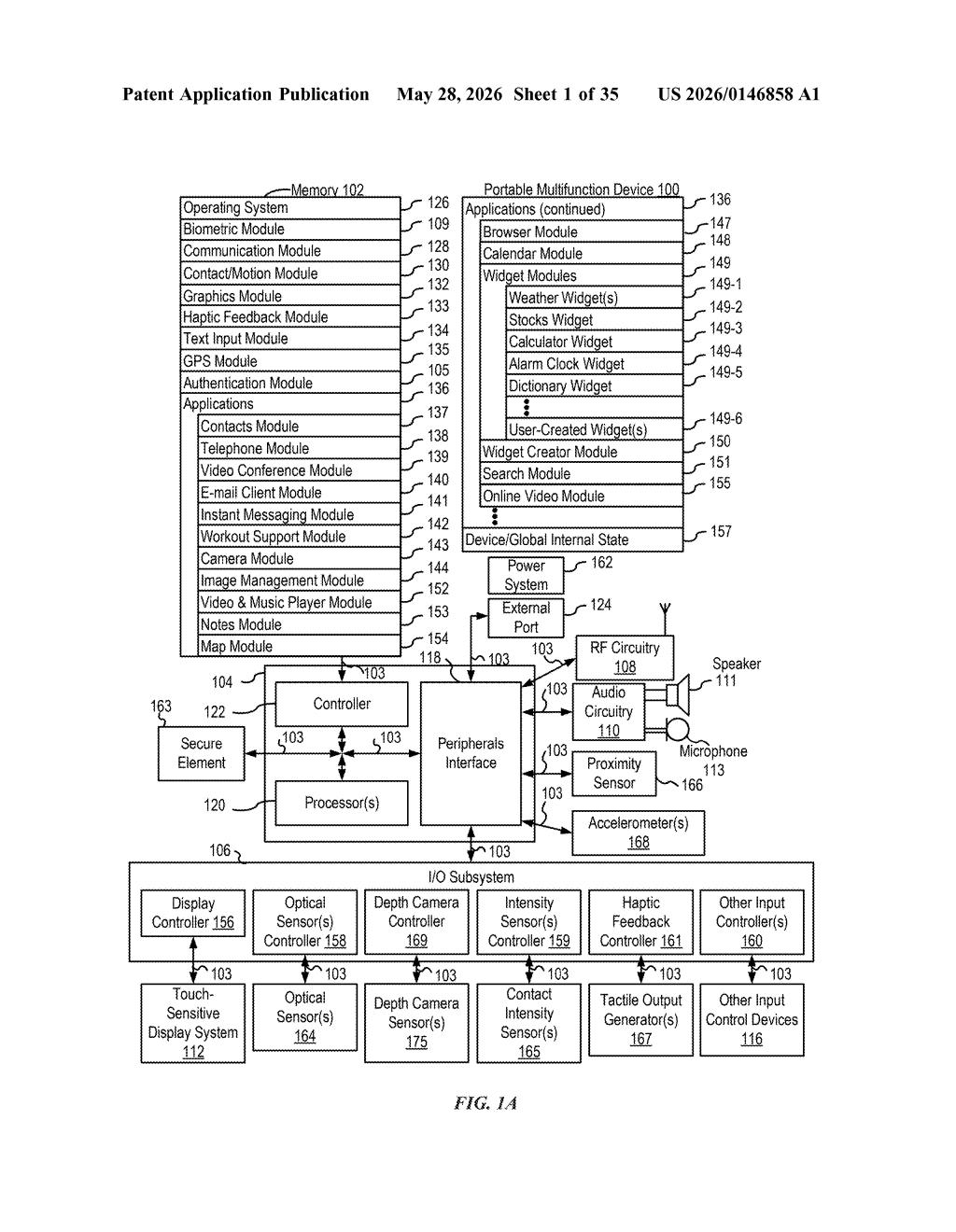
The patent references standard device architecture — GPS module, camera module, RF circuitry — suggesting this is designed for a portable multifunction device like an iPhone, though the claims are broad enough to cover any image-capture-equipped device running a navigation mode.
What this means for Maps and wearable navigation
Turn-by-turn navigation has barely evolved in a decade: distance + street name, repeat. This patent pushes toward directions that are situationally aware — anchored to what you can see, not to an abstract coordinate. For pedestrians especially, landmark-relative directions are how humans naturally give and receive guidance. A system that adapts its language to your actual visual context could make walking navigation meaningfully less frustrating in dense urban environments.
The broader implication is for Apple Maps and potentially Vision Pro or future AR glasses, where overlaying context-aware directions onto a live camera view is an obvious fit. If Apple can reliably identify landmarks in real time and tie directions to them, it closes a gap that Google Maps has been chipping at with its Live View AR walking feature — but Apple's approach as described here focuses on the instruction logic itself, not just visual overlays.
This is genuinely useful thinking applied to a problem that frustrates real people every day — pedestrian navigation in cities is still clunky, and landmark-based directions are how humans actually communicate wayfinding. The patent's conditional logic (show this instruction if you see this object, show a different one if you see that object instead) is elegant in its simplicity. Whether Apple can build the landmark recognition engine reliable enough to make it work in production is the real question, but the design intent here is clearly user-experience-first.
There are more where this came from
We read every patent application Big Tech publishes and send you the ones worth knowing. Plain English, free, every week.
Want this weekly breakdown for a company we don't cover? Patentlyze Pro →