
Apple Patents a Dual-Laser System for Reading Apple Watch Crown Inputs
Apple's Digital Crown is already one of the most sophisticated dials on any consumer device — but a new patent suggests the company wants to track exactly how you're turning it using lasers.
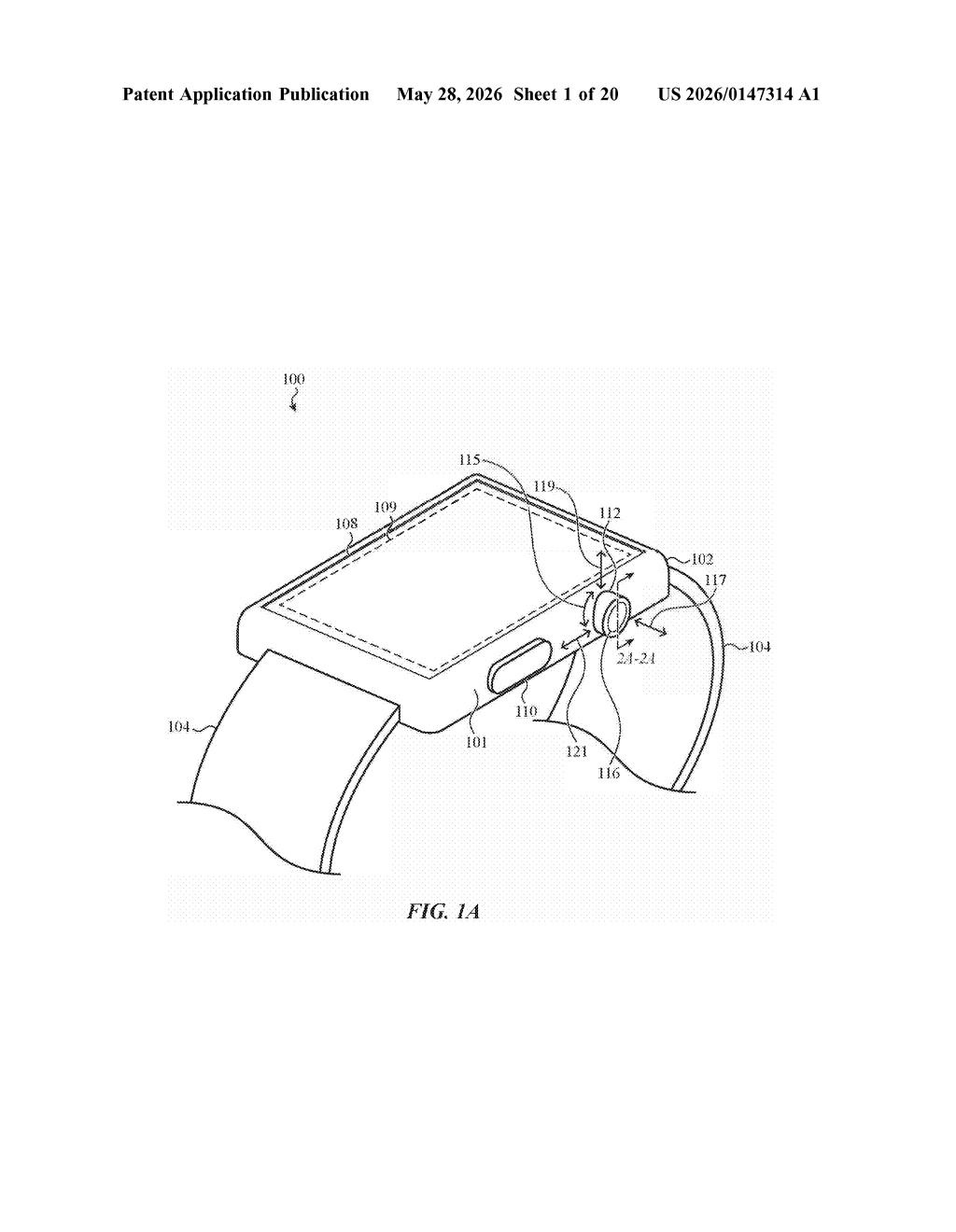
What Apple's laser-tracked Watch crown actually does
Imagine turning the dial on the side of your Apple Watch. Right now, that crown uses mechanical sensors to detect how far you've rotated it and whether you've pushed it in. Apple's new patent describes replacing or augmenting those sensors with a pair of tiny laser modules tucked inside the watch.
Each laser shoots a beam onto a spinning part inside the crown called a rotor. By reading the light that bounces back, the watch can figure out how much you've turned the crown, which direction, and how far you've pressed it in — all from light reflection alone.
Using two separate lasers instead of one is the key move here. The second module adds a cross-check, giving the processor enough independent data to separate a rotation signal from a press signal — two inputs that can happen simultaneously.
How two laser beams decode rotation and press depth
The patent describes an input system built around a crown with two distinct components: a knob (the part your finger touches outside the watch) and a rotor (an internal disc coupled to the knob that moves when you rotate or push).
Two laser modules are positioned inside the housing, each aimed at the rotor. Each module both fires a beam and reads the reflected light back — essentially acting as a tiny optical sensor.
- Rotational input detection: The processing system combines data from both laser modules to determine the angle, speed, and direction of the crown's rotation.
- Translational input detection: When you press the crown inward (a linear push), the rotor moves axially. The same two lasers detect this shift using a separate set of reflected-light readings.
- Dual-channel cross-referencing: Because both modules contribute independent data streams, the chip can disambiguate a twist from a press — even when both happen at the same time.
The use of laser-based optical sensing (rather than mechanical contacts or capacitive encoders) suggests Apple is looking for a solution that's more wear-resistant and potentially more precise at detecting fine-grained input differences.
What this means for Apple Watch input precision
The Digital Crown is one of Apple Watch's primary input surfaces, and how precisely it can be read directly affects how useful the watch is as a control device. A laser-based approach could allow for finer scroll granularity in apps, better differentiation between a light tap and a firm push, and fewer mechanical parts that wear out over time.
For health and fitness use cases — where tiny adjustments matter, like scrolling through workout data mid-run — more precise crown tracking is a genuine quality-of-life improvement. There's also a durability angle: optical sensors have no physical contact points between parts, which means less friction and potentially longer product lifespans.
This is solid, unglamorous engineering work on one of Apple Watch's core interaction surfaces. Laser-based encoders are well established in industrial and gaming contexts (high-end optical mice use similar principles), so the interesting question isn't whether this works — it's whether Apple can miniaturize it reliably enough to survive a sweat-filled workout watch. Worth watching as a signal that Apple is rethinking the crown's internals, not just its exterior.
There are more where this came from
We read every patent application Big Tech publishes and send you the ones worth knowing. Plain English, free, every week.
Want this weekly breakdown for a company we don't cover? Patentlyze Pro →