
Google Patents a Context-Aware Prompt Generator That Feeds Your LLM Suggestions
What if your AI assistant didn't wait for you to ask the right question — it quietly figured out what kind of help you needed and crafted the perfect prompt on your behalf? That's exactly what Google is patenting here.
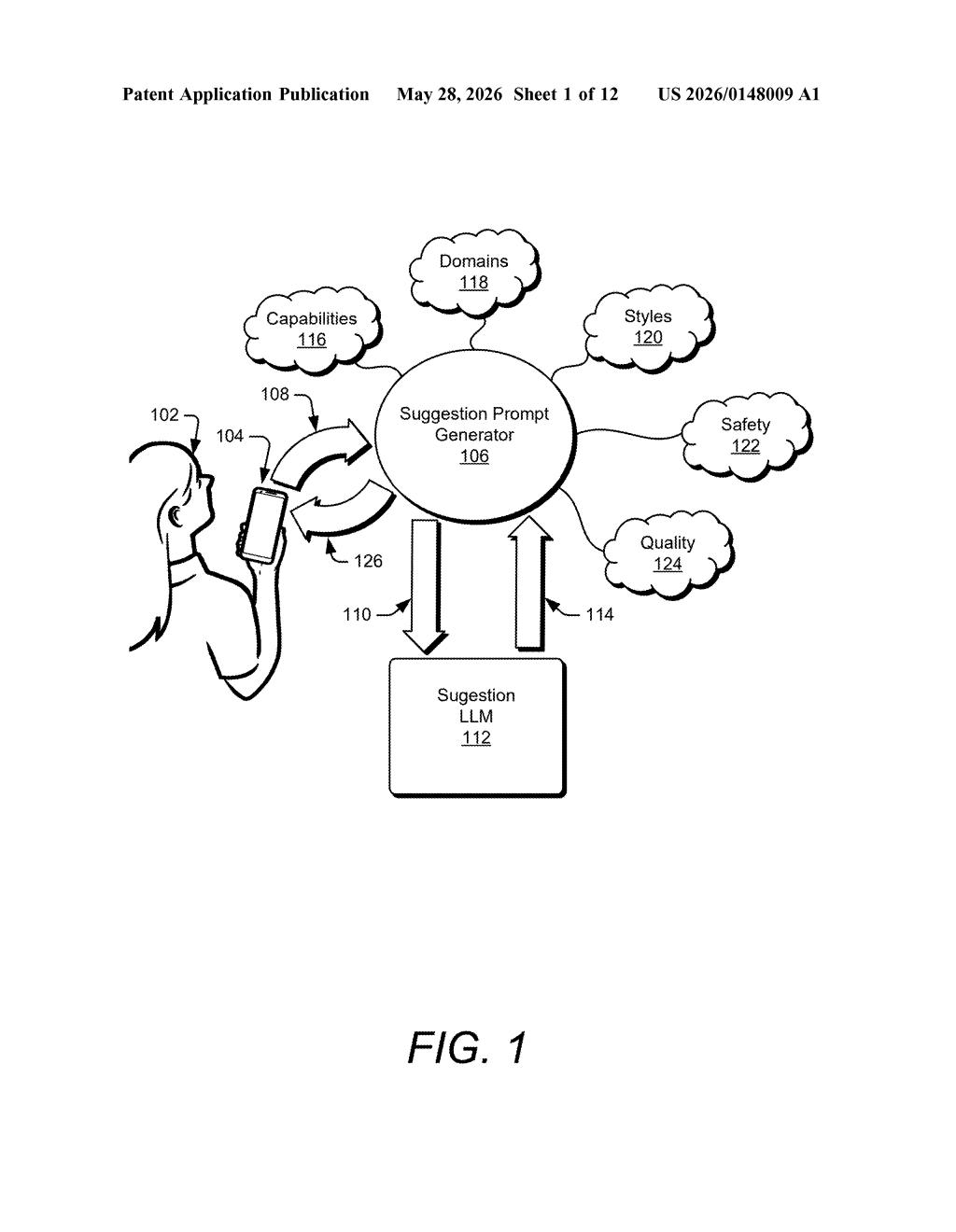
What Google's dynamic prompt system actually does
Imagine you're typing an email about a legal dispute, then switch tabs to schedule a doctor's appointment. A generic AI assistant might treat both conversations the same way. Google's new patent describes a system that actually reads the room — it looks at what you're doing and what kind of context you're in, then automatically builds the right kind of question to ask an AI model on your behalf.
The key idea is something called a suggestion prompt generator. Instead of passing your raw input straight to a large language model, this layer figures out the domain you're operating in — legal, medical, casual chat, productivity, whatever — and shapes the prompt accordingly. It can also filter what goes in and what comes back out, keeping suggestions relevant and on-topic.
The result is an AI that offers smarter, more contextually appropriate suggestions without you having to prompt-engineer anything yourself. You just do your thing, and the system handles the translation into something the LLM can actually work with.
How the suggestion prompt generator picks domains and filters
At its core, this patent describes a prompt generation middleware layer that sits between a user's raw interaction data and a large language model. Rather than letting the LLM receive unstructured input and guess at what kind of response is useful, the system classifies the situation first.
Here's how the pipeline works:
- Interaction data ingestion: The device collects what you're doing — text you've typed, messages received, app context, conversation history.
- Domain selection: A suggestion prompt generator analyzes the context and picks a domain from a predefined list (think: 'email drafting,' 'medical query,' 'customer support'). This is essentially a classification step — figuring out which bucket your current task fits into.
- Prompt construction: Using the selected domain, the system builds a structured prompt that's tuned to elicit the most relevant LLM response. The patent also references style, quality, and capability parameters as inputs — so the prompt can be shaped for tone, length, or task type.
- Filtering: Both the input data and the LLM's output can be passed through a domain-specific filter — stripping irrelevant content or enforcing safety/relevance constraints before anything reaches the user.
The system is designed to run on-device (the patent references an electronic device with local processors and memory), which suggests this could operate with some degree of on-device inference rather than purely cloud-side processing.
What this means for Google's AI assistant roadmap
The practical implication here is that Google's AI surfaces — Gemini, Assistant, Workspace — could become significantly more proactive and context-sensitive without asking users to become prompt engineers. Instead of getting a generic suggestion when you're drafting a legal email vs. a birthday message, the system would already know which register to work in and pre-tune the model accordingly.
For Google specifically, this matters in the Workspace and Android ecosystem, where AI suggestions already appear in Gmail, Docs, and Messages. A smarter domain-detection layer could sharpen those suggestions considerably — and the filtering pipeline hints at an architecture designed to stay within guardrails across sensitive domains like health or finance. Whether this ships as a Gemini feature or something more invisible under the hood remains to be seen.
This is a solid piece of AI-plumbing work, not a flashy consumer feature — but that's kind of the point. The patent essentially formalizes what good prompt engineering looks like as an automated system, which is genuinely useful infrastructure for any company trying to make LLM suggestions feel natural across wildly different contexts. Google is clearly thinking about how to make Gemini-style suggestions coherent at scale, and this is a concrete architectural answer to that problem.
There are more where this came from
We read every patent application Big Tech publishes and send you the ones worth knowing. Plain English, free, every week.
Want this weekly breakdown for a company we don't cover? Patentlyze Pro →