
Google Patents a Multi-Agent System That Merges Conflicting AI Prompts
What happens when two AI agents disagree about how to phrase a request to a generative model? Google's latest patent describes a system that resolves those conflicts automatically, merging multiple agents' prompts into one coherent request before anything gets sent to the model.
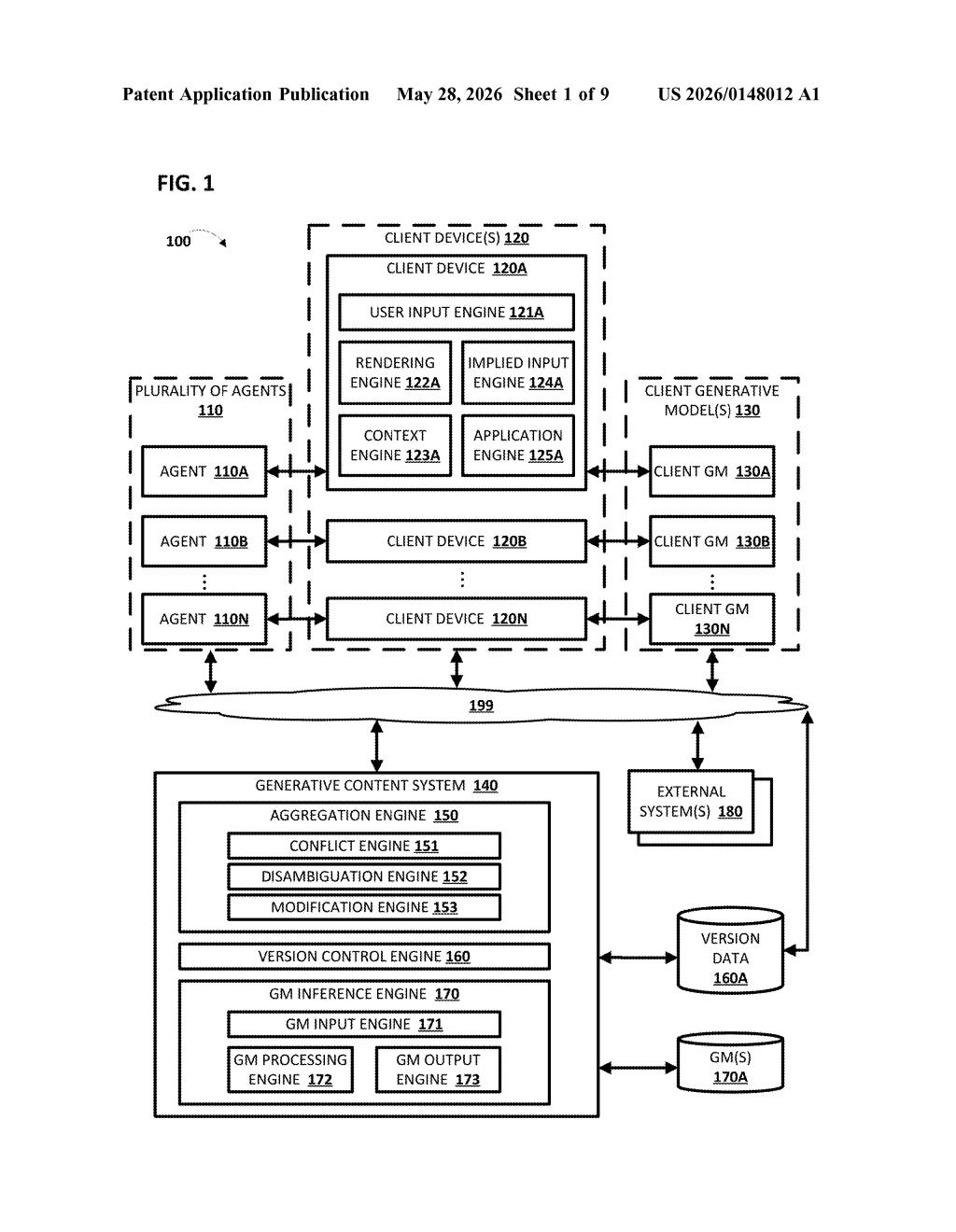
What Google's collaborative prompt-merging system actually does
Imagine a team of coworkers all trying to send instructions to the same assistant at the same time — but their instructions contradict each other. One person says 'use Canny edge detection,' another says 'use a different algorithm entirely.' Without someone to arbitrate, the assistant gets confused.
Google's patent tackles exactly this problem, but for AI agents — software programs that each generate their own natural language prompt to send to a generative model like Gemini. Instead of letting all those prompts pile up or collide, the system aggregates them into a single unified prompt, detecting and resolving conflicts along the way.
The key step is a disambiguation process: when two agents propose conflicting parameters, the system picks one — based on rules or context — and builds the final, combined prompt around that decision. The result is one clean, coherent request that the generative model can actually work with.
How the disambiguation process resolves conflicting parameters
The patent describes a server-side coordination layer sitting between a plurality of agents (multiple independent software processes, each producing its own natural language prompt) and a single generative model (GM).
Each agent submits a prompt containing one or more candidate parameters — specific instructions or settings embedded in natural language, like which algorithm to use or what output format to produce. The system collects all of these prompts and attempts to combine them into a joint NL prompt.
The interesting part is conflict resolution. When two agents include incompatible candidate parameters — say, one wants Canny edge detection and another wants a different image-processing method — the system flags the clash and runs a disambiguation process (a rule-based or model-driven decision procedure) to pick one parameter over the other. That selection is then factored into the final merged prompt.
- Step 1: Collect individual NL prompts from each agent
- Step 2: Identify conflicting parameters across prompts
- Step 3: Run disambiguation to select the winning parameter
- Step 4: Construct the joint NL prompt incorporating that decision
- Step 5: Send the joint prompt to the generative model for a response
The abstract specifically calls out a generative coding application as an example use case, suggesting this is designed partly for agentic coding workflows.
What this means for multi-agent AI pipelines
As AI pipelines get more complex, you're increasingly dealing with multiple agents operating in parallel — each with its own sub-goals, preferences, and prompt strategies. Sending all of those to a model independently is wasteful and inconsistent; merging them naively produces incoherent garbage. A coordination layer that resolves conflicts before the model ever sees the prompt is a real engineering need, not a theoretical one.
For Google, this fits squarely into its push to make Gemini the backbone of multi-agent developer tooling. If agentic coding assistants, research tools, and workflow automations all need to share a single model endpoint, something has to manage the traffic — and this patent describes exactly that arbitration logic.
This is a genuinely useful piece of infrastructure for multi-agent AI systems, and Google filing it now makes sense given where agentic AI tooling is headed. The core idea — conflict-aware prompt merging — solves a real coordination problem that anyone building multi-agent pipelines has already hit. It's not flashy, but it's the kind of plumbing that makes complex systems actually work.
There are more where this came from
We read every patent application Big Tech publishes and send you the ones worth knowing. Plain English, free, every week.
Want this weekly breakdown for a company we don't cover? Patentlyze Pro →