
IBM Patents Technology That Runs Massive AI Brain Across Multiple Connected Processors
Running a large AI model usually means sending data back and forth to external memory, which is slow and power-hungry. IBM's new patent describes a way to slice the model up so each chip in a chain holds its own piece, and data just flows forward through them like an assembly line.
What IBM's on-chip LLM partitioning actually does
Imagine a factory assembly line where each station does one specific job and then passes the work to the next station, rather than one giant machine doing everything at once. That's roughly what IBM is patenting here for AI models.
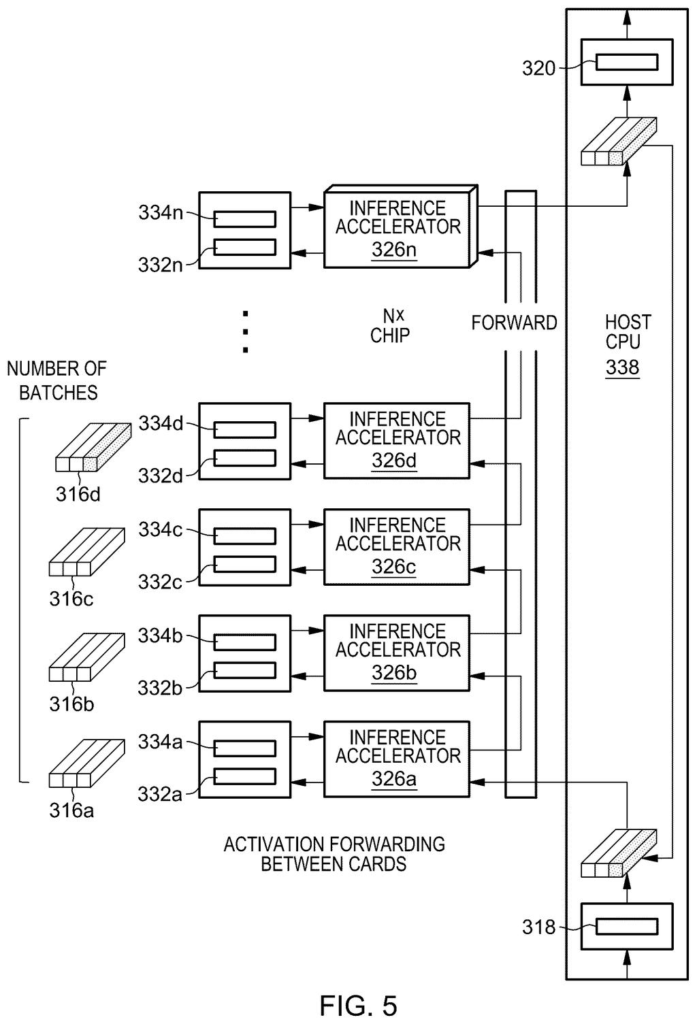
A large language model (the kind of AI that powers chatbots) normally has many layers of computation stacked on top of each other. IBM's approach cuts those layers into slices, loads each slice onto a separate chip, and lets the output of one chip flow directly into the next. Each chip stores its piece of the model in its own built-in memory, so there's no constant back-and-forth with a central memory bank.
The result is that a very large AI model could run across a sequence of smaller, specialized chips rather than requiring one enormous, expensive processor. That's potentially useful anywhere you want AI to run locally, from data center appliances to dedicated inference hardware.
How each chip stores and passes AI activations forward
The patent describes a method for running LLM inference (the process of generating an answer from a trained AI model) across a sequence of chips using what it calls activation forwarding.
A typical large language model is built from three types of layers stacked in order:
- An embedding layer, which converts input tokens (words or word-pieces) into numerical vectors.
- Transformer layers, the main computational workhorse, which process and refine those vectors repeatedly.
- An output layer, which converts the final vectors into a predicted next token.
IBM's method partitions the transformer layers so that each partition (one or more transformer layers) lives on a single chip, with the trained model weights stored in that chip's on-chip memory. When a layer finishes computing, it passes its output, called an activation (essentially the intermediate result), directly to the next chip in the sequence, which handles the next partition.
Because each chip holds its own weights locally, the system avoids repeatedly fetching data from off-chip memory, which is one of the main bottlenecks in modern AI inference hardware. The final chip in the chain produces the model's actual output.
What this means for running AI without giant server farms
The main cost of running large AI models today is not raw computation but memory bandwidth, the time spent shuttling weights back and forth between a processor and external memory. By pinning each model slice to a chip that permanently holds those weights, IBM's approach could cut that bottleneck significantly for dedicated inference hardware.
This kind of architecture is particularly relevant for neuromorphic or custom AI chips, an area IBM has invested in heavily. If inference can be distributed across a chain of smaller chips, it opens a path to building AI systems that are more energy-efficient and easier to scale by just adding more chips to the chain, rather than upgrading to a single larger processor.
This is a focused, technically credible patent from a team that includes several of IBM's neuromorphic computing researchers, the same group behind the NorthPole chip. It's not flashy, but the activation-forwarding-across-a-chip-chain idea maps closely onto real hardware IBM has already built. Worth tracking if you follow AI inference efficiency.
There are more where this came from
We read every patent application Big Tech publishes and send you the ones worth knowing. Plain English, free, every week.
The drawings
13 drawing sheets from US 2026/0220446 A1 · click any drawing to enlarge


Want this weekly breakdown for a company we don't cover? Patentlyze Pro →