
Amazon Patents a Chunk-by-Chunk Self-Correction System for AI Chatbots
What if your AI assistant could catch its own mistakes mid-response and quietly fix them before you ever see the wrong answer? That's exactly what Amazon is trying to build.
How Amazon's AI rewrites its own wrong answers
Imagine you ask an AI assistant a question about your Amazon order, a product return policy, or a complex topic — and the AI confidently gives you an answer that's half right and half wrong. You'd have no idea which half to trust.
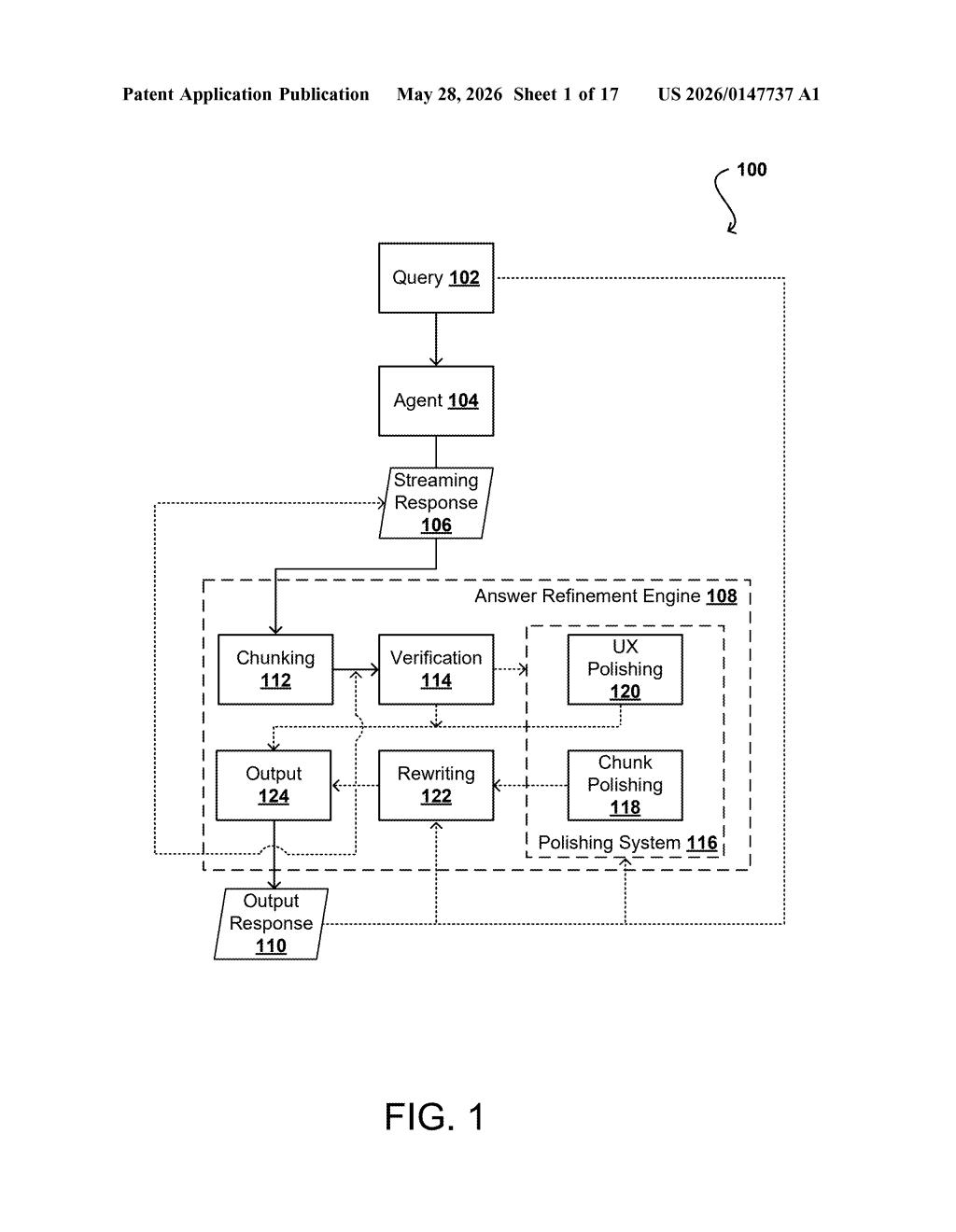
Amazon's patent describes a system that works like an editor sitting between the AI and your screen. As the AI generates a response, the system breaks it into small chunks, checks each one for accuracy, and rewrites any chunk that doesn't hold up. Only after a chunk passes the check does it get included in what you actually read.
There's also a subtler layer: chunks that are conditionally valid — meaning they're only true under certain assumptions — get flagged and reworded to add that context. So instead of getting a confident-sounding answer that's quietly misleading, you'd get one that says "this is true if X." The goal is fewer hallucinations reaching the user.
How the chunk validation and rewrite pipeline works
The system sits inside a generative AI pipeline — the chain of steps between your question and the AI's answer. After an AI model produces an initial response to a query, this refinement layer intercepts it before it reaches the user.
The pipeline works in stages:
- Chunking: The initial response is divided into discrete segments ("chunks") — think sentence-level or claim-level pieces, not just words.
- Validity check: Each chunk is evaluated for factual validity. Chunks flagged as invalid are rewritten by the AI system and re-evaluated until they pass.
- Conditional validity check: Chunks that pass the basic validity check may still be conditionally valid — meaning they're only accurate under specific circumstances. These get modified to surface those conditions explicitly, adding caveats or context.
- Polishing: The patent references a "chunk polishing" step, suggesting a final pass to smooth out the language after corrections are made.
The final response delivered to the user is explicitly described as different from the initial AI-generated response — meaning this isn't just a filter, it's an active rewrite layer. The whole process is orchestrated by the same AI systems doing the generating, creating a feedback loop where the model is essentially auditing itself.
What this means for AI hallucination in real products
AI hallucination — where a model confidently states something false — is one of the biggest practical barriers to deploying AI in customer-facing products. For Amazon, which runs Alexa, AWS's Q assistant, and a growing suite of AI-powered shopping and support tools, the stakes for giving users wrong answers are high: bad product recommendations, incorrect policy information, or flawed code suggestions can erode trust fast.
What makes this approach interesting isn't just that it catches errors — it's that it handles the gray area. The "conditional validity" concept acknowledges that a lot of AI wrongness isn't outright false, it's misleadingly incomplete. If this makes it into production, you'd theoretically get AI answers that are more honest about their own limits — which is actually harder to build than just filtering out the obviously wrong stuff.
This is a real engineering response to a real problem, and the conditional validity piece is genuinely thoughtful — it's trying to solve for the "technically true but misleading" failure mode that's often worse than an outright error. The challenge is that self-correction loops using the same model that made the error are only as good as the model's ability to recognize its own mistakes, which is an open research problem. Worth watching, but the gap between the patent's architecture and a reliable deployed system is large.
There are more where this came from
We read every patent application Big Tech publishes and send you the ones worth knowing. Plain English, free, every week.
Want this weekly breakdown for a company we don't cover? Patentlyze Pro →