
Intel Patents Parallel Huffman Decoding to Compress LLM Weights on GPU
Running a large language model on a GPU requires moving enormous amounts of weight data around — and that bandwidth cost is a real bottleneck. Intel's new patent proposes packing those weights tighter using a classical compression trick, then unpacking them in parallel at inference time.
How Intel shrinks AI model weights without losing anything
Imagine you're streaming a 4K movie, but your internet connection is only fast enough for HD. One fix: compress the video more efficiently before it travels, then decompress it at your TV without losing any quality. Intel is applying the same idea to AI models running on chips.
Large language models have billions of numerical weights — the values that define how the AI thinks. Normally those weights sit in memory and get loaded into the processor constantly. That memory-to-processor trip is slow and power-hungry. Intel's patent describes a way to losslessly compress those weights using a technique called Huffman encoding (the same family of tricks used in ZIP files), then decode them in parallel directly on the graphics processor.
The key word is lossless — nothing is approximated or thrown away. The AI model behaves identically; it just takes up less space in transit. For devices where memory bandwidth is precious — think edge AI hardware or power-constrained servers — that's a meaningful win.
How the GPU decodes grouped Huffman blocks in parallel
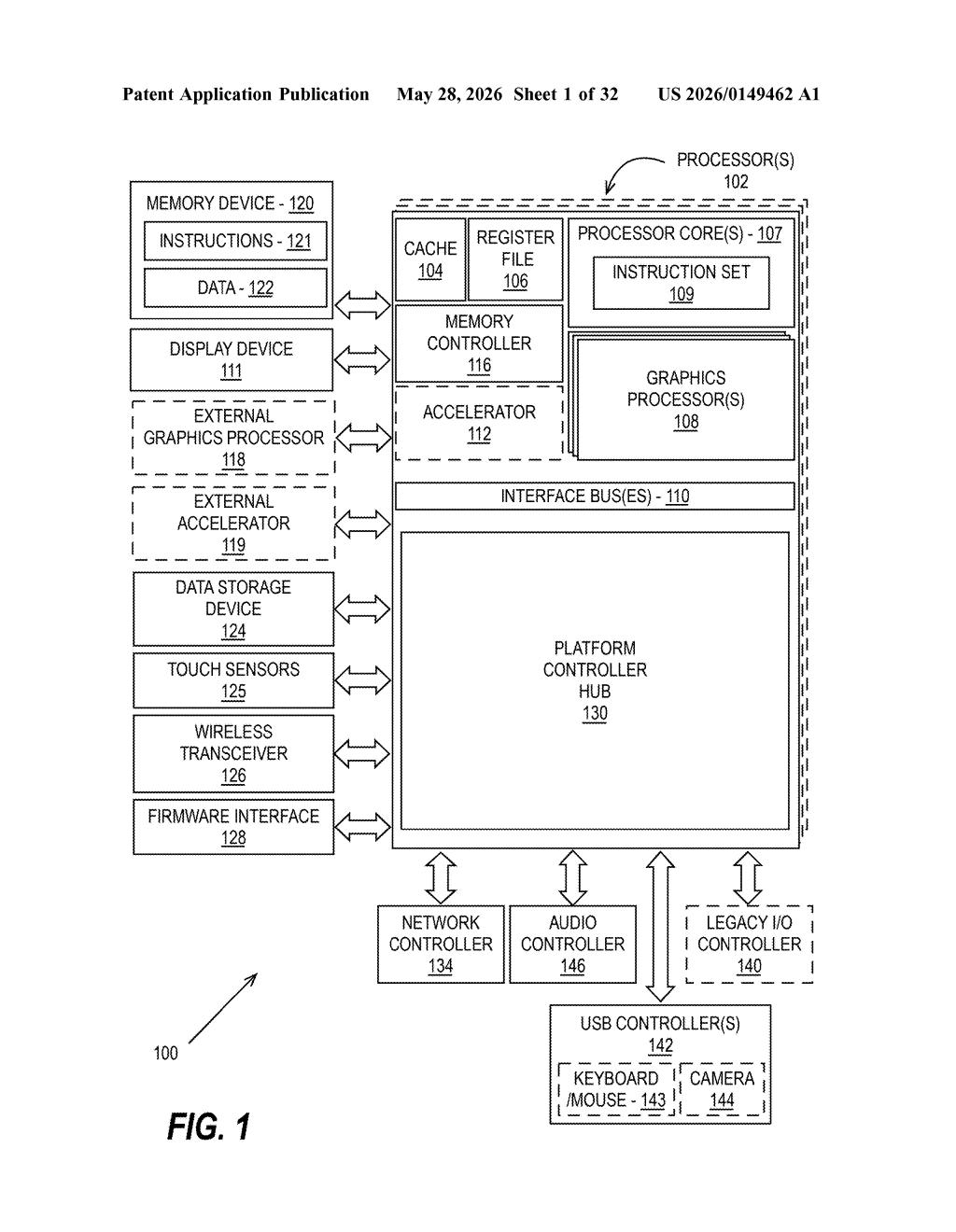
The patent describes a graphics processor (GPU) architecture where at least one processing resource inside a graphics processing cluster is specifically set up to handle compressed AI model parameters.
Here's the flow:
- Compressed model weights arrive as blocks of encoded parameters alongside a decode table — a lookup structure that maps compressed bit patterns back to original values.
- The processor runs a parallel Huffman decoding operation, working on multiple blocks simultaneously rather than sequentially. Huffman encoding assigns shorter bit strings to more frequently occurring values, so common weight values compress well. Decoding normally has to happen serially because each symbol's boundary depends on the previous one — Intel's grouped approach sidesteps that by pre-splitting the stream into independently decodable blocks.
- Decoded blocks are organized into parameter groups, which are then unpacked into the actual floating-point or integer values the neural network needs.
- The unpacked weights feed directly into the inference operation — the forward pass through the model — and the result is stored or output.
The grouping trick is the core insight: by encoding parameters in discrete, parallel-friendly chunks, the GPU can throw many processing resources at decoding simultaneously, turning what is usually a serial bottleneck into a parallelizable workload.
What this means for running LLMs on tighter hardware
Memory bandwidth is one of the hardest constraints in deploying LLMs — not compute, but the sheer cost of shuttling billions of weight values between DRAM and processor cores. Lossless compression that runs transparently at inference time could let you fit a larger model into the same memory budget, or run the same model faster on bandwidth-limited hardware like integrated GPUs or edge accelerators.
Intel's GPU business is fighting for relevance against Nvidia and AMD, and differentiated firmware-level features like this are exactly the kind of thing that could matter in the AI accelerator market. If this ships in a future Intel Arc or Gaudi product, it would be a quiet but real advantage for customers trying to squeeze more out of constrained deployments.
This is a solid, well-scoped engineering patent — not a moonshot, but the kind of infrastructure work that actually ships. Lossless compression for LLM weights is a legitimate problem worth solving, and the parallel-decoding angle addresses the classic bottleneck of serial Huffman streams. Intel filing this suggests they're building compression-aware inference into their GPU stack at the hardware level, which is a smarter bet than leaving it entirely to software.
There are more where this came from
We read every patent application Big Tech publishes and send you the ones worth knowing. Plain English, free, every week.
Want this weekly breakdown for a company we don't cover? Patentlyze Pro →