
Salesforce Patents a Real-Time Sync System for Linked Virtual Workspaces
Salesforce is patenting a way to keep two separate virtual workspaces — think channels or rooms — automatically in sync, so a change made in one instantly appears in the other. It's the kind of plumbing that sounds dull until you've ever managed a project spread across a dozen Slack channels.
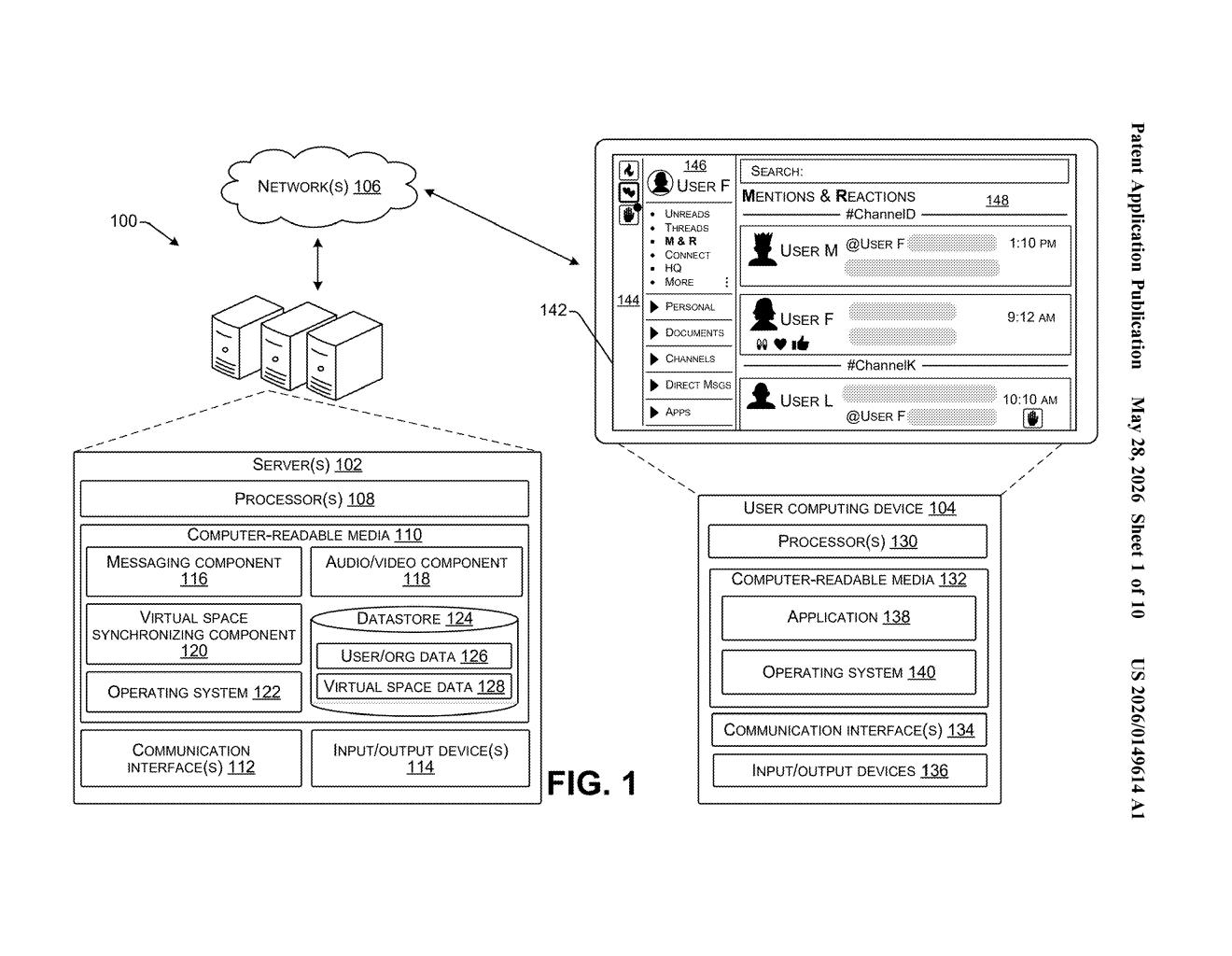
What Salesforce's linked virtual space sync actually does
Imagine you run a company that has one main project channel and a separate channel for a partner team or client. Right now, keeping both up to date means copying and pasting, forwarding messages, or just hoping people check both places. That's a mess.
Salesforce's patent describes a system where you can link two virtual spaces together — and whenever someone updates one, the other automatically updates too. You'd pick a template to set up the second space, then the platform takes care of the rest.
The key idea is continuous, bidirectional sync: it doesn't matter which space gets the update or who made it — both stay current. No more version drift, no more "did you see the message in the other channel?"
How the template-to-sync pipeline ties spaces together
The system works inside a group-based communication platform (almost certainly Slack, which Salesforce owns). A user in a first virtual space — say, a Slack channel — can trigger a request to create and link a second virtual space.
From there, the flow goes like this:
- An input box appears inside the first space, offering virtual space templates (pre-configured setups for things like a project channel, a support room, or a client workspace).
- The user picks a template, and the platform generates the second space based on that selection.
- The two spaces are then formally associated — linked at the platform level, not just by a shared link or name convention.
- Any modification made to the first space — by the original user or any other user in that space — is automatically mirrored to the second space, and vice versa.
The patent's claim covers both directions: it doesn't matter whether the edit happens in space one or space two. The sync propagates either way. The updated view is then pushed to the relevant user's device interface automatically.
What this means for Slack's multi-team collaboration future
If you use Slack at scale — large organizations, external partner channels, or Salesforce's own Slack Connect for cross-company collaboration — keeping content consistent across multiple channels is a genuine pain point. This patent suggests Salesforce is building infrastructure to solve that at the platform level, not as a third-party workaround.
For enterprise users, automatic bidirectional sync could reduce the admin overhead of maintaining parallel channels for different audiences (internal team vs. client-facing, English vs. localized versions, etc.). It also has obvious implications for compliance and audit trails — if every linked space reflects the same ground truth, there's less risk of decisions being made on stale information.
This is solid, unsexy infrastructure work that Slack power users will genuinely appreciate. The template-driven approach is smart — it means the second space isn't a blank clone but something purpose-built from the start. Don't expect a splashy announcement; expect this to quietly show up as a Slack feature sometime in the next product cycle.
There are more where this came from
We read every patent application Big Tech publishes and send you the ones worth knowing. Plain English, free, every week.
Want this weekly breakdown for a company we don't cover? Patentlyze Pro →