
Samsung Patents a Way to Wake Only the Car Camera That's Actually Needed
Instead of running every car camera all the time, Samsung's new patent describes a system that uses ultra-wideband radar to spot and classify nearby objects — then wakes only the camera pointing at the one that matters.
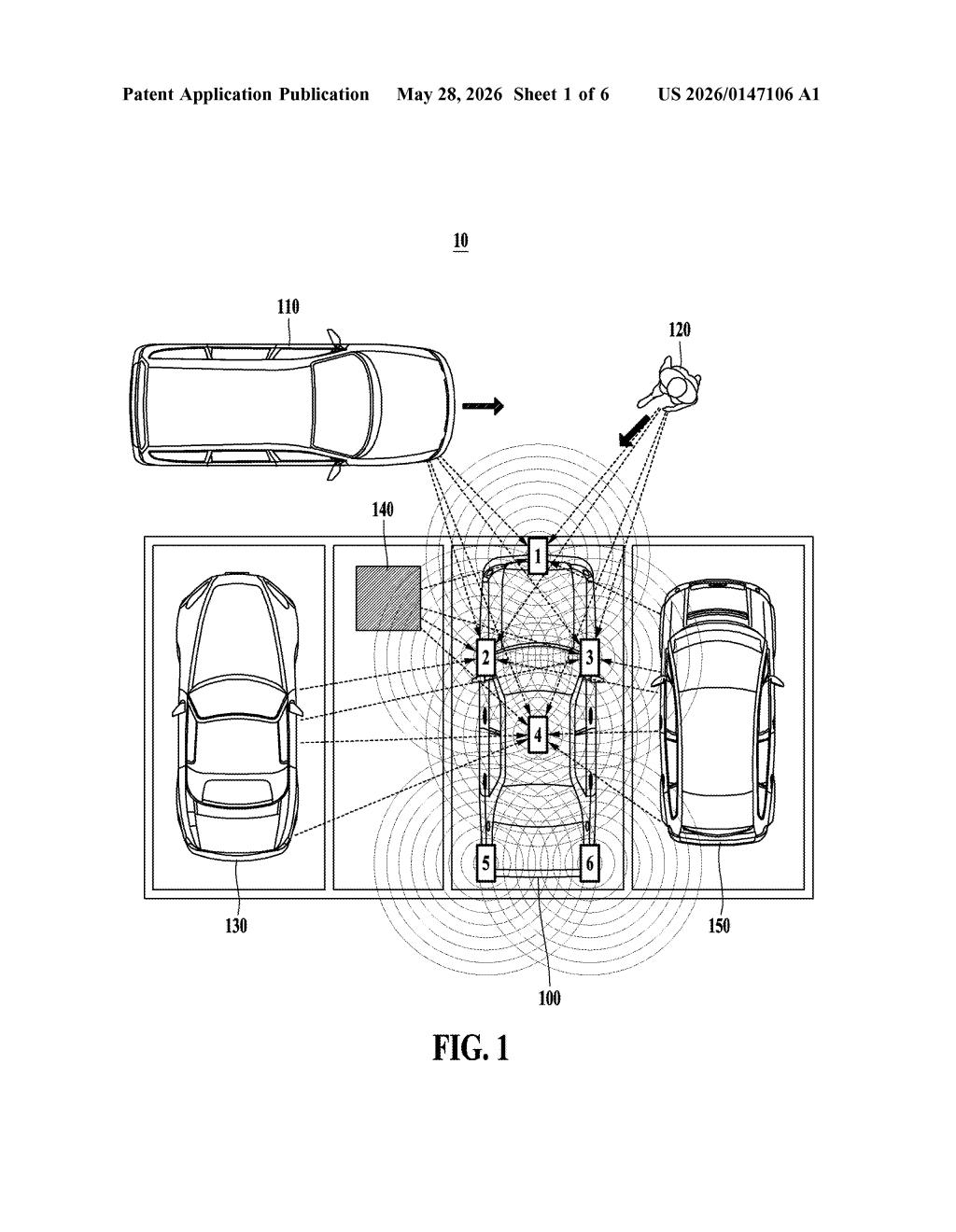
What Samsung's UWB camera-activation system actually does
Imagine your car has four cameras — front, rear, and both sides. Right now, most camera systems either run all of them constantly (draining power and storage) or rely on simple motion triggers that can't tell a blowing plastic bag from a cyclist. Samsung's patent describes a smarter approach.
Ultra-wideband (UWB) radio pulses — the same short-range, high-precision tech in Apple AirTags and Samsung SmartTags — are broadcast from multiple modules around the vehicle. When those pulses bounce back off nearby objects, the system measures where each object is, how fast it's moving, and what type of object it likely is (person, vehicle, debris, etc.).
If a specific object clears a threshold — say, a pedestrian moving toward the car's blind spot — the system pinpoints which of the vehicle's cameras has the best angle and activates just that one. You get targeted coverage exactly where it's needed, without burning resources watching empty curbs.
How UWB radar picks targets and routes them to a camera
The patent describes a multi-step pipeline running inside a vehicle's processor:
- UWB signal emission and reception: Multiple UWB modules fire radio pulses in different directions. The reflected signals return with timing and phase data precise enough to locate objects within centimeters.
- Candidate object identification: The system filters the raw radar returns to find anything that's moving — eliminating static background clutter like parked cars or walls.
- Position, velocity, and classification: For each moving candidate, the system estimates its location, speed, and object class (think rough categories: person, cyclist, vehicle). This classification step is what separates it from a simple motion detector.
- Target selection: A logic layer applies "predetermined conditions" — essentially configurable rules — to decide which candidate object is the one worth tracking. A fast-approaching object in a blind spot would rank higher than a slowly drifting one far away.
- Camera activation: The system maps the target's position to whichever camera in the vehicle's array has the right field of view, then powers that camera on.
The patent doesn't specify exactly how classification is done — it could be a neural network or a rules-based classifier — but the UWB ranging data is the core input throughout.
What this means for vehicle safety and smart camera arrays
Vehicle camera systems today tend to follow two philosophies: always-on (accurate but power-hungry) or proximity-triggered (efficient but dumb). Samsung's patent sketches out a middle path where the type and behavior of an object determines whether any camera wakes at all. That matters most in scenarios like low-speed parking, reversing in crowded lots, or monitoring a cyclist lane-splitting alongside a truck.
For consumers, the practical payoff could be longer battery life in EVs, reduced storage overhead for dashcam footage, and fewer false activations. For Samsung specifically, this positions their UWB chipset business — already embedded in Galaxy phones and SmartTags — as an automotive sensor platform, which is a market they've been pushing into with partners like Harman.
This is a genuinely useful integration of UWB's precision sensing into vehicle camera management — the object classification step is what makes it interesting, since a system that can distinguish a pedestrian from wind-blown debris before committing camera resources is meaningfully better than dumb motion triggers. Samsung's angle here is less about cameras and more about cementing UWB as automotive infrastructure, which is a clear strategic thread worth watching.
There are more where this came from
We read every patent application Big Tech publishes and send you the ones worth knowing. Plain English, free, every week.
Want this weekly breakdown for a company we don't cover? Patentlyze Pro →