
Adobe's New Patent Wants to Let AI Sculpt 3D Objects the Way It Generates Images
Adobe is patenting a way to make 3D mesh construction compatible with machine learning training loops — a longstanding headache in computer graphics that has blocked AI from directly sculpting geometry the same way it learns to generate images.
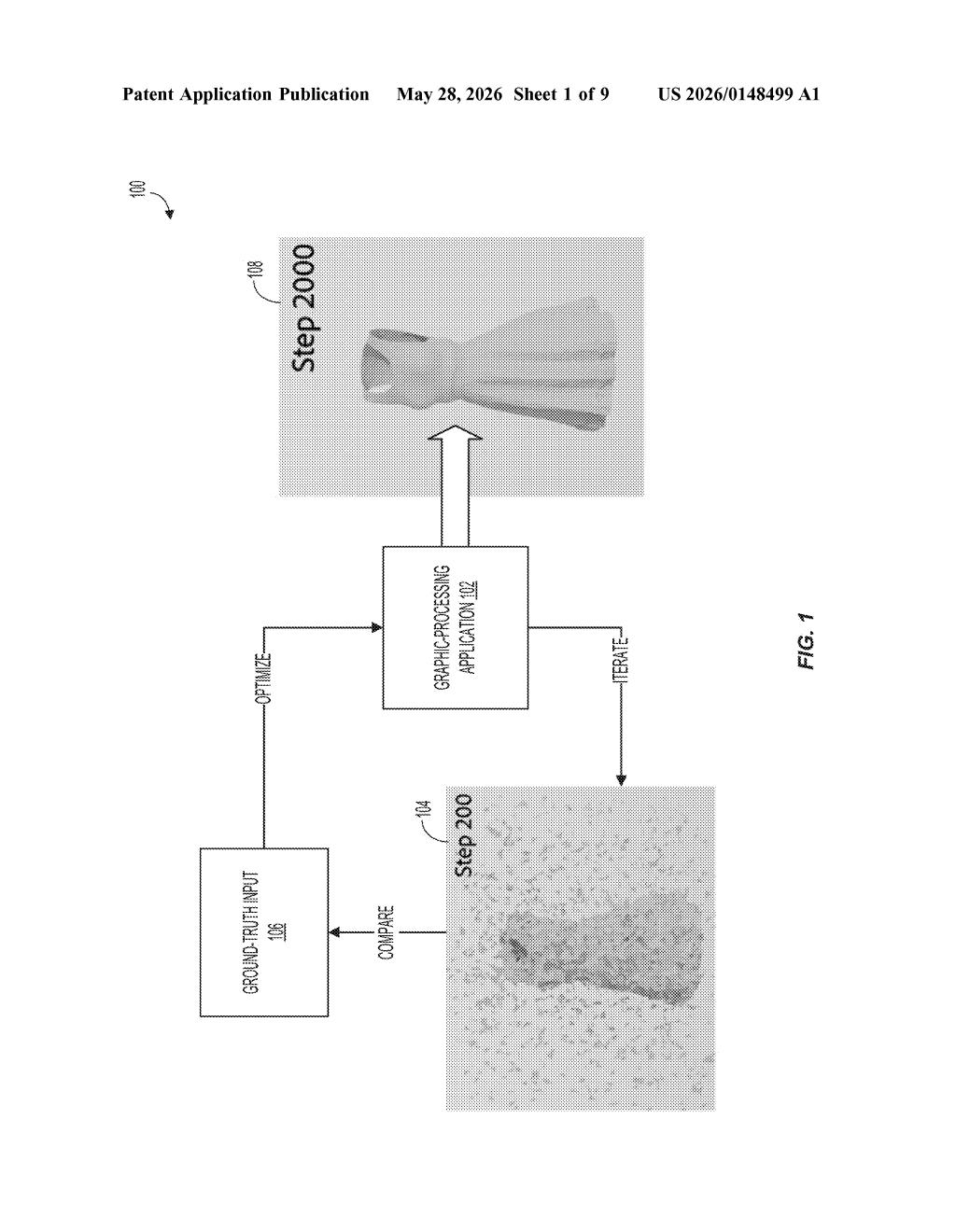
What Adobe's DMesh does to 3D object shapes
Imagine you're trying to teach an AI to sculpt a 3D model of a chair. The problem is that traditional 3D meshes — the wireframe skeletons that define the shape of objects in games, films, and design software — aren't built in a way that AI training algorithms can easily adjust. It's like trying to do calculus on a jigsaw puzzle: the pieces snap into discrete positions, and AI needs smooth, continuous feedback to learn.
Adobe's DMesh patent tackles this by assigning every triangle (or simplex) in the mesh a probability score — essentially a confidence value for whether that triangle should exist in the final shape. The AI can then nudge those scores up or down based on how well the mesh matches a reference image or 3D object, and the whole process stays mathematically smooth enough for gradient-based learning to work.
The result is a mesh that learns its own geometry. Triangles that help match the target shape survive; triangles that don't get pruned away. It's a more principled approach than many existing hacks, and it could make 3D reconstruction and generation significantly more automated inside tools like Adobe Substance or Firefly 3D.
How DMesh builds and prunes simplices iteratively
DMesh starts from a set of 3D points, each tagged with a weighted value. These weights feed into a weighted Delaunay triangulation — a classical computational geometry technique that connects points into non-overlapping triangles (in 2D) or tetrahedra (in 3D) in a mathematically optimal way. The weighting step lets the system bias which points get connected to which, giving the AI a lever to pull during optimization.
Once an initial mesh is built from these simplices (the geometric building blocks — triangles in 2D, tetrahedra in 3D), each simplex is assigned an existence probability value: a continuous score between 0 and 1 representing how likely that simplex is to belong in the final mesh. This is the key differentiability trick — instead of binary keep/discard decisions (which would break gradient flow), you get soft probabilities that AI optimizers can work with.
The system then enters an iterative loop:
- Compare the current mesh against a ground-truth input (a reference image or 3D scan)
- Compute a loss — a measure of how wrong the mesh is
- Backpropagate gradients to adjust existence probabilities and point weights
- Repeat until the mesh converges
Finally, simplices whose existence probability clears a threshold are kept; the rest are discarded, yielding a clean, optimized mesh. The whole pipeline is end-to-end differentiable, meaning it can plug directly into neural network training without custom workarounds.
What this means for AI-driven 3D content creation
The dirty secret of AI-driven 3D generation is that most systems generate implicit representations — neural fields or point clouds — and then convert them to meshes as a post-processing step that breaks gradient flow. That conversion step is where quality degrades and fine geometric detail gets lost. DMesh sidesteps that by keeping the mesh itself in the optimization loop the whole time, which is genuinely useful for anyone building 3D generative models or reconstruction pipelines.
For Adobe specifically, this fits squarely into the company's push toward AI-assisted 3D content creation via Firefly and Substance. If DMesh ships in some form, it could mean that generating a usable, topology-clean mesh from a photo or text prompt becomes far less manual — which would matter a lot to game developers, VFX artists, and product designers who currently spend hours cleaning up AI-generated geometry.
This is a legitimate technical contribution to a genuinely hard problem in differentiable rendering — not a defensive filing or a paper patent. The weighted Delaunay approach is clever because it builds on well-understood geometry theory rather than inventing a brand-new representation from scratch. Whether it ships into a product is a separate question, but the research pedigree here (the inventor list overlaps with published academic work on differentiable mesh representations) suggests Adobe is serious about this direction.
There are more where this came from
We read every patent application Big Tech publishes and send you the ones worth knowing. Plain English, free, every week.
Want this weekly breakdown for a company we don't cover? Patentlyze Pro →