
Google's New Patent Keeps Tabs on Your Phone's AI Without Seeing Your Data
Google wants to know how well the AI running on your phone is performing — but without actually looking at what you typed, said, or searched. This patent describes a system that generates model health reports entirely on-device, then ships only the abstract numbers to Google's servers.
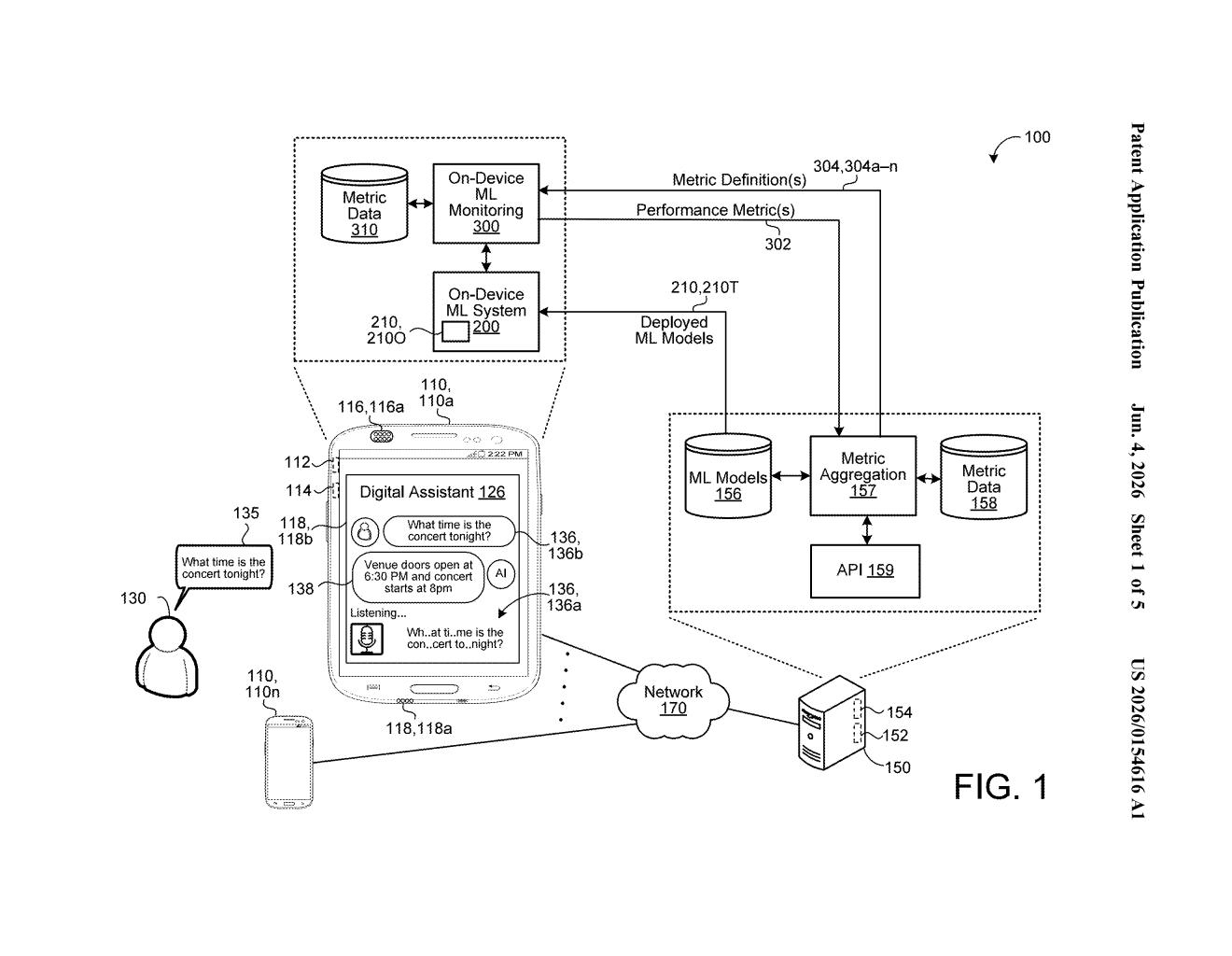
How Google watches its on-device AI without seeing your data
Imagine your phone has a mini version of a Google AI model built right in — one that runs locally to do things like transcribe speech, suggest replies, or recognize photos. Google wants to know if that local model is doing a good job, but checking in the traditional way (sending your data back to Google) is a privacy problem.
This patent describes a different approach: the phone itself watches how the AI is performing and compiles summary statistics — things like how confident the model was, or how often predictions fell into certain categories — without ever sending Google your actual photos, messages, or voice recordings.
Only those abstract performance numbers leave your device. Google's servers never see the underlying input or what the model actually predicted. It's like a teacher grading papers by receiving only a class average, never the individual answers.
How the device generates metrics without exposing raw outputs
The system has three main stages:
- Model deployment: A pre-trained ML model is downloaded from Google's remote servers onto the user's device, where a local "on-device" version runs inference (makes predictions) against data captured by the device — microphone input, camera frames, text, etc.
- On-device performance tracking: The device collects performance data — internal signals like prediction confidence scores, output distributions, or consistency metrics — that characterize how well the local model is behaving. Crucially, this step happens entirely on the device; the raw inputs and raw predicted outputs are never packaged up for transmission.
- Metric generation and upload: The device distills that performance data into performance metrics — compact, abstract numerical summaries — and sends only those to Google. Think of it as computing a histogram or aggregate score locally, then uploading just the histogram shape, not the individual data points.
The claim language explicitly says metrics are generated "without exposing content of the input data or the plurality of predicted outputs to the remote system" — that phrase does the heavy privacy lifting. The patent covers any on-device ML model that corresponds to a server-side pre-trained counterpart, which is a broad umbrella covering federated-style deployments across many Google products.
Why privacy-safe AI telemetry changes how Google trains models
On-device AI is only as good as Google's ability to debug and improve it — and historically that meant sending telemetry that included sensitive content. This patent formalizes an architecture where model quality monitoring is privacy-preserving by design, not by policy promise. That's a meaningful shift: even if a subpoena or breach hit Google's servers, the raw user data was never there to begin with.
For you as a user, this means Google could potentially collect richer feedback loops from on-device models like Pixel's live transcription, Gboard next-word prediction, or on-device photo search — without that data collection expanding Google's view into your personal content. It also positions Google well for increasingly strict regulatory environments in the EU and elsewhere that are scrutinizing AI data pipelines.
This is genuinely useful privacy infrastructure, not just a PR filing. The specific architectural commitment — metrics computed on-device, raw data never transmitted — is the kind of technical guarantee that's much harder to quietly walk back than a vague data policy. It's not flashy, but for anyone tracking how AI companies are building trust into their systems at the engineering level, this is the right kind of signal.
There are more where this came from
We read every patent application Big Tech publishes and send you the ones worth knowing. Plain English, free, every week.
Want this weekly breakdown for a company we don't cover? Patentlyze Pro →