
Meta's New Patent Hides Muscle-Reading Sensors Inside a Fabric Wristband
Meta is patenting a wristband that picks up the electrical signals your muscles fire when you move — wrapped in fabric, held in place by magnets, and designed to sit flush against your wrist skin without any obvious hardware sticking out.
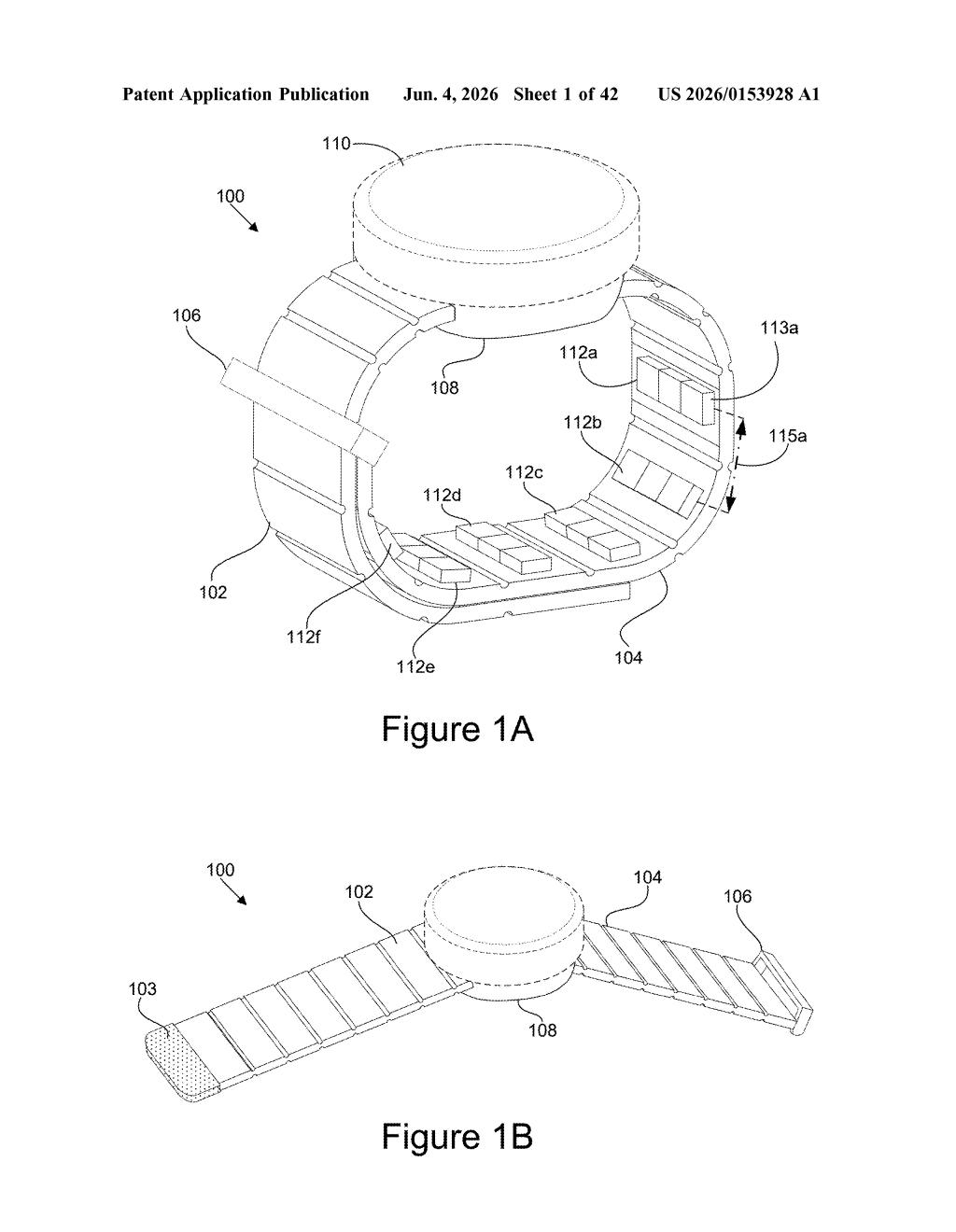
What Meta's muscle-reading wristband actually does
Imagine a fitness tracker, but instead of counting steps it's listening to your nerves. Every time you twitch a finger or flex your wrist, your muscles fire tiny electrical pulses. This wristband is designed to detect those pulses directly through your skin — and use them as a control signal for a computer or headset.
The clever part is how it stays put. A chain of paramagnetic (weakly magnetic) material runs along one half of the band, and a magnet sits at the tip of the other half. When you wrap the band around your wrist and let the ends overlap, the magnet grips the chain wherever it lands — no buckle holes, no fixed sizing, just a clean snap at whatever circumference fits your wrist.
The electrodes that do the actual sensing poke through small openings in the surrounding fabric, so they can touch your skin while the rest of the band stays soft and textile-like. A small cinch structure locks the two halves together. The whole thing is designed to feel more like a bracelet than a medical device.
How the electrodes, textile, and magnet chain work together
This patent describes a biopotential-sensing wristband — a band that detects the electrical signals (called biopotential signals) produced by muscle activity. The specific type it's targeting is EMG (electromyography), which reads the neuromuscular signals that travel down your arm when you move your fingers or wrist. Meta's broader neural input research uses EMG to let users control AR/VR interfaces with subtle hand gestures.
The band has two halves joined by a cinch structure. The first half contains the sensing hardware: an embedded structural member housing the electrode array, all wrapped in a textile (fabric) layer. The textile has precise cutouts so the electrodes make direct skin contact — critical for accurate EMG signal pickup — while everything else feels soft against the wrist.
The second half handles the fastening. It contains:
- A paramagnetic chain running along the length of the first band portion — a material that's attracted to magnets but doesn't stay permanently magnetized itself
- A magnet at the distal tip of the second band portion that snaps to the chain
- A soft inner layer wrapped in its own textile sleeve
The magnetic-chain system is the fastening innovation. Unlike a buckle with fixed holes, the magnet can engage with the chain at any point along its length, giving the band stepless, continuous size adjustment. This matters for EMG accuracy — the electrodes need to sit at consistent locations on the wrist to reliably detect signals from the right muscle groups.
What this means for Meta's neural input ambitions
Meta's neural input research — the technology behind its EMG wristband work acquired through CTRL-Labs — has always had a hardware comfort problem. EMG sensors need reliable, repeatable skin contact across users with very different wrist sizes, and traditional watch-style buckles don't deliver that. This patent addresses that fit problem directly with a fastening system that adjusts continuously rather than in fixed increments, which could meaningfully improve signal consistency across a diverse user base.
For you as a potential user, this is the difference between a wristband that works only when sized exactly right versus one that snaps comfortably to your wrist and still puts the electrodes exactly where they need to be. It also suggests Meta is actively engineering toward a consumer-ready form factor, not just a lab prototype.
This is genuinely interesting hardware-design work. The magnetic chain clasp is an elegant solution to a real and underappreciated problem in biosignal wearables — fit consistency — and the textile-with-cutouts approach signals serious thought about making EMG wearables feel like consumer products. Whether it ships as a standalone controller or as a band bundled with Ray-Ban smart glasses or a future headset, Meta clearly has a specific product path in mind here.
There are more where this came from
We read every patent application Big Tech publishes and send you the ones worth knowing. Plain English, free, every week.
Want this weekly breakdown for a company we don't cover? Patentlyze Pro →