
Nvidia Patents a Way to Teach Self-Driving Cars Which Nearby Objects Actually Matter
Not every object near a self-driving car is equally dangerous — a parked mailbox isn't the same threat as a cyclist crossing your path. Nvidia's new patent describes a system that figures out exactly which nearby objects actually matter, and how much.
What Nvidia's perception zone system actually does
Imagine you're driving and a dog runs onto the sidewalk ahead. You'd instantly judge whether it's likely to dart into the street or stay put — and you'd focus your attention accordingly. Self-driving cars have to make the same call, but they're constantly surrounded by dozens of objects. Right now, many perception systems either treat everything as equally important or rely on fixed rules about what to worry about.
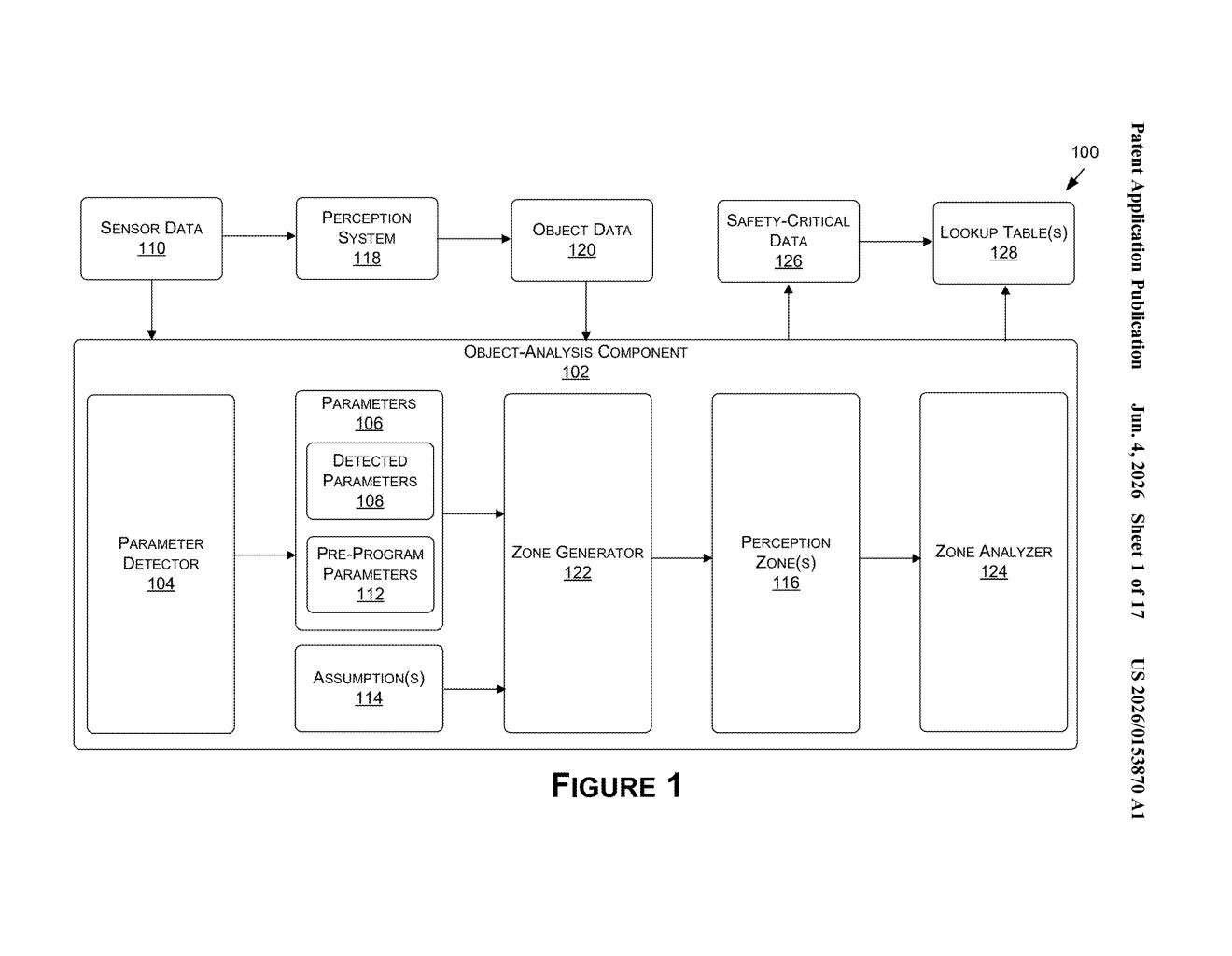
Nvidia's patent describes a smarter approach: the car watches an object's direction of travel, models how both the car and the object are likely to move, and then draws a custom perception zone — essentially a region of space where that object could realistically cause a problem. If the object is inside that zone, it gets flagged as safety-critical.
This isn't just for real-time driving. The system can also be used offline to test and validate a car's perception software — checking whether a detection failure was genuinely dangerous or just a harmless miss. That dual-use angle makes it a useful tool both in the vehicle and in the development lab.
How the system calculates and uses perception zones
The core idea is to compute a perception zone — a dynamic, spatially-defined region — for each detected object in the vehicle's environment. The zone isn't a fixed bubble; it's shaped by three inputs:
- The ego-machine's dynamic model — how the autonomous vehicle itself is expected to move (speed, heading, braking limits).
- The object's dynamic model — how the detected object (a pedestrian, cyclist, or another car) is predicted to behave based on its current direction of travel.
- Possible interaction scenarios — the set of plausible ways the two could end up in the same place at the same time.
Once the perception zone is computed, the system checks whether the object falls inside it. If yes, the object is classified as safety-critical, and the vehicle's planning, navigation, or control stack prioritizes it accordingly.
The patent also describes a validation mode, where the system is used offline to audit a perception pipeline. If a sensor missed detecting an object, the system can assess whether that miss actually mattered — was the object in a zone where it could have caused a collision, or was it irrelevant to safety? This helps engineers distinguish genuinely dangerous perception failures from benign false negatives, which is a non-trivial problem when certifying autonomous systems.
What this means for safer, more efficient self-driving systems
For self-driving cars, computational attention is a limited resource. A system that treats every pedestrian on a distant sidewalk with the same urgency as a car running a red light ahead will be slow, noisy, and prone to over-reaction. By creating object-specific perception zones tied to realistic motion predictions, Nvidia's approach lets the vehicle focus its planning resources where they actually count.
The validation use case is arguably just as important. Testing autonomous perception systems is hard — you need to know not just what the system missed, but whether it mattered. A tool that automatically classifies detection errors by their safety relevance could significantly speed up the certification pipeline for AV developers, including Nvidia's partners building on its DRIVE platform.
This is a thoughtful piece of infrastructure-level work for autonomous vehicles — not flashy, but the kind of thing that separates a capable AV stack from a certified one. The dual-use angle (real-time driving AND offline validation) is clever and suggests Nvidia is thinking about the full development lifecycle, not just runtime performance. Worth watching if you follow AV safety certification.
There are more where this came from
We read every patent application Big Tech publishes and send you the ones worth knowing. Plain English, free, every week.
Want this weekly breakdown for a company we don't cover? Patentlyze Pro →