
Nvidia Patents a GPU-Parallel System for Tracking Multiple Objects Across Video Frames
Keeping track of dozens of moving objects in a live video stream is one of the hardest problems in computer vision — and Nvidia thinks running it all in parallel on a GPU is the answer.
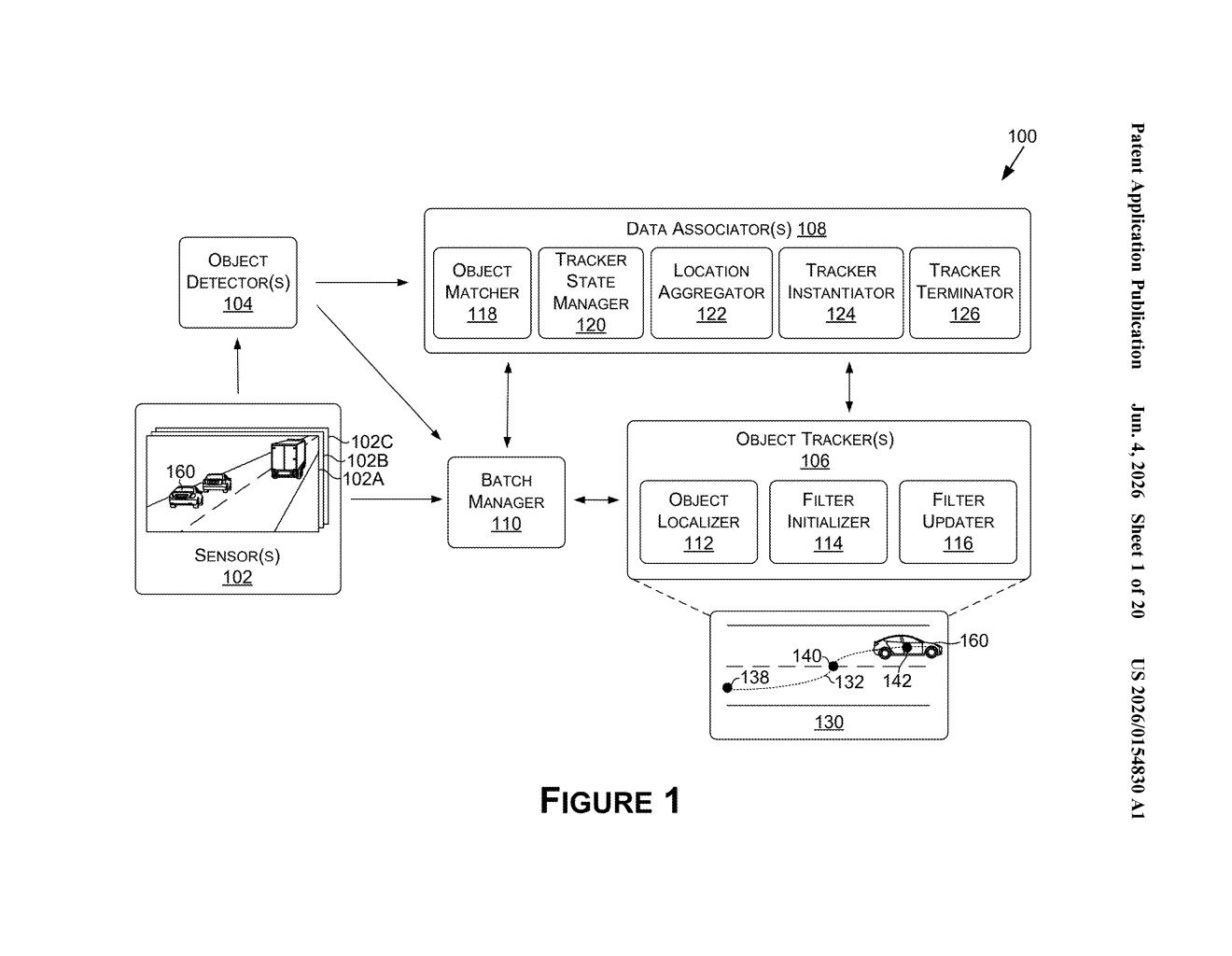
How Nvidia's correlation-based object tracker works
Imagine you're watching security footage of a busy intersection, and you need to follow each pedestrian and car across every frame of video, even when they overlap or briefly disappear. Today's tracking software often handles each object one at a time, which gets slow fast.
Nvidia's patent describes a system that batches all that work together and sends it to a GPU to process simultaneously. Instead of tracking objects one by one, the GPU handles many trackers in parallel — across multiple cameras and multiple objects at once — dramatically cutting the time it takes.
The clever part is how the system decides whether the object it sees in frame 2 is the same object from frame 1. It uses something called a correlation response — essentially a confidence score — to match locations across frames. Higher score means "yes, that's the same person." The system also handles tricky situations like partial occlusion (when someone walks behind a pole) using special maps that tell the tracker to focus on the visible parts.
How correlation response values link objects frame to frame
At its core, this patent covers three interconnected ideas bundled into a GPU-accelerated object tracking pipeline.
Batch processing on GPU: Image regions of interest are extracted from one or more video frames, resized to match a standard template size, and loaded into GPU memory all at once. This means many trackers — from multiple cameras or multiple objects — run in parallel rather than sequentially on a CPU.
Association via correlation response values: The system uses correlation filters (a technique that slides a learned template over a search region and produces a heatmap of match scores) to find where a tracked object likely is in a new frame. Critically, the patent proposes using these raw correlation scores — not just the peak location — as the basis for deciding whether two detections across frames belong to the same object. A high score = strong match; a low score = likely a different object or a false positive.
Focused windowing and occlusion maps: To make the correlation filters more accurate, the system learns to weight the training signal toward the most informative parts of an image (focused windowing) and uses occlusion maps to down-weight regions where the object is partially hidden. This makes the tracker more robust when objects overlap or pass behind obstacles.
Together these pieces form a pipeline designed to run efficiently on Nvidia's own GPU hardware at scale.
What this means for real-time AI video analysis
Multi-object tracking is a critical bottleneck in autonomous vehicles, warehouse robotics, drone surveillance, and smart-city camera systems — anywhere you need to follow many things at once in real time. Offloading this work to the GPU in batch is a meaningful engineering advance: it means you can track more objects, from more cameras, with less latency, on the same hardware you already have.
For you as a developer or fleet operator, this kind of efficiency gain translates directly into either lower cloud compute costs or the ability to run more capable tracking on edge devices. And because Nvidia controls both the silicon and the software stack here (via platforms like DeepStream and DRIVE), a patent like this fits neatly into the company's strategy of making its GPUs the default choice for video AI workloads.
This is solid, workmanlike engineering rather than a conceptual leap — but that's exactly the kind of patent that actually ships. Nvidia is filling in the performance layer beneath its existing video-AI software stack, and GPU-batched multi-object tracking with occlusion-aware filters is a real pain point for anyone running large-scale video analytics. Worth watching if you build on DeepStream or DRIVE.
There are more where this came from
We read every patent application Big Tech publishes and send you the ones worth knowing. Plain English, free, every week.
Want this weekly breakdown for a company we don't cover? Patentlyze Pro →