
Nvidia Files Patent for AI That Restores Sharp Detail Lost in Compressed Images
When an AI tries to understand an image, it often works with a shrunken-down version first and then has to guess at the details it lost. Nvidia's new patent describes a learned routine for recovering those details more accurately than standard upscaling techniques.
How Nvidia's vision AI fills in what it missed
Imagine taking a photo, shrinking it to a thumbnail so your phone can process it faster, and then trying to blow it back up to full size. You'd lose sharpness and introduce blurry artifacts. AI vision systems run into exactly this problem: they compress images into compact summaries called feature maps, and when they need more detail, standard upscaling leaves behind visual noise.
Nvidia's patent describes a method where the AI learns how to upsample, meaning it's trained to intelligently reconstruct fine detail rather than just stretching pixels. The process first strips out compression artifacts, then blends a scaled-up version of the image summary with a version that preserves fine-grained details, and finally trims away the leftover noise channels.
The result is a cleaner, more detailed picture of what's in the scene. That matters most in situations where a vision AI needs to identify small objects, read text, or track precise edges in real time.
… generating a de-biased feature map and a de-biased tiled feature map by removing artifacts from the feature map and the tiled feature map …
Translation: The system cleans up digital distortion and compression flaws from the image data.
Inside Nvidia's artifact removal and channel-slicing pipeline
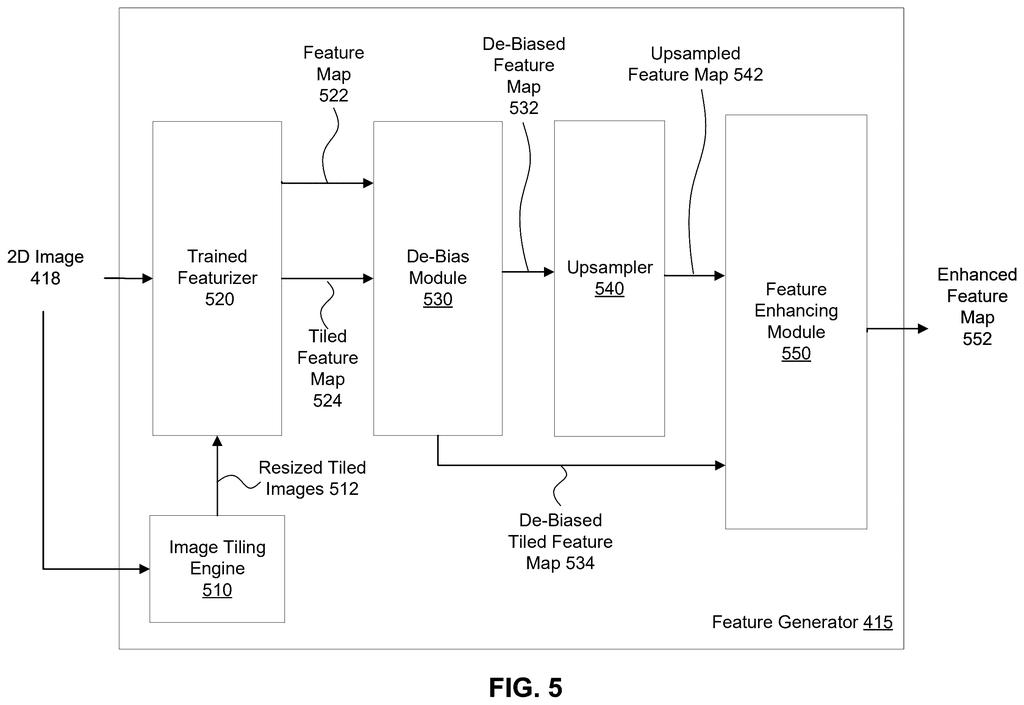
The patent describes a pipeline that processes a 2D image through a vision model (the AI backbone that turns pixels into a structured summary of the scene) and produces two parallel outputs: a standard feature map and a tiled feature map. The tiled version captures fine-grained detail by processing the image in overlapping patches rather than all at once.
Before combining anything, the system performs de-biasing, a step that strips away systematic artifacts (the predictable distortions introduced by compression or tiling) from both feature maps. This is important because merging two noisy signals just produces louder noise.
Next, the cleaned-up standard feature map is upsampled (scaled up to a higher resolution) using a learned routine, meaning the model has been trained on examples so it knows how to intelligently fill in gaps rather than interpolating blindly. The upsampled result is then concatenated (joined side by side as stacked data layers) with the cleaned tiled feature map, giving the model both scale and detail to work with.
Finally, the combined map is processed by a lightweight network, and specific channels (think of these as data planes, each encoding one aspect of the scene) are sliced off. This trimming step discards information that was only needed as scaffolding during the upsampling process and produces the final enhanced feature map.
… generating an enhanced feature map by slicing off one or more channels of the output feature map …
Translation: The AI finalizes the improved image data by trimming away unnecessary digital channels.
What sharper vision AI means for robotics and autonomous systems
Vision AI is the backbone of systems ranging from autonomous vehicles to factory robots to medical imaging tools. All of them suffer when the AI misses small details, like a pedestrian at the edge of frame or a hairline crack in a component. Better upsampling directly translates to fewer misses, and because this approach is a plug-in enhancement to existing vision models rather than a full replacement, it can in principle be dropped into systems already in production.
For you as a user or observer, the practical payoff would show up in more accurate object detection in cameras, sharper understanding in AR or robotics applications, and potentially faster processing since the model doesn't have to run at full resolution from the start. Whether Nvidia ships this as part of a training toolkit, an inference library, or embedded in future hardware accelerators is not specified in the patent, but the technique is squarely aimed at the vision-AI workloads Nvidia's GPUs dominate.
This is a focused, competent engineering patent rather than a splashy AI announcement. The de-biasing plus learned upsampling combination is a sensible solution to a real problem in production vision systems, and it fits neatly into Nvidia's broader push to make its platforms the default choice for vision AI workloads. Don't expect a press release, but expect to see ideas like this baked into future CUDA or TensorRT libraries.
There are more where this came from
We read every patent application Big Tech publishes and send you the ones worth knowing. Plain English, free, every week.
The drawings
9 drawing sheets from US 2026/0228856 A1 · click any drawing to enlarge


Want this weekly breakdown for a company we don't cover? Patentlyze Pro →
Be the first to weigh in