
Nvidia Patents a Fix for Grainy, Computer-Generated Images of Curved Surfaces
Ray tracing makes scenes look stunning, but it introduces visual noise that has to be cleaned up afterward. Nvidia's new patent tackles a specific headache: getting that cleanup right when the surfaces being rendered are smoothly curved, not flat polygons.
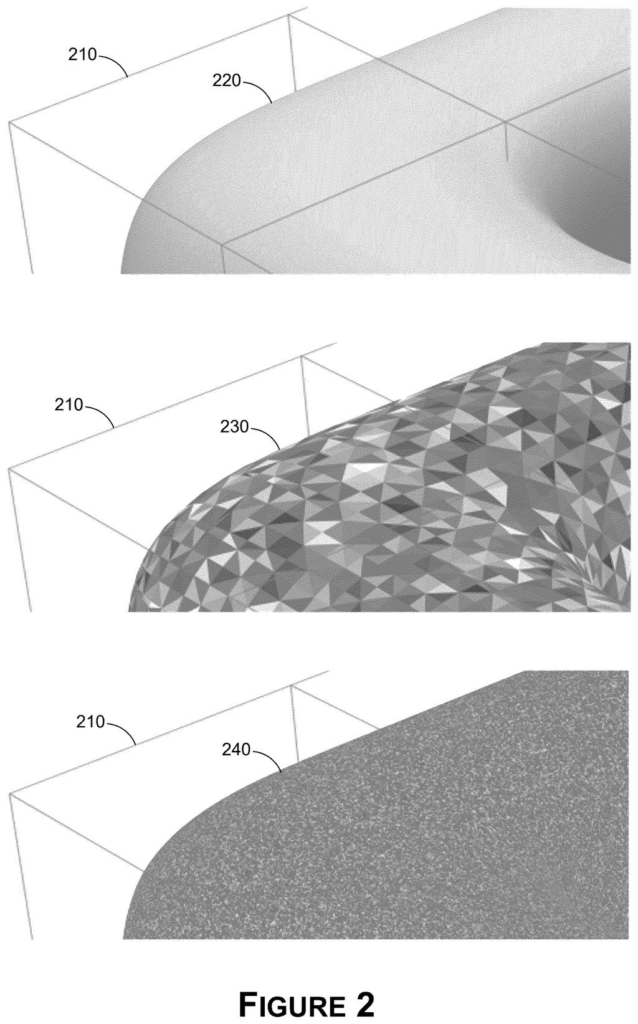
How Nvidia removes noise from curved 3D surfaces
Imagine watching a ray-traced game where a shiny car hood or a character's skin looks grainy for a split second before the image settles. That grain is called noise, and removing it without blurring the picture is one of the hardest problems in real-time graphics.
To clean up noise intelligently, a renderer needs to know how every part of the picture moved from one frame to the next. That information is stored in something called a motion vector. The problem is that flat polygons are easy to track, but smooth, curved surfaces (like the kind used for organic shapes) can generate inaccurate motion vectors, causing the denoiser to smear or ghost the image.
Nvidia's patent describes a method that figures out motion vectors specifically for those curved surfaces by working with the math that defines the curve itself, rather than just looking at where pixels ended up on screen. The result is a more accurate picture of how curved geometry moved, which lets the denoising step do a cleaner job.
generate, for at least one pixel of one or more pixels of a current frame depicting a scene, a parametric representation of a current location on a limit surface of the scene corresponding to the pixel …
Translation: It calculates math coordinates for the exact spot on a curved 3D shape that each pixel is showing.
How motion vectors are rebuilt from parametric surface math
The patent centers on parametric surfaces, a way of describing smooth curves using mathematical formulas rather than a mesh of flat triangles. When a renderer wants to display one, it subdivides or tessellates the surface into fine geometry. Nvidia calls the final, fully smoothed result the limit surface.
For every pixel in the current frame, the system records a parametric location on the limit surface: essentially the mathematical coordinates of the exact point on the curve that pixel is looking at. It then uses those same coordinates to reconstruct where that point was in the previous frame.
- Current and previous 3D positions on the limit surface are calculated from the parametric coordinates.
- Both positions are projected into 2D screen space.
- The difference between the two projected positions becomes the motion vector for that pixel.
- Those motion vectors feed into the denoiser to accurately merge color information across frames.
Because the motion is derived from the surface's own mathematical definition rather than from approximate screen-space heuristics, the vectors are more precise, especially for surfaces that deform or animate between frames.
… the motion of a rendered (e.g., limit, displaced) surface may be computed by reconstructing current and previous 3D locations on the limit surface using the parametric location of the limit surface each pixel views …
Translation: It tracks how those curved surfaces move across the screen over time to help clear up visual noise.
What this means for real-time ray tracing quality
Denoising is the backbone of modern real-time ray tracing. Every major GPU vendor ships a denoiser (Nvidia's is called DLSS Ray Reconstruction), and its quality depends almost entirely on the accuracy of motion vectors. Bad motion vectors cause ghosting, where objects leave smeared trails, or disocclusion artifacts, where newly revealed areas look wrong.
Curved parametric surfaces show up constantly in high-end rendering: character skin, vehicle bodies, architectural details. If this technique makes it into a future driver or SDK update, it could eliminate a whole category of visual artifacts that currently require artists to work around manually. That matters both for game developers and for film and visualization pipelines that use Nvidia hardware.
This is a focused, specific engineering contribution aimed at a well-known weak spot in GPU-based denoising. It won't make headlines the way a new GPU architecture does, but developers who build ray-traced content know exactly the artifacts this is trying to fix. Worth watching for integration into a future version of Nvidia's graphics SDK.
There are more where this came from
We read every patent application Big Tech publishes and send you the ones worth knowing. Plain English, free, every week.
The drawings
18 drawing sheets from US 2026/0228863 A1 · click any drawing to enlarge


Want this weekly breakdown for a company we don't cover? Patentlyze Pro →
Be the first to weigh in