
Qualcomm Patents a More Precise 5G Location System Using Double Round-Trip Timing
Getting a precise location fix indoors over 5G is harder than it sounds — radio signals bounce, hardware introduces tiny delays, and those errors compound fast. Qualcomm's new patent tackles that by sending timing correction data alongside the positioning signals themselves.
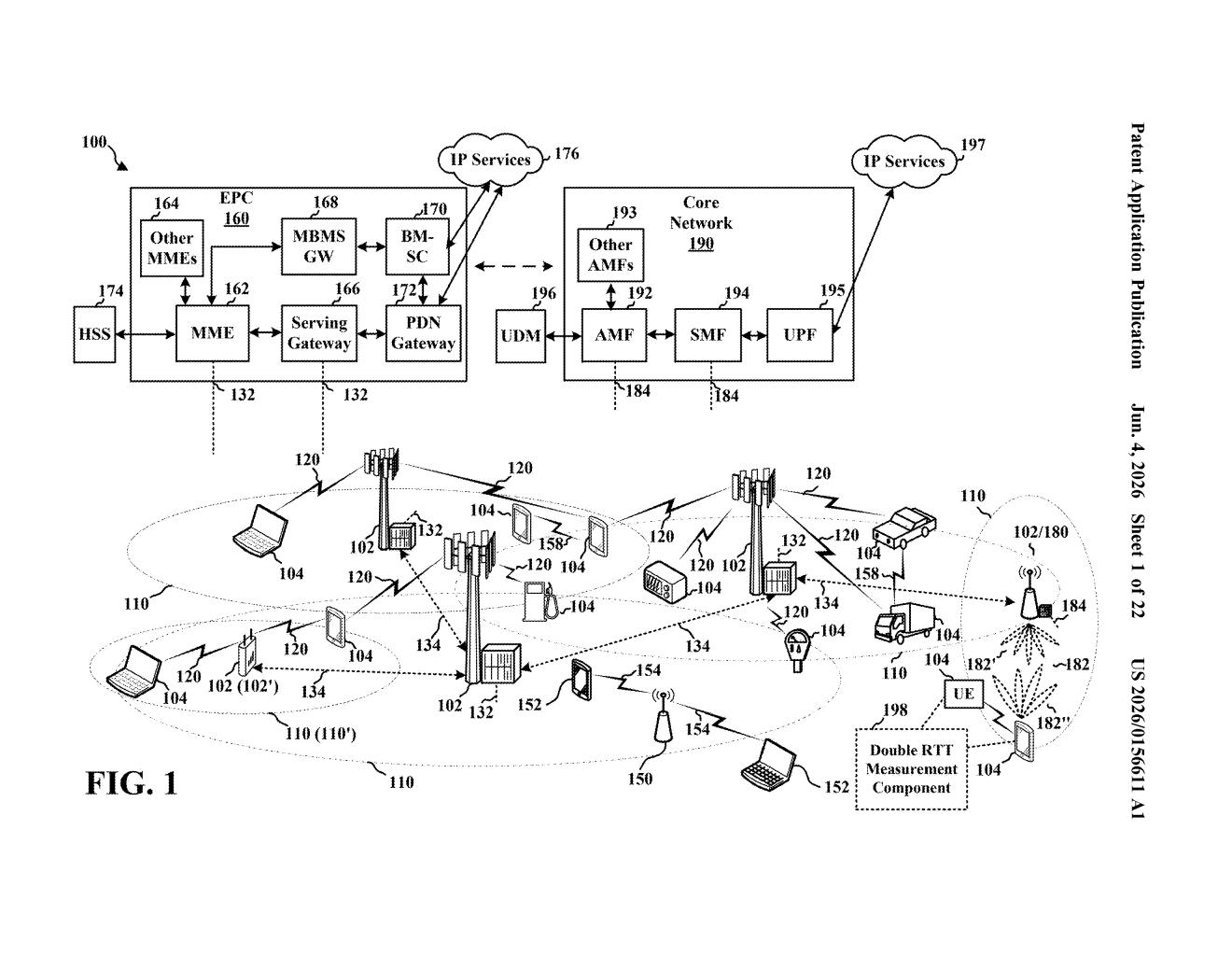
How Qualcomm's double round-trip timing pins down your location
Imagine your phone is trying to figure out exactly where it is inside a building using 5G, not GPS. To do that, it and the nearby cell tower exchange a rapid series of radio signals and measure how long the round trip takes. The shorter the trip, the closer you are. Sounds simple — but the hardware at both ends introduces tiny delays that throw off the math.
Qualcomm's patent describes a system where the base station (the tower) tells your device exactly how much delay its own hardware adds at each step of that ping-pong exchange. There's a delay for sending the first positioning signal, another for receiving your reply, and yet another for sending a second positioning signal — and the patent covers all the combinations.
Armed with those correction values, your device can strip out the hardware noise and calculate a much cleaner distance estimate. This "double round-trip" approach — two positioning signals bracketing your device's response — gives the math extra anchoring points, making the final location fix more reliable than a single exchange.
How TEG delays correct the double-RTT measurement chain
The patent describes a double-sided round trip time (DS-RTT) positioning protocol between a base station (BS) and a user equipment (UE — your phone or connected device).
The exchange works like this:
- The BS transmits a first Positioning Reference Signal (PRS) — a known radio pattern the UE uses as a timestamp anchor.
- The UE transmits a Sounding Reference Signal (SRS) back toward the BS.
- The BS then transmits a second PRS, closing the loop.
By recording the precise timing of all three events, both sides can calculate the propagation delay — and therefore distance. The problem is that each antenna port or hardware path at the base station introduces its own latency, called a Timing Error Group (TEG) delay (essentially, how long it takes the radio circuitry to actually send or receive a signal after it's supposed to). If you don't account for those, your distance estimate is off.
The patent's core contribution is a structured way for the BS to report up to five distinct TEG delays to the UE — covering every combination of transmit and receive events in the double-RTT exchange. The UE then uses whichever subset it receives to correct the raw timing measurements before computing the final range estimate. This is a standards-level engineering detail aimed squarely at 5G NR positioning specifications.
What this means for 5G indoor and precision positioning
Precise indoor and urban positioning is one of 5G's headline promises — think emergency responders locating a caller inside a high-rise, or warehouse robots that don't rely on GPS. Double-sided RTT is already part of the 3GPP 5G positioning standard, but TEG delay reporting has been an underspecified gap. This patent addresses exactly that gap, giving device makers and network operators a cleaner framework for exchanging hardware-calibration data.
For you as a user, the payoff is subtler but real: location-dependent services — navigation handoffs between outdoor GPS and indoor 5G, asset tracking, augmented reality anchoring — all get more reliable when the underlying range estimates are less contaminated by hardware noise. Qualcomm is a dominant supplier of 5G modem silicon, so a technique like this has a credible path into deployed chipsets.
This is a narrow but legitimate piece of standards engineering. Qualcomm files heavily in the 3GPP positioning space, and TEG delay correction for double-RTT is exactly the kind of detail that separates a good spec from a deployable one. It won't make headlines, but it's the type of IP that quietly ends up in chipset firmware shipped in hundreds of millions of devices.
There are more where this came from
We read every patent application Big Tech publishes and send you the ones worth knowing. Plain English, free, every week.
Want this weekly breakdown for a company we don't cover? Patentlyze Pro →