
Google Patents a Way to Train AI to Reframe Photos Using Plain-English Commands
Imagine typing 'zoom out a little' or 'shift the angle left' and having an AI recompose your photo as if you'd physically moved the camera. That's the idea behind Google's latest image-editing patent.
What Google's camera-reframing AI actually does
Have you ever taken a photo and wished you'd stepped back a couple of feet, or tilted the camera slightly before hitting the shutter? Usually, that moment is gone. Google is working on an AI system that could let you describe the change you wanted — in plain English — and have it recompose the image as if the camera had actually moved.
The patent covers how Google would train that AI, not just build it. The trick is creating thousands of practice examples: pairs of images where one is the original shot and the other is what the scene would have looked like from a different angle or distance, matched up with simple text instructions like "zoom out" or "rotate the camera right."
By feeding an AI system enough of those before-and-after pairs alongside the plain-language instructions that describe each change, the system learns to follow those instructions on new photos it has never seen before. The result is an editor that could let you reshape a photo's perspective without ever touching a slider.
How Google builds training data for camera-pose edits
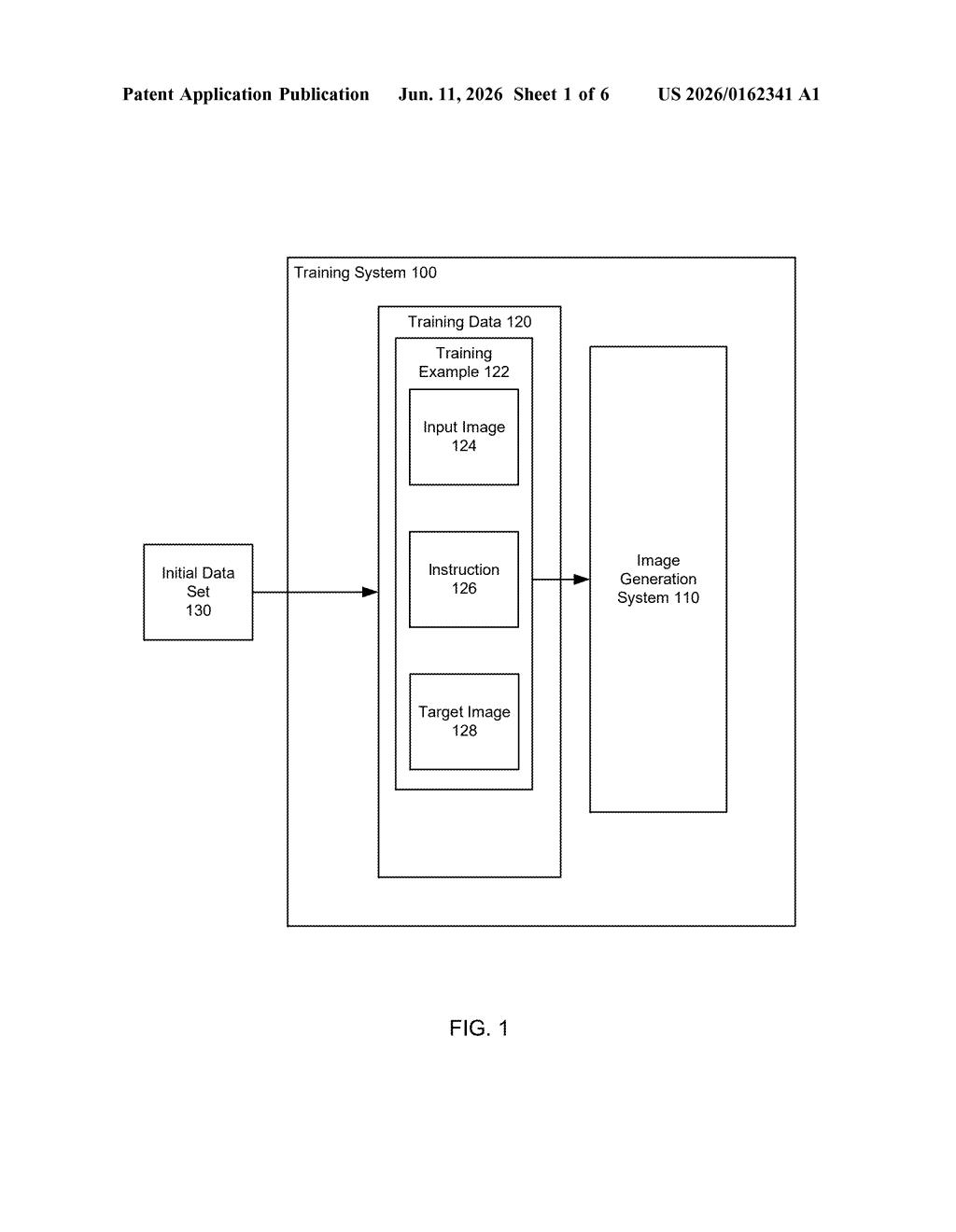
The patent describes a training pipeline for an image generation system — an AI that edits photos — specifically focused on teaching it to simulate changes in camera pose (position and angle in 3D space).
Here's how the training data gets built:
- Google starts with an initial dataset of images or video frames.
- From those, it generates spatial trajectories — sequences of images that represent what a scene looks like from a series of related viewpoints, like frames from a camera slowly panning or pulling back.
- Each trajectory becomes a set of training examples, each pairing an input image with a target image (what the scene looks like from a different angle) and a natural language instruction — a plain-text description of the camera move, such as "tilt the camera up" or "move the camera further from the subject."
The AI learns to connect the instruction to the visual transformation. Because the training pairs are derived from real spatial sequences rather than purely synthetic data, the learned transformations should reflect how scenes actually change with camera movement — including how objects partially hidden at one angle might appear at another.
The patent focuses entirely on the training methodology, not the inference-time user experience, so the exact model architecture is left open.
What this means for AI-powered photo editing tools
Right now, recomposing a photo after the fact is either a cropping job (which throws away pixels) or a complex manual task in software like Photoshop that requires skill and time. An AI that genuinely understands camera geometry could let anyone — not just photo editors — describe what they wanted and get a plausible result back instantly.
For Google, this fits squarely into the direction of its Pixel camera software and tools like Magic Eraser and Photo Unblur. If the training approach here works at scale, it could underpin features that let you retroactively fix framing on any photo you've already taken — using nothing more than a text prompt.
This is a solid, focused patent on a genuinely useful problem: teaching AI the geometry of camera movement through carefully constructed training data. The approach of deriving paired examples from spatial image trajectories is sensible and well-suited to the task. Whether the outputs are convincing enough for real photos — especially for large reframing changes where the AI has to invent new scene content — is the hard question this patent doesn't answer.
There are more where this came from
We read every patent application Big Tech publishes and send you the ones worth knowing. Plain English, free, every week.
Want this weekly breakdown for a company we don't cover? Patentlyze Pro →