
Google Patents a Tool That Turns Plain-English Instructions Into Working Code
Imagine describing a software task in plain English and watching it turn into a fully editable visual diagram of working code — no typing a single line yourself. That's the core idea behind this Google patent.
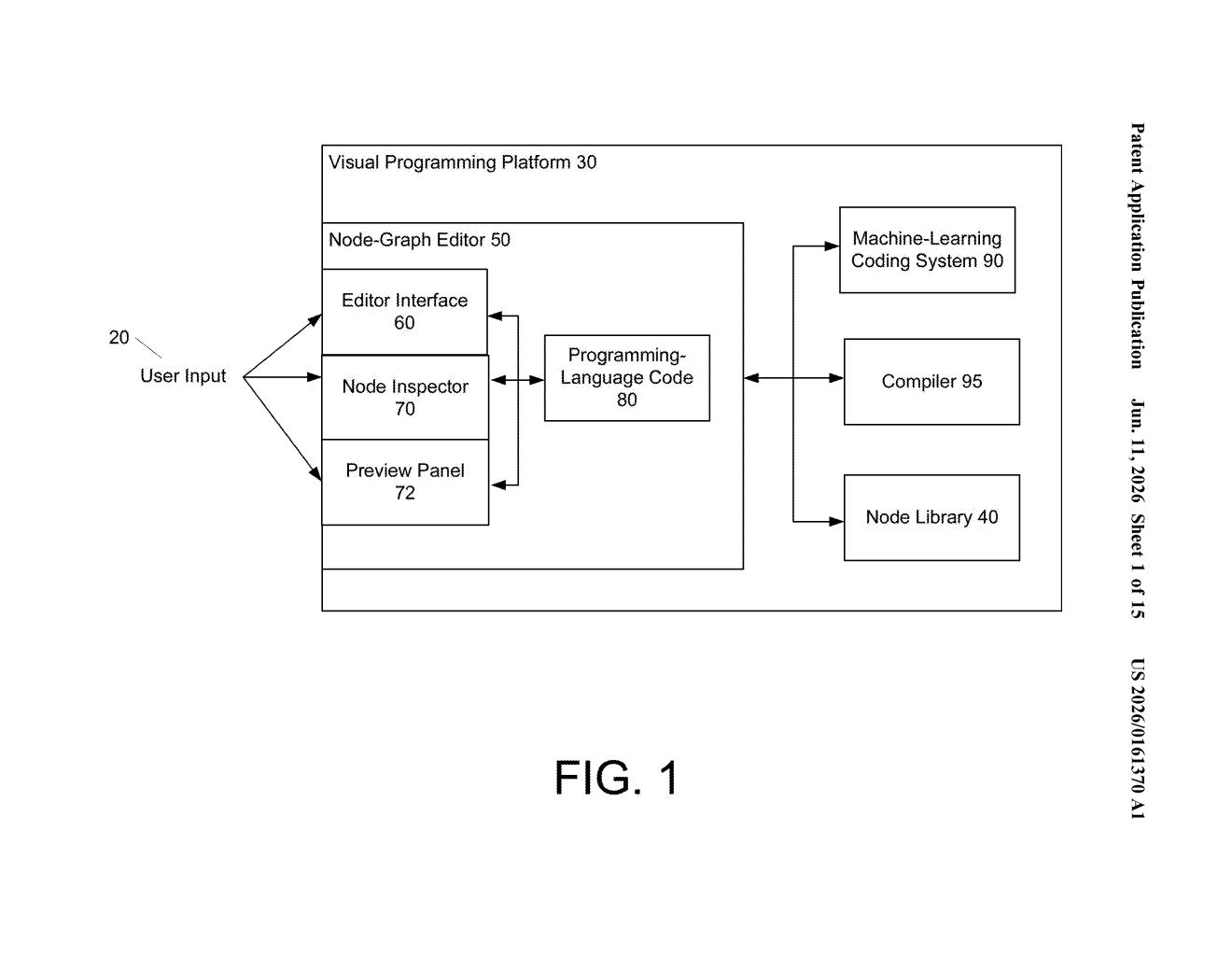
What Google's plain-English-to-code platform actually does
Picture this: instead of writing code, you type something like "build a pipeline that takes a photo, detects objects in it, and saves the results to a spreadsheet." Google's patented system reads that sentence, figures out the steps involved, and automatically generates a visual flowchart of the program — with real, working code underneath it.
The key twist is that you don't have to touch the code directly. You can drag, connect, and rearrange the visual blocks in the diagram, and the underlying code updates along with it. It's closer to building with Lego bricks than writing a script.
This kind of tool sits between traditional programming and the no-code apps you might already know. It's aimed at people who know what they want a program to do — but don't necessarily want to wrestle with syntax to make it happen.
How the AI turns a text prompt into editable visual code
The system operates as a visual programming platform with an AI engine at its core. When you describe a task in plain language, the platform hands that description to a machine-learned model, which generates pseudocode — a human-readable, informal sketch of the algorithm (think: step-by-step instructions in near-English, not actual executable code).
That pseudocode is then fed into a compiler (a tool that translates high-level descriptions into real executable code) to produce working programming-language code. Simultaneously, the platform generates a graphical visualization of the resulting pipeline — showing each processing stage as a connected node or block in an interactive diagram.
Crucially, the patent specifies that edits made to the visual diagram are reflected in the underlying code. The key steps in the pipeline are:
- User submits a natural-language task description
- AI model generates pseudocode representing the logic
- Compiler converts pseudocode into executable code
- Platform renders an interactive visual graph of the pipeline
- User edits the graph; code updates accordingly
The patent doesn't name a specific AI model, so this could be built on any of Google's existing large language models, such as Gemini.
What this means for no-code and AI-assisted development
The no-code and low-code software market has exploded in recent years, but most tools force a trade-off: ease of use or real power, rarely both. Google's approach tries to bridge that gap by using AI to generate real code first, then letting you shape it visually — meaning the output isn't locked into a simplified drag-and-drop abstraction but is actual, portable, editable software.
For Google, this fits neatly into its broader push to embed AI assistance into developer tooling — territory where it competes directly with Microsoft (GitHub Copilot) and the growing field of AI coding assistants. A visual-first interface could also open programming to a wider audience, including data scientists, researchers, and domain experts who think in workflows, not syntax.
This is a genuinely interesting patent because it doesn't just slap an AI chat box onto an IDE — it proposes a tighter loop where AI-generated logic becomes a visual, editable artifact rather than a black-box text suggestion. The pseudocode intermediary step is a smart architectural choice that keeps humans in the loop without requiring them to read raw code. Whether it ships as a product is another question, but the design thinking here is more considered than the average AI-coding patent.
There are more where this came from
We read every patent application Big Tech publishes and send you the ones worth knowing. Plain English, free, every week.
Want this weekly breakdown for a company we don't cover? Patentlyze Pro →