
Google
Google · AI / ML · Filed Sep 12, 2025 · USPTO published Jun 11, 2026 · Jun 11 release
Google Patents an AI That Writes a Draft Brief Before Creating Your Final Content
Before Google's AI creates anything for you, it writes a quick text description of what it's about to make — and asks if that's what you actually wanted. It's a small idea with real efficiency wins behind it.
- Publication number
- US 2026/0161700 A1(US20260161700A1)
- Applicant
- Google LLC
- Filed · Published
- Sep 12, 2025 · Jun 11, 2026
- Inventors
- Adrien Fredj Baranes, Robert Andrew Marchant, Triona Butler, Kristen Olsen, Nimisha Karnatak
- Status when we published
- Waiting for an examiner
- Document
- 20 claims
- US classification
- 707/732
- Parent application
- Claims priority from a provisional application 63694191 (filed Sep 12, 2024)
How Google's AI skips the wasteful trial-and-error
Imagine asking an AI to design a birthday card. Instead of immediately spitting out a full, polished image you might hate, the AI first writes you a short note: "A warm illustration of a golden retriever wearing a party hat, with pastel colors and a handwritten font." You read it, tweak it, and only then does the AI generate the actual card.
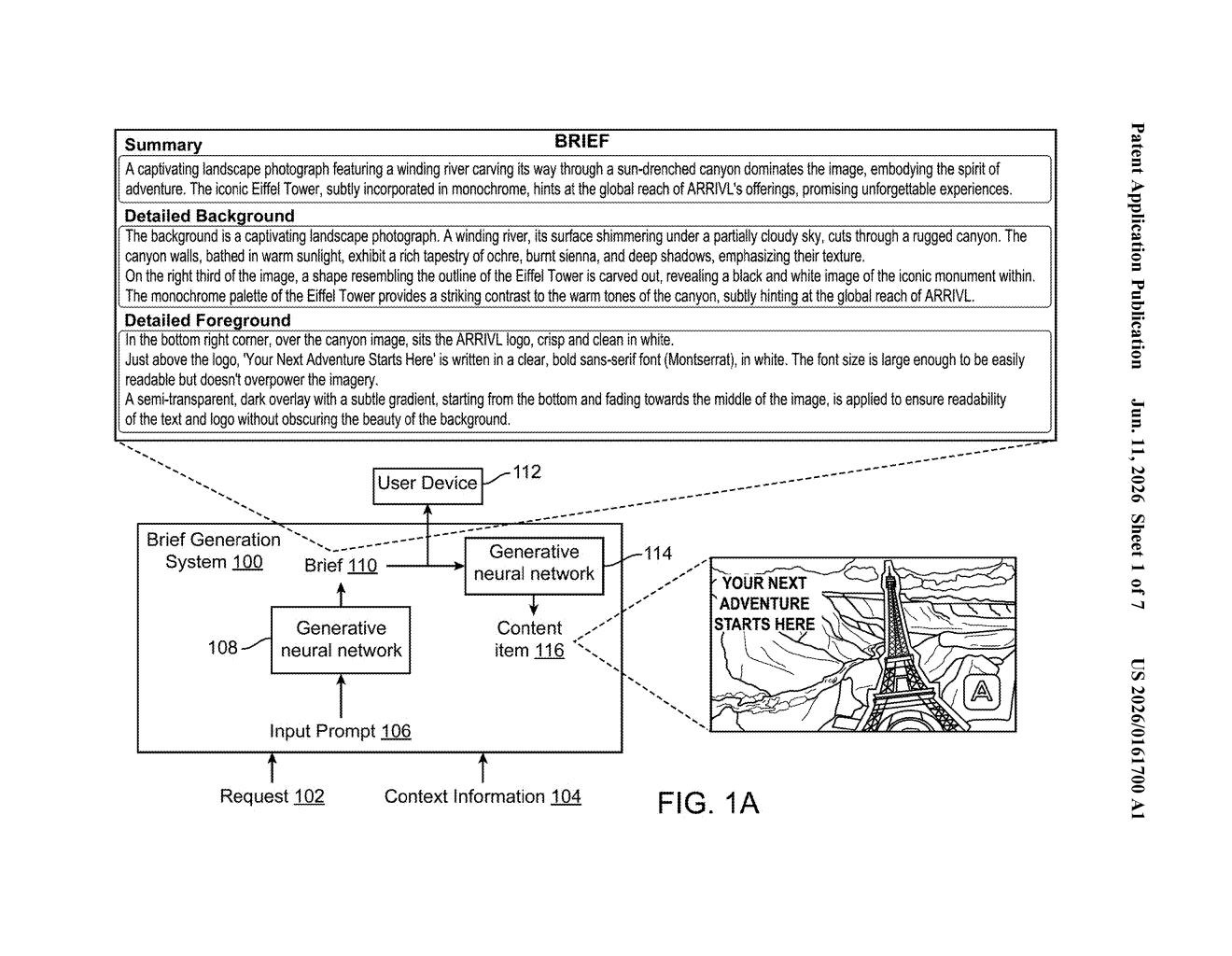
That's the core of what Google is patenting here. The system learns your preferences, builds a plain-text "brief" describing what the final content will look like, and shows it to you before doing the expensive work of actually creating anything. You get a chance to course-correct before any real computing resources are burned.
The payoff is efficiency: generating text is cheap; generating full images or other rich content is not. By getting your sign-off on a text brief first, Google's system avoids making multiple versions of something you never wanted in the first place.
How the brief-first generation pipeline works
The patent describes a pipeline with a clear two-step structure:
- Step 1 — Brief generation: When you request a customized content item, the system collects context about your preferences (past behavior, stated choices, profile data) and feeds that into a generative neural network to produce a short, natural-language description — a "brief" — of what the final content will look, feel, and say.
- Step 2 — Iterative refinement: That brief is shown to you before anything expensive is generated. You can request changes, and the system regenerates the cheap text brief as many times as needed until it matches what you want.
- Step 3 — Final generation: Only once the brief is approved does the system generate the actual content item — an image, document, ad creative, or similar rich output.
The key insight is the cost asymmetry. Running a large generative model to produce a paragraph of text costs a tiny fraction of what it costs to generate a full image or video. By front-loading the alignment work into the text phase, the system avoids the "generate, reject, regenerate" loop that would otherwise waste significant compute.
The claim specifically covers receiving user context, building a prompt, running it through a generative neural network (an AI model like those behind image or text generators), and returning the brief to the user's device for review.
What this means for AI-generated content tools
For users, this means fewer "that's not what I meant" moments with AI creative tools. The brief gives you a readable checkpoint — something you can actually evaluate with words — before the AI commits to a finished product. That's a meaningful quality-of-life improvement for anyone using AI to generate personalized content like ads, cards, presentations, or social posts.
For Google, the efficiency angle is the real story. At scale, shaving even a fraction of unnecessary generation runs off millions of daily requests translates into enormous infrastructure savings. This patent fits neatly into Google's broader push to make its AI tools faster and cheaper to operate — which matters a lot as generative AI costs remain a pressure point across the industry.
Source: US 2026/0161700 A1 at the USPTO (PDF). Full patent text and figures are in the official publication.
Get our take in your Top Stories
Liked this breakdown? Add Patentlyze as a preferred source on Google, and our plain-English take shows up more often in your Top Stories the next time Google patent news breaks.
Add Patentlyze on Google
One click.
There are more where this came from
We read every patent application Big Tech publishes and send you the ones worth knowing. Plain English, free, every week.
More from Google
All 1,079 Google patents →
More in AI / ML
All 2,637 AI / ML patents →
Salesforce
Salesforce Patents a System That Makes AI Code-Writers Grade Their Own Tests
Disney
Disney Patent Lets Anyone Query Databases Using Plain Language Instead of Complex Commands
Nvidia
Nvidia Patents a Way to Make Different AI Models Share Information Directly
IBM