
New Patent Enables AI Queries Without Sending Data to Google Servers
What if your phone's AI assistant could give you personalized answers without sending your questions — or your personal data — to a server every single time? That's exactly what this Google patent is describing.
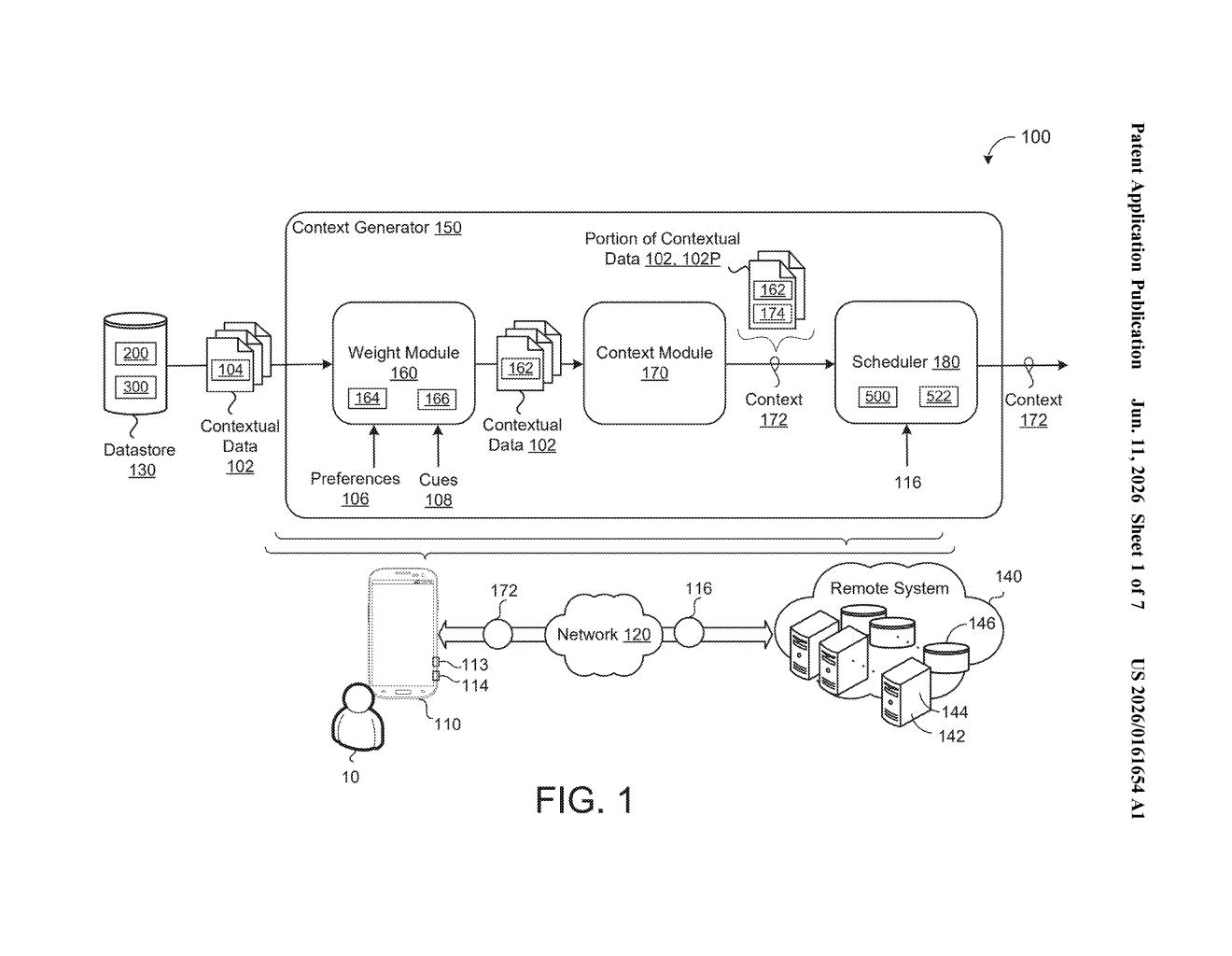
How Google's on-device context snapshot actually works
Imagine you ask your phone's AI assistant something personal, like what kind of restaurant you'd enjoy tonight. Normally, to give a useful answer, the AI needs to know a lot about you — your preferences, habits, maybe your location history. That usually means shipping your question and your personal data up to a cloud server, every time.
Google's patent describes a different approach. A system running in the cloud gathers bits of information about you from various online services you've already authorized — think your calendar, your search history, your music app. It then weighs which pieces are actually relevant to you, trims the list down to the most useful snapshot, and sends that compact profile down to your device.
Once it's there, your phone stores it locally. From that point on, when you ask the AI something, it can answer using that stored context and an on-device AI model — no round-trip to Google's servers required. You get personalized answers with less of your data leaving your hands.
How the context builder scores and trims your data
The patent describes a two-part system. The first part lives in the cloud: a contextual generator that, with your explicit permission, pulls data about you from multiple online service providers — each covering a different topic area (entertainment preferences, calendar events, shopping habits, and so on).
For each piece of data it collects, the system assigns a weight — essentially a relevance score indicating how much that data point actually reflects who you are and what you care about. Low-weight items get dropped; high-weight items make the cut. The result is a trimmed-down context package: a curated, compressed snapshot of you that's meaningful but not bloated.
That context package gets pushed to your device, where it's stored locally. The key detail is what happens next: when you run a query, your phone's on-device neural network (a local AI model) uses that stored context to personalize its answer — all without phoning home.
The claim also specifies that the whole thing begins with explicit user authorization — you decide which data sources the contextual generator is allowed to tap before any of this starts. That's a notable architectural choice, not just a privacy footnote.
What this means for AI privacy on Android and beyond
The practical upside here is twofold: speed and privacy. Queries that don't need to travel to a server are faster, and data that stays on your device is harder for third parties to intercept or misuse. As on-device AI models become capable enough to handle real tasks — something Google is actively pushing with its Gemini Nano line — the bottleneck shifts from the model itself to context: the AI is only as useful as what it knows about you.
This patent is essentially Google's answer to that bottleneck. Rather than abandoning personalization to gain privacy, it tries to give you both. For users who've grown wary of how much their AI assistants beam back to the cloud, that framing matters — even if the initial context-building step still happens server-side.
This is a genuinely interesting systems patent because it addresses a real tension in AI assistant design: personalization usually requires cloud access, but cloud access raises privacy concerns. Google's proposed middle path — build the profile in the cloud once, push it to the device, answer queries locally after that — is a reasonable engineering compromise. Whether Google implements it faithfully, or uses it as cover for continued server-side processing, is a separate question entirely.
There are more where this came from
We read every patent application Big Tech publishes and send you the ones worth knowing. Plain English, free, every week.
Want this weekly breakdown for a company we don't cover? Patentlyze Pro →