Latest display patents, Page 56
Screens are one of tech's fiercest battlegrounds: folding panels, pixel circuits, brightness tricks, and the seams where two displays meet. We read every display filing and translate it into plain English.
- in the Nov 19 release
- 10
- in November so far
- 44
- filings tracked
- 746
- last 90 days
- 228
Recent filings
Newest first · 746 total-
Sony · Published May 21
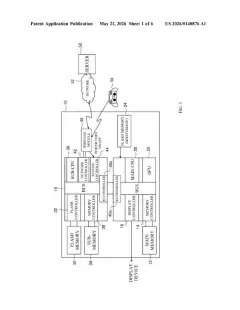
Sony Patents a Shared Logical Address System to Speed Up Console Boot Loading
Sony is patenting a way to make your console's secondary processor pre-load downloaded data in the background — using the exact same memory address layout that the main chip expects — so content can appear on screen before the console even finishes booting.
-
Apple · Published May 21
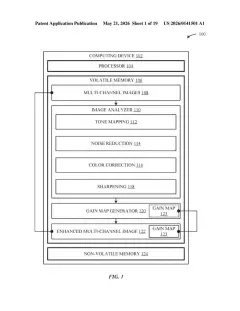
Apple Patents a Curve-Based Method for Generating HDR Gain Maps
Apple is filing patents around one of the quieter but genuinely tricky problems in modern photography: how do you let an HDR image display beautifully on both a dazzling Pro Display XDR and a five-year-old laptop screen at the same time? The answer is a gain map — and this patent is about generating one automatically.
-
Nvidia · Published May 21
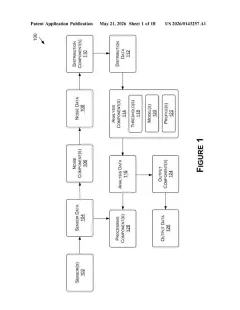
Nvidia Patents a System That Tracks Camera Aging Through Pixel Noise
Your camera might look fine from the outside, but its pixels are quietly getting noisier over time — and Nvidia wants to catch that before it causes a problem in an autonomous vehicle.
-
Samsung · Published May 21
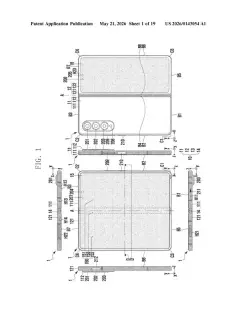
Samsung Patents a Wrapped FPCB Battery Connection for Foldable Phones
Getting a battery and a motherboard to talk to each other sounds trivial — until you're doing it inside a foldable phone where every fraction of a millimeter counts. Samsung's latest patent is all about a smarter way to route that connection.
-
Samsung · Published May 21
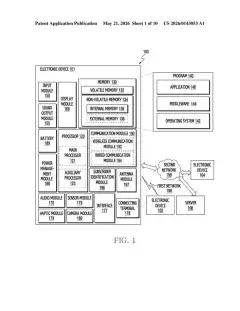
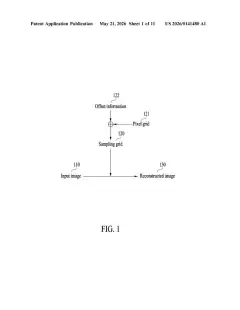
Samsung Patents a Sampling-Grid Method for Pixel-Level Image Reconstruction
Samsung is patenting a way to rebuild images pixel-by-pixel using a grid that already knows where each reconstructed pixel should land — a low-level but potentially powerful approach to image upscaling, correction, or super-resolution.
-
Samsung · Published May 21
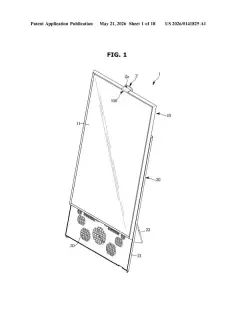
Samsung Patents a Clip-On Bracket That Mounts Your Phone Directly to a Monitor
Samsung is patenting a physical bracket that snaps onto the edge of a monitor frame and holds your phone in place — turning the display and the device into a single combined unit.
-
Samsung · Published May 21
Samsung Patents a Context-Aware Screen-Switching System for Tri-Fold Phones
Samsung is quietly figuring out one of the trickiest parts of tri-fold phones: what should happen to your screen when you partially — or fully — unfold the device? This patent lays out a specific answer.
-
Samsung · Published May 21
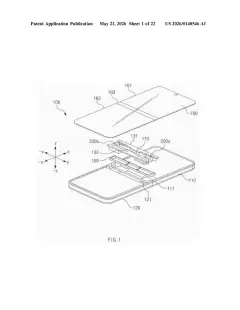
Samsung Patents a Multi-Rail Hinge System for Sturdier Foldable Phones
Foldable phones live and die by their hinges — and Samsung just filed a patent for a more mechanically controlled hinge design that uses a network of interlocking rails and spring-loaded support members to keep both sides of the display tracking together smoothly.
-
Samsung · Published May 21
Samsung Patents a Dual-Barrier Hinge System to Keep Foldables Dust-Free
Dust and debris sneaking into the hinge is one of the most common ways foldable phones fail early — and Samsung may have a mechanical fix that doesn't rely on software or materials science alone.
-
Samsung · Published May 21
Samsung Patents an Under-Display Fingerprint Sensor Built Into the Pixel Layer
Samsung's new patent tucks a capacitive fingerprint sensor directly into the same layer as the display's pixel electrodes — no separate sensor module needed, no extra thickness.
-
Samsung · Published May 21
Samsung Patents Real-Time App Status Overlays for Foldable Cover Displays
Samsung is filing patents to make the small cover screen on its foldable phones more useful — not just a clock, but a live window into whatever apps are running inside.
-
Samsung · Published May 21
Samsung Patents an Internal Acoustic Duct That Routes Speaker Sound Around Display Electronics
Getting loud, clear speaker audio out of a razor-thin smartphone is harder than it looks — especially when the display's driver circuitry is sitting right where the sound needs to go. Samsung's new patent solves that by building a dedicated acoustic tunnel inside the phone's frame itself.