
Adobe Patents an AI System That Rewrites Underperforming Website Copy on Its Own
What if your website could look at its own analytics, find the headline or button that isn't working, and rewrite it, without anyone opening a content editor? That's exactly what Adobe is patenting.
How Adobe's AI spots and rewrites weak website text
A marketing manager stares at a dashboard showing that the "Buy Now" button on the company's homepage has a terrible click rate. She knows something on the page is wrong, but figuring out what to change and then actually rewriting it takes hours of work across two different tools.
Adobe's new patent describes a system that handles that loop automatically. It watches how real visitors interact with your site, spots which buttons, headlines, or calls-to-action are underperforming, and then hands those pieces, along with the surrounding text for context, to an AI writing agent. The agent produces a rewritten version, and the new copy is shown to you for review before going live.
The key idea is that the AI isn't just guessing. It's using real visitor behavior to decide which elements to fix first, and it always rewrites them in context, so the new text fits naturally with the rest of the page.
… generating, by a prompt generation module, a prompt for an artificial intelligence (AI) agent, the prompt including the candidate content block and instructions to generate a content block variant comprising the candidate conversion element and a context information variant for the context information associated with the candidate conversion element; …
Translation: The system tells an AI to rewrite the weak text while keeping the original conversion goal intact.
How the system picks targets and builds AI prompts
The system works in four stages, each handled by a separate software module.
- Conversion detection: A machine learning model scans the page's code and labels specific elements, such as buttons, links, and headlines, as "conversion elements" (meaning they're meant to prompt the visitor to do something).
- Performance measurement: A metrics module pulls in real use monitoring (RUM) analytics, which is live data about how actual visitors are clicking, scrolling, and bouncing. Each conversion element gets a performance score.
- Target selection: Based on those scores, the system picks the weakest candidate element to work on first.
- Prompt assembly and AI rewrite: The system grabs not just that element but also the surrounding text (the "content block"), bundles it into a structured prompt, and sends it to a generative AI agent. The agent is told to keep the original conversion element intact but rewrite the surrounding copy. The revised block is then surfaced in a UI for human review or pushed directly back into the page.
The claim language specifies that the original conversion element must survive in the new version; only the context around it changes. That's an important design choice: the system is improving the presentation, not swapping out the core action.
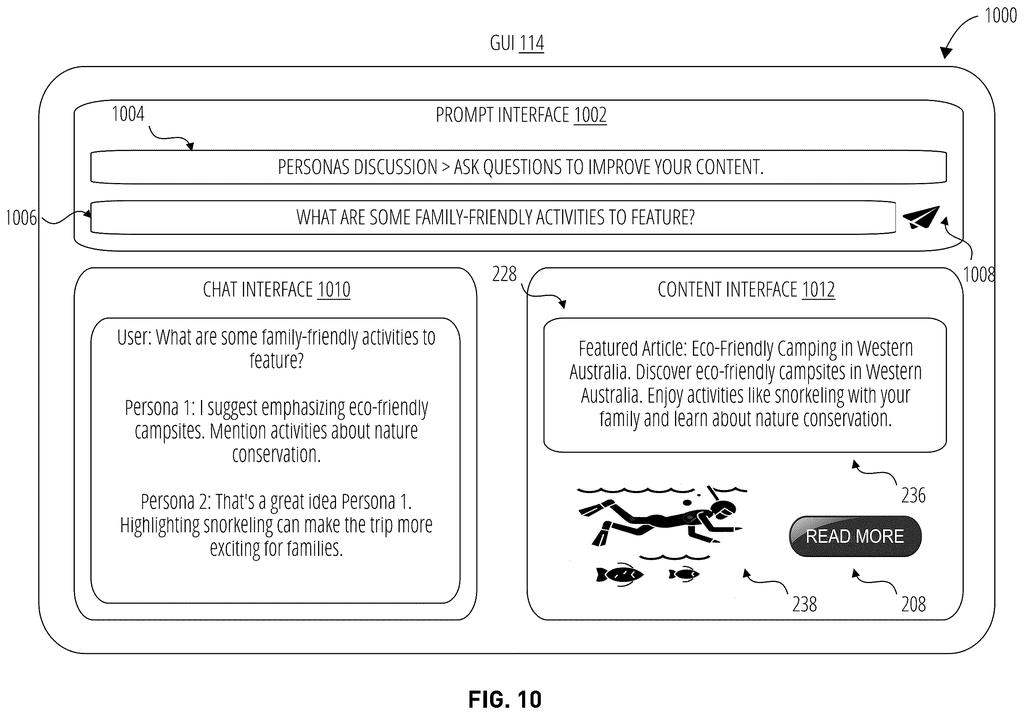
A content update module receives the content block variant from the GAI agent. The content update module presents the content block variant on a graphical user interface (GUI).
Translation: The updated text is sent back and shown on a screen for review or publishing.
What this means for web designers and marketers
For anyone running a website, the friction between "I know this page isn't working" and "I've fixed it" is real and slow. Tools that surface performance data and tools that edit copy have historically lived in separate apps, connected only by a human copying numbers from one screen and typing new words into another. This patent describes collapsing that loop into a single automated pipeline.
Adobe's run of AI-assisted content-editing filings suggests the company sees tools like this as a natural extension of products such as Experience Manager and Firefly. If this system ships inside those products, it could shift A/B testing from a deliberate experiment marketers schedule into something that happens continuously in the background.
Adobe's fourth filing we've tracked on our AI agents acting for you since August builds on earlier applications like plain-English job automation and a self-explaining assistant.
Claim 1 is broader than it first appears. It doesn't lock in a specific AI model, a specific website platform, or even a specific definition of "conversion element." Any system that detects elements via machine learning, scores them against live visitor data, and then uses any AI agent to produce a variant would fall inside this claim's perimeter.
That breadth has consequences. A startup building an AI copywriting tool that plugs into real-user analytics and suggests edits to underperforming page sections would be walking close to this claim, even if its product looks nothing like Adobe's. The claim covers the workflow, not the UI.
The weakest point is that the patent's core loop, measure, select, rewrite, is conceptually simple and has been discussed in the marketing-tech industry for years. Whether the patent office decides the specific combination here is inventive enough to grant is the real question. As written, though, the claim is sweeping enough to be taken seriously by anyone building in this space.
There are more where this came from
We read every patent application Big Tech publishes and send you the ones worth knowing. Plain English, free, every week.
The drawings
13 drawing sheets from US 2026/0278245 A1 · click any drawing to enlarge


Want this weekly breakdown for a company we don't cover? Patentlyze Pro →
Be the first to weigh in