
Adobe
Adobe · AI / ML · Filed Feb 25, 2025 · USPTO published Aug 27, 2026 · Aug 27 release
Adobe Patents an AI That Figures Out What You Actually Meant Before Searching Your Documents
Most AI search tools take your question at face value and hope for the best. Adobe's new patent describes a system that pauses to map out every plausible meaning of your question before it ever goes looking for an answer.
- Publication number
- US 2026/0252597 A1(US20260252597A1)
- Applicant
- ADOBE INC.
- Filed · Published
- Feb 25, 2025 · Aug 27, 2026
- Inventors
- Yeonjun In, Sungchul Kim, Ryan A. Rossi, Md Mehrab Tanjim, Tong Yu, Ritwik Sinha
- Status when we published
- Waiting for an examiner
- Document
- 20 claims
- US classification
- 707/736
- Examiner
- PYO, MONICA M (Art Unit 2161)
What Adobe's ambiguity-first document search actually does
Every time you ask a document search tool a question, the tool makes a quiet assumption: that it knows exactly what you meant. When the question is vague or could mean two different things, that assumption falls apart and you get an answer that technically fits the words but misses the point.
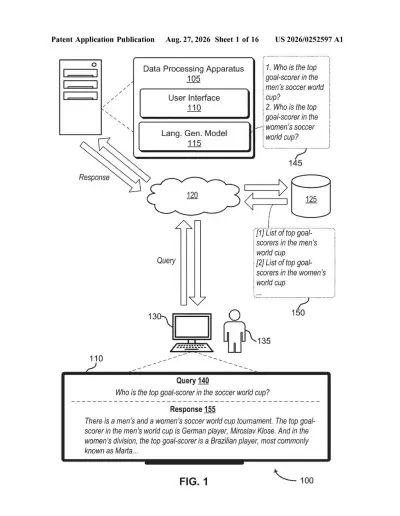
Adobe's patent describes a different approach. Before the AI searches your documents, it generates a short explanation of why your question is ambiguous. It then spins out several different interpretations of what you might have meant. It uses all of those interpretations to pull relevant passages from your documents, then assembles a single response that covers the actual range of what you were asking.
The practical upside: if you ask something like "What is our return policy?" and that phrase means different things for different product lines, the system finds passages covering each case rather than picking one at random. You get a more complete answer without having to ask the same question five different ways.
… generating, using a language generation model, an intermediate response based on a first input to the language generation model, wherein the intermediate response describes an ambiguity of the query …
Translation: The AI first checks your search terms to figure out what is unclear or missing.
How the model rewrites a vague query before retrieving text
The patent describes a three-stage pipeline, all driven by the same language generation model (an AI trained to read and write text).
- Stage 1, Ambiguity detection: The model receives your original query and produces an intermediate response that explicitly describes what is unclear about it. Think of this as the AI writing a note to itself: "This question could refer to X or Y."
- Stage 2, Interpretation generation: The model receives the original query plus that ambiguity note and generates several distinct restatements of the question, each capturing a different plausible meaning. These are the "first interpretations" the patent refers to.
- Stage 3, Retrieval and synthesis: Each interpretation is used independently to retrieve relevant text passages from the document set (a technique called retrieval-augmented generation, or RAG, which grounds AI answers in real source text rather than memory). All retrieved passages are then fed into a final model call that produces one consolidated answer.
The key architectural choice is keeping the ambiguity step explicit and intermediate: instead of bundling disambiguation silently into a single prompt, the system surfaces it as a named artifact that shapes every downstream step. That intermediate output is passed as a formal input to the next stage, making the reasoning chain inspectable rather than buried inside one black-box call.
… generating a plurality of first interpretations of the query, retrieving a plurality of text passages from the set of documents based on the plurality of first interpretations …
Translation: It then creates multiple possible meanings and searches your files using all of them.
What this means for AI tools that search company documents
For anyone who uses AI tools to search through long contracts, policy manuals, research archives, or customer records, query ambiguity is the main reason answers go wrong. A system that deliberately maps the ambiguity before searching is more likely to surface the passages that cover the full scope of what was asked, and less likely to confidently return the wrong thing.
Adobe already sells document and content management products where this kind of search matters directly. The patent fits a broader wave of enterprise AI filings aimed at making document question-answering reliable enough to trust in a professional setting. Patentlyze's plain-English patent summaries track that wave across major tech companies as they work out what "accurate AI search" actually requires at the engineering level.
That makes this Adobe's 13th filing we've tracked in AI vision since May, a count that includes one on themed design from text and one on multi-level object cutouts.
Source: US 2026/0252597 A1 at the USPTO (PDF). Full patent text and figures are in the official publication.
Get our take in your Top Stories
Liked this breakdown? Add Patentlyze as a preferred source on Google, and our plain-English take shows up more often in your Top Stories the next time Adobe patent news breaks.
Add Patentlyze on Google
One click.
There are more where this came from
We read the new patents from Big Tech, carmakers and more and send you the ones worth knowing. Plain English, free, every week.
The drawings · 16 sheets
16 drawing sheets from US 2026/0252597 A1 · click any drawing to enlarge


Show the other 8 sheets


More from Adobe
All 270 Adobe patents →
More in AI vision
All 352 AI vision patents →
Google
Google Patent: Robots Obeying Open-Ended Object Commands Without Hardcoded Vocabulary Lists
IBM
IBM Patents Software That Reads Crowd Movement to Stop Arena Dangers Early
Google
Google Patent Teaches AI to Recognize Objects in Images Without Human Labels
Microsoft