
Google Patent Teaches AI to Recognize Objects in Images Without Human Labels
Most AI models see an image as a blob of pixels. Google's new patent describes a system that automatically carves a scene into separate objects, each tracked by its own memory slot, without anyone labeling the objects first.
How Google's slot attention actually separates objects
Imagine you hand a photo of a kitchen to an AI assistant and ask it to count the apples. Today, most AI systems would struggle unless they were trained on thousands of labeled kitchen photos where every apple was already circled and named. That's slow, expensive, and brittle when objects look even a little different.
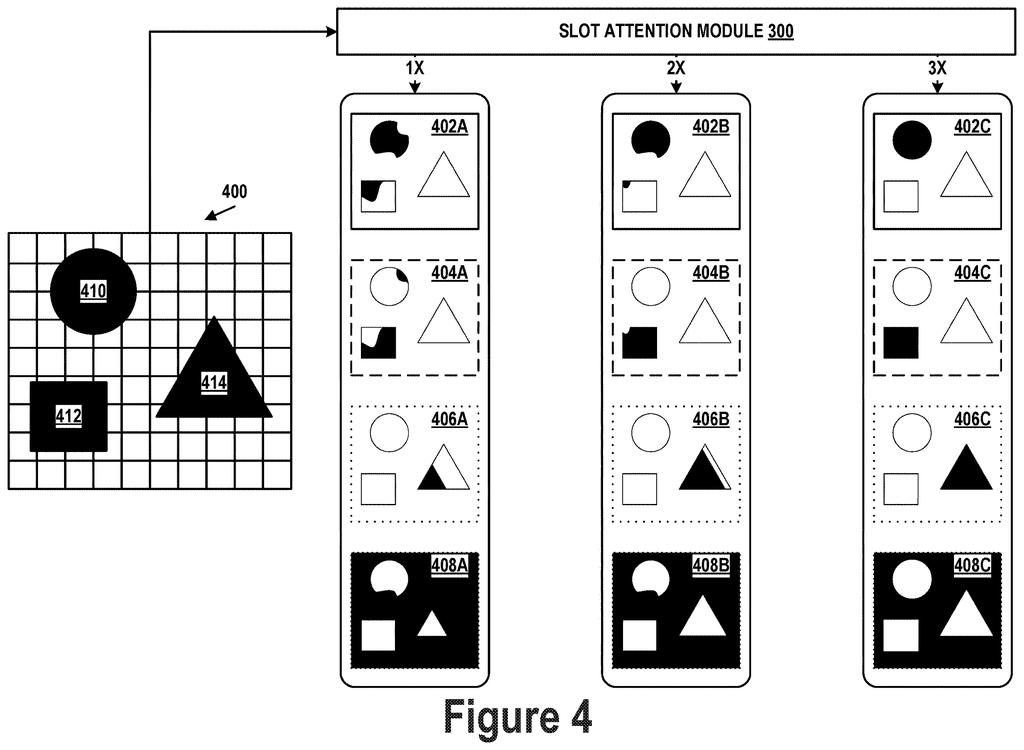
Google's patent proposes a different approach. Instead of teaching the AI what every object looks like in advance, the system sets up a fixed number of empty memory buckets, called slots, and then runs a competition. Each slot tries to claim the parts of the image that look most like a single, coherent thing. By the end of the process, each slot ideally holds one object and knows where it is.
The result is an AI that can break a scene into its parts on its own, without a human annotator marking every object. That has big potential for tasks like robotic vision, video understanding, and any situation where you want an AI to reason about what is in a scene, not just describe the whole picture as one unit.
… determining, using the ML model, an attention matrix based on the plurality of feature vectors and the plurality of slot vectors, wherein the attention matrix comprises N vectors corresponding to a first dimension of the attention matrix …
Translation: The system calculates relationships between image features and object slots using a mathematical grid.
How the attention matrix pins each slot to one object
The patent describes a technique called slot attention, a mechanism for getting a neural network to decompose an input (like an image or video frame) into a set of structured representations, one per object.
Here is how the process unfolds step by step:
- Feature extraction: The input image is first converted into a grid of feature vectors, each one describing a small patch of the image in numerical terms.
- Slot initialization: The model sets up K slots, essentially K blank memory units that will each learn to represent one entity.
- Attention competition: The model computes an attention matrix by comparing every feature patch against every slot. The comparison uses learned functions called key, query, and value transforms (borrowed from the Transformer architecture that powers large language models). Crucially, the normalization is done across slots for each patch, not across patches for each slot. That means patches must compete to belong to slots, which pushes different slots to specialize on different parts of the image.
- Slot update: Each slot's memory is updated based on which patches it won in the competition, using a recurrent neural network memory unit to fold in the new information over multiple rounds.
The process iterates, with slots progressively sharpening their focus until each one converges on a distinct object or region. Tasks like counting, tracking, or spatial reasoning can then be performed directly on the slot representations rather than on raw pixels.
… determining an attention matrix based on a product of the plurality of feature vectors transformed by a key function and the plurality of slot vectors transformed by a query function …
Translation: The model compares transformed image data against memory slots to find matches.
What this means for AI that understands scenes, not just pixels
The hardest thing about teaching AI to understand physical scenes is getting it to recognize that a scene has parts. Current approaches either require massive amounts of labeled training data (someone circling every object in every photo) or they treat the whole scene as one undivided pattern. Both options are costly or limited. A model that figures out object boundaries on its own could reduce the labeling burden for robotics, autonomous vehicles, and medical imaging systems, where annotating data is especially time-consuming.
For Google, this connects directly to its work on vision models and AI assistants that need to reason about the physical world, not just classify images. The normalization trick at the heart of slot attention is a specific and non-obvious design choice that gives the method its teeth, and it's the kind of low-level architectural idea that could surface in many downstream products. Big Tech patent news covering AI perception and scene-understanding is tracking a cluster of similar structural-AI filings right now, and Google's slot attention approach is one of the more clearly specified entries in that space.
That makes this Google's 29th filing in the AI vision work we've tracked since May, joining one that rebuilds camera angles and one on named entity search.
Labeling images for AI training is grinding, expensive work. Someone has to look at every photo and draw boundaries around every object in it, and that human effort costs the industry billions of dollars a year before a single useful system ships. This patent attacks that cost directly by teaching a network to figure out on its own which parts of an image belong to which object.
The approach uses a mathematical competition among the network's internal memory slots, so each slot claims one coherent region rather than all of them blending together. The match between problem and solution feels proportionate.
Reducing dependence on hand-labeled data would make visual AI cheaper to build and far easier to deploy in new situations, and Google operating at the scale it does means even a partial reduction in that labeling burden adds up to something significant.
Get our take in your Top Stories
Liked this breakdown? Add Patentlyze as a preferred source on Google, and our plain-English take shows up more often in your Top Stories the next time Google patent news breaks.
There are more where this came from
We read every patent application Big Tech publishes and send you the ones worth knowing. Plain English, free, every week.
The drawings
7 drawing sheets from US 2026/0252870 A1 · click any drawing to enlarge


Want this weekly breakdown for a company we don't cover? Patentlyze Pro →
Be the first to weigh in