
Adobe Patents an AI That Cuts Out Photo Objects at Multiple Detail Levels at Once
Click once on a car in a photo and Adobe's system could instantly offer you the whole car, just the door, or just the door handle, all at the same time, without clicking again.
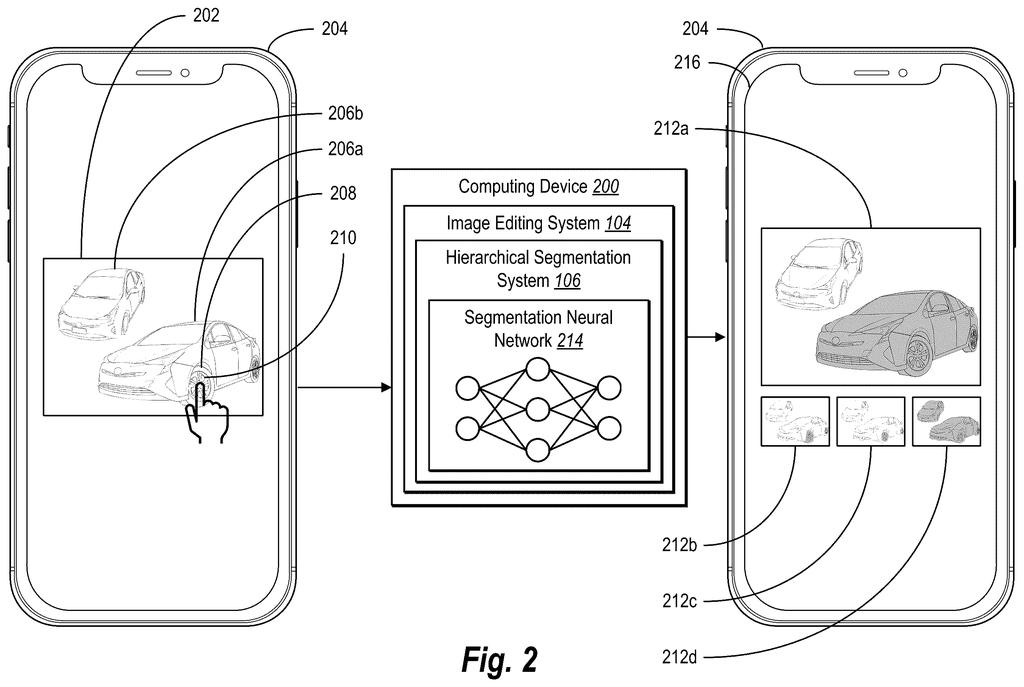
What Adobe's layered object-selection AI actually does
Ever tried to select just the right piece of an object in a photo editor, only to keep clicking until you got it? Most selection tools force you to commit: you either grab the whole thing or you painstakingly trace a smaller part.
Adobe's new patent describes an AI that, when you click on an object in an image, figures out the selection at multiple levels of detail simultaneously. Click on a jacket and the system can hand you a selection of the entire jacket and just the sleeve, in one pass. You pick which level of detail fits what you need.
The idea is to stop forcing you to re-click or adjust slider settings just to move between a broad and a tight selection. The AI does the hierarchy work behind the scenes, so your workflow moves faster and with fewer frustrated undos.
… determining, using a segmentation neural network and based on the user input, a parent token corresponding to a first semantic level for the object and a child token corresponding to a second semantic level for the object that is hierarchically lower than the first semantic level …
Translation: The AI identifies the object at different levels of detail, such as selecting a whole person and then just their hand.
How the neural network builds parent and child mask tokens
The system takes a digital image and a user's click (or set of clicks) on a pixel inside an object. A segmentation neural network (an AI trained to identify and outline distinct regions of an image) then produces two kinds of internal representations called tokens: a "parent token" tied to a broader semantic level (say, the whole bicycle) and a "child token" tied to a narrower semantic level that sits below it in the hierarchy (say, just the front wheel).
- Parent token: encodes what the object is at a coarser, wider level of meaning
- Child token: encodes a more granular sub-part, hierarchically nested under the parent
From those tokens, the same neural network generates two separate masks (pixel-level outlines that mark which parts of the image belong to the selection). The first mask corresponds to the parent level; the second to the child level. Both can be displayed to the user at once, letting the person choose which outline to apply.
The key engineering point is that the network is conditioned (trained to respond) on varying semantic levels, meaning it learns to distinguish "whole object" from "part of object" during training rather than running two completely separate models. That single-network approach is what makes generating both masks in one pass feasible.
The present disclosure relates to systems, methods, and non-transitory computer-readable media that generate a hierarchy of masks for a selected object within a digital image.
Translation: Adobe is patenting a way for software to create a layered set of cutouts for any object you click on in a photo.
What this means for designers doing precise photo cutouts
For anyone who edits photos professionally, the most time-consuming part of compositing work is often the selection itself. Cutting a model away from a background is one task; isolating just their collar for a color change is another. Today those are separate operations requiring separate tools, separate clicks, and a lot of patience.
Adobe already ships AI-powered selection tools in Photoshop and Firefly, and this patent points toward a future where a single click hands you a stack of ready-made selections at different granularities. Image editing is one of the more active areas among interesting tech patents right now, and Adobe's hierarchical approach suggests the company is trying to collapse what used to be a multi-step workflow into a single decision point for the user.
Anyone who touches image editing software professionally knows this tedium: selecting the right level of an object without redoing the work, day after day, with the time cost across a studio adding up fast. Adobe's answer, training one network to output a ready hierarchy of masks rather than making users iterate through tools, is appropriately sized to the frustration. The approach is architecturally tidy, and it addresses a friction point that competing selection tools have mostly left unresolved.
There are more where this came from
We read every patent application Big Tech publishes and send you the ones worth knowing. Plain English, free, every week.
The drawings
12 drawing sheets from US 2026/0237206 A1 · click any drawing to enlarge


Want this weekly breakdown for a company we don't cover? Patentlyze Pro →
Be the first to weigh in