
Adobe Patent Targets Font Identification for Typefaces Outside Its Training Data
You snap a photo of a poster, and Adobe's tools instantly tell you which font it uses, even if that font was never part of the AI's original training data. That's the core idea behind this new Adobe patent.
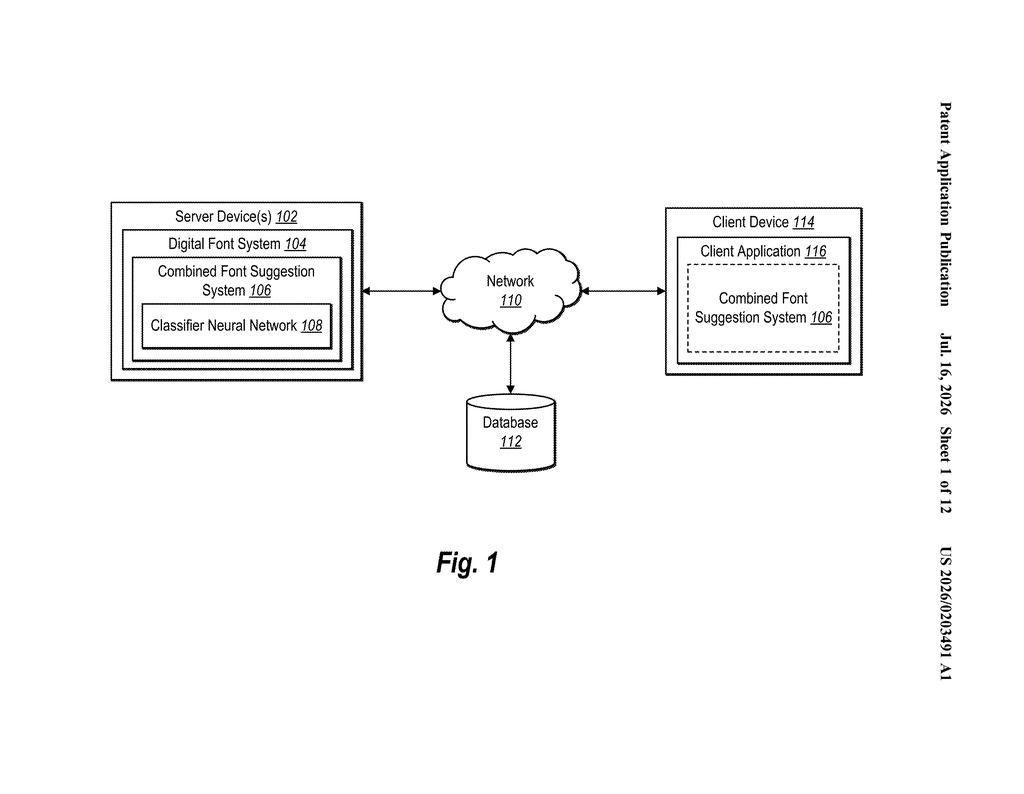
How Adobe's font-matching AI handles unknown typefaces
Imagine you spot a beautiful typeface on a restaurant menu or a billboard and you want to use it in your own design. Finding out what font it is has always been a bit of a guessing game, even with existing font-recognition tools.
Adobe's new patent describes an AI system that looks at the text in an image, builds a kind of fingerprint of its visual style, and then compares that fingerprint against fonts, including fonts the AI was never trained on. It does this by generating similar fingerprints for those newer, unknown fonts using sample characters, then measuring how closely they match.
The result is a ranked list of suggested fonts that look most like the one in your image. The clever part is that the system doesn't need to be retrained every time a new font enters the library. It can evaluate fresh additions on the fly, which keeps the tool useful as font collections grow.
How the classifier maps image text to new font embeddings
The system uses a classifier neural network (an AI model trained to recognize patterns in images) that was originally trained on a fixed set of known fonts. When you give it an image containing text, it converts the appearance of that text into an embedding vector (a long list of numbers that encodes the visual style of the letters).
The interesting engineering challenge is what happens with fonts the AI has never seen. Instead of retraining the whole model, the system runs those new fonts through the same neural network using stylized glyphs (sample characters rendered in each font). That process produces a matching embedding vector for each candidate font.
The system then calculates similarity scores comparing the image's embedding vector to each font's embedding vector. Fonts whose numbers land closest to the image's numbers get surfaced as recommendations in the interface.
- Step 1: Extract a visual fingerprint from text in the uploaded image
- Step 2: Generate matching fingerprints for candidate fonts using sample characters
- Step 3: Rank candidates by how closely their fingerprint matches the image's
- Step 4: Display the top matches to the user
What this means for designers working with mystery fonts
For designers, the practical value is obvious: font identification tools typically only recognize typefaces baked into their training data. Every time a new font is released, older systems either ignore it or require a costly retraining cycle. Adobe's approach sidesteps that by treating font matching as a comparison problem rather than a classification problem, meaning new fonts can be added to the searchable library without touching the underlying AI.
For Adobe specifically, this could reinforce the value of its Adobe Fonts subscription by making the library feel more discoverable. If you can photograph almost any text in the wild and get a match from Adobe's catalog, that's a strong reason to stay inside the Adobe ecosystem for your type needs.
This is genuinely useful applied AI work, not a research demo. The ability to match against fonts the model was never trained on is the kind of practical engineering that actually makes design software better day-to-day. It's not flashy, but it solves a real problem designers complain about, and the architecture is clean enough that it could scale well as font libraries keep growing.
There are more where this came from
We read every patent application Big Tech publishes and send you the ones worth knowing. Plain English, free, every week.
Want this weekly breakdown for a company we don't cover? Patentlyze Pro →
Be the first to weigh in