
Amazon
Amazon · AI / ML · Filed Mar 31, 2025 · USPTO published Oct 1, 2026 · Oct 1 release
Amazon Patents a Filter That Screens AI Inputs and Outputs for Dangerous Content
Amazon has filed a patent for a two-way checkpoint system that scans what users send to an AI model and what the AI sends back, blocking anything that looks like a known bad actor or a harmful output before it ever reaches its destination.
- Publication number
- US 2026/0300066 A1(US20260300066A1)
- Applicant
- Amazon Technologies, Inc.
- Filed · Published
- Mar 31, 2025 · Oct 1, 2026
- Inventors
- Naveen Konrajankuppam Mahavishnu, Narayanaswami Natraj Bharadwaj, Nishith Sinha, Vivek Bhadauria
- Status when we published
- Waiting for an examiner
- Document
- 20 claims
- US classification
- 706/18
What Amazon's AI content screening system actually does
You're a company that has built an AI assistant for your customers. One day, someone figures out how to feed it trick questions that make it say something dangerous, or the model starts spitting out sensitive information it shouldn't. By the time you find out, the damage is done.
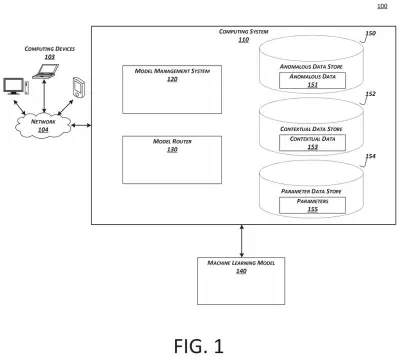
Amazon's patent describes a guardrail system that sits between the user and the AI, acting like a bouncer at both the door and the exit. Every time someone sends a request to an AI model, the system converts that request into a kind of mathematical fingerprint and checks it against a library of fingerprints from known-bad inputs. If there's a suspicious match, the request gets blocked, redirected, or cleaned up before it ever touches the AI.
The same check happens on the way out. The AI's reply gets its own fingerprint and goes through the same comparison. If the output looks too similar to something that's caused problems before, it gets caught there too. The system can drop it entirely, send it somewhere for review, or strip out the offending parts.
… determine a manner of processing the first input based on comparing the first vector embedding and the one or more vector embeddings, wherein the manner of processing the first input indicates to drop the first input, route the first input to a first destination, or filter the first input …
Translation: The system decides whether to block, redirect, or clean a user prompt after checking it against known threats.
How the vector search catches bad prompts and bad replies
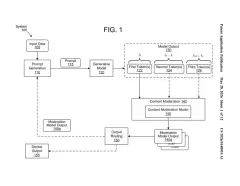
The patent describes a pipeline that wraps around any machine learning model and performs anomaly screening at two points: the input (the user's prompt) and the output (the model's reply).
The core mechanism relies on vector embeddings (a technique where text or other data is converted into a long list of numbers that captures its meaning). When a user sends a request, the system runs it through an embedding model to produce that numerical fingerprint. It then performs a vector search (essentially asking "how close is this fingerprint to any fingerprint in our database of problematic examples?") against a stored library of embeddings from previously flagged, anomalous inputs and outputs.
Based on how close the match is, the system picks one of three responses:
- Drop the input entirely and return nothing
- Route it to a different destination (a human reviewer, a fallback system, or a logging service)
- Filter it by modifying the content before passing it on
If the input passes the first check, it reaches the AI model. The model's reply then goes through the same embedding and comparison process before being returned to the user. This means a prompt that slips through could still be caught if the model's answer looks like a known-bad output.
Systems and methods are provided to detect anomalous data obtained from and/or to be routed to a machine learning model.
Translation: The patent describes technology designed to catch unusual or dangerous data entering or leaving an AI model.
What this means for businesses running AI in production
For any company deploying an AI model to real users, "jailbreaks" (trick prompts that make AI systems bypass their safety rules) and harmful outputs are a genuine operational risk. Right now, many safety filters rely on keyword matching or static rule lists, which attackers learn to dodge. A system that compares the meaning of a request against a library of past problems, rather than just looking for banned words, is harder to trick with creative rephrasing.
The two-way design is the part worth noting. Catching a bad output even after a seemingly normal input reaches the model adds a second line of defense. For businesses in regulated industries (healthcare, finance, legal) where an AI giving the wrong answer carries real liability, that kind of belt-and-suspenders approach has obvious appeal. Amazon keeps filing on AI safety and model deployment infrastructure, and this fits squarely in that pattern.
Amazon's ninth filing since July in our AI guardrails work watchlist builds on earlier applications, including one blocking unauthorized data access and one limiting word-for-word copying.
Source: US 2026/0300066 A1 at the USPTO (PDF). Full patent text and figures are in the official publication.
Get our take in your Top Stories
Liked this breakdown? Add Patentlyze as a preferred source on Google, and our plain-English take shows up more often in your Top Stories the next time Amazon patent news breaks.
Add Patentlyze on Google
One click.
There are more where this came from
We read the new patents from Big Tech, carmakers and more and send you the ones worth knowing. Plain English, free, every week.
The drawings · 9 sheets
9 drawing sheets from US 2026/0300066 A1 · click any drawing to enlarge


Show sheet 9

More from Amazon
All 114 Amazon patents →
More in AI safety
All 60 AI safety patents →
Google
Google Patents a Lightweight Filter That Catches Harmful AI Responses Faster
IBM
IBM Patents an AI That Grades Its Own Decisions and Learns From Them
IBM
IBM Patents a System That Keeps Its Own AI Guardrails Sharp Using Live Data
IBM
No comments yet