
Google Patents an AI Model That Skips Processing Steps It Doesn't Need
Most AI models process every piece of input the same way, even when most of it is straightforward. Google's new patent describes a system that learns to skip the expensive steps when they aren't needed, making the same model faster without shrinking it.
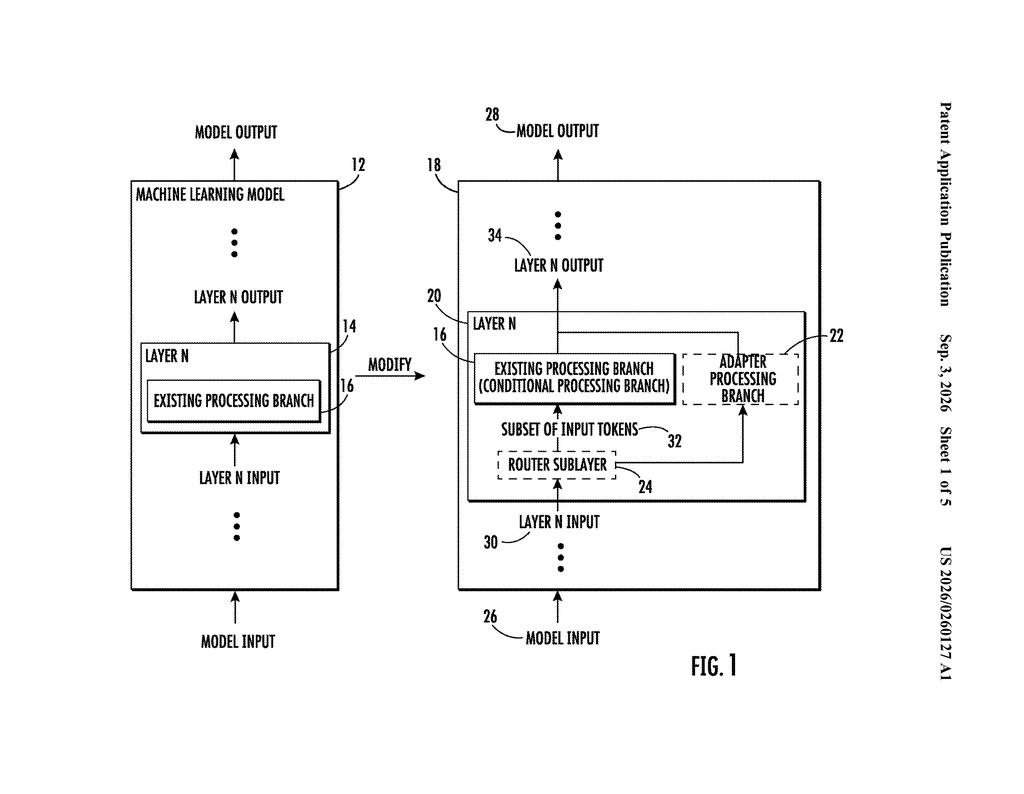
What Google's conditional adapter AI actually does
Ever tried to figure out why your phone's voice assistant sometimes answers instantly and other times takes a beat to think? Part of the answer is that AI models tend to treat every word in a sentence as equally complicated, even when most words are totally routine.
Google's new patent describes a model design that fixes this. Inside the AI, a small decision-making layer called a router looks at each word (or token) coming in and decides: does this one actually need the full, expensive treatment, or can it sail through a simpler path? Only the tokens that need deep analysis get routed to the more intensive processing branch. Everything else takes the faster lane.
The practical upside is that you get a model that behaves as if it were carefully fine-tuned for a specific job, but runs closer to the speed of a general-purpose one. Google's ongoing push to make large AI models cheaper to run shows up in several filings, and this is one of the more concrete proposals in that space.
… select a subset of the plurality of input tokens for processing with the conditional processing branch based on the plurality of routing values …
Translation: The system picks only the most important pieces of data to run through extra processing steps.
How the router picks which tokens get extra processing
The patent describes what Google calls a Conditional Adapter (CODA) model. The core idea is to take a large pre-trained AI model and add lightweight processing branches called adapters that handle task-specific work, while leaving most of the original model untouched. That part (adapters for transfer learning) is already common practice in the AI field.
What makes this different is the router sublayer. In most adapter setups, every input token passes through the adapter branch every time. Here, the router learns, during training, which tokens are worth routing to the adapter and which are not. It generates a routing value for each token and only sends a selected subset through the more expensive conditional processing branch.
The architecture looks like this for each layer:
- A conditional processing branch that handles the tokens needing deeper, task-specific analysis
- An adapter processing branch running in parallel that handles the rest
- A router sublayer with learned parameters that decides which token goes where
Because fewer tokens go through the heavy branch on any given pass, the model does less total computation per inference step (each time it generates an answer). The routing weights are baked in at training time, so there is no extra decision-making overhead at runtime.
Provided is a parameter-efficient transfer learning method that gains both parameter and inference efficiency.
Translation: The approach makes artificial intelligence models run faster while using less computer power.
What faster AI inference means for Google's products
For end users, faster AI inference means shorter wait times, lower cloud costs, and the ability to run capable models on devices with less processing power. If Google applies this to something like Gemini or its search-summarization features, you might notice responses arriving a bit more quickly without any visible change in quality.
For the industry, the more significant angle is efficiency at scale. Running large AI models costs enormous amounts of money and energy. A technique that reduces the per-token compute load without retraining from scratch is the kind of engineering improvement that compounds across millions of daily queries. Whether this specific design makes it into a shipping product depends on how well it holds up against competing approaches already in use at Google.
That makes this Google's 36th filing we've tracked in Enterprise AI since May, a group that includes work on checking AI code before it runs and predicting future video frames.
The core idea here is a software change layered on top of models that already exist, which means Google's engineers could test it without buying new hardware or rebuilding anything from scratch. That is a meaningfully short path to a real product.
The main risk is the routing step, where the system decides moment-to-moment how much thinking a given piece of text actually needs. A router that guesses wrong consistently could make responses slower or worse, and that kind of problem tends to hide until something is running in front of real users at scale.
Twelve named inventors and a specific, detailed mechanism suggest this came from active engineering work rather than a precautionary legal filing. Whether it outperforms whatever Google is already running internally is the only threshold that determines if users ever see it.
Get our take in your Top Stories
Liked this breakdown? Add Patentlyze as a preferred source on Google, and our plain-English take shows up more often in your Top Stories the next time Google patent news breaks.
There are more where this came from
We read every patent application Big Tech publishes and send you the ones worth knowing. Plain English, free, every week.
The drawings
5 drawing sheets from US 2026/0260127 A1 · click any drawing to enlarge


Want this weekly breakdown for a company we don't cover? Patentlyze Pro →
Be the first to weigh in