
AMD Patents a Faster Method for Wrapping 3D Objects to Improve Realistic Lighting
Ray tracing makes games and 3D graphics look stunning, but it's expensive to compute. AMD thinks it found a shortcut that cuts one of the most tedious parts of that math down to almost nothing.
How AMD speeds up realistic lighting in 3D scenes
You're playing a game where sunlight streams through a window, casting sharp shadows across the floor. Your GPU is doing millions of tiny collision checks every second, figuring out which virtual rays of light hit which objects. The more precisely it can rule out objects a ray won't hit, the faster and cheaper the whole process gets.
That's where bounding boxes come in. Think of them as invisible gift-wrapping around every object in the scene. A ray checks the box first; if it misses the box, it skips the object entirely. The trouble is, standard boxes line up with the world's axes (up, sideways, forward), which means a tilted sword or a diagonal wall gets wrapped in a box that's too big and too boxy, causing lots of false alarms.
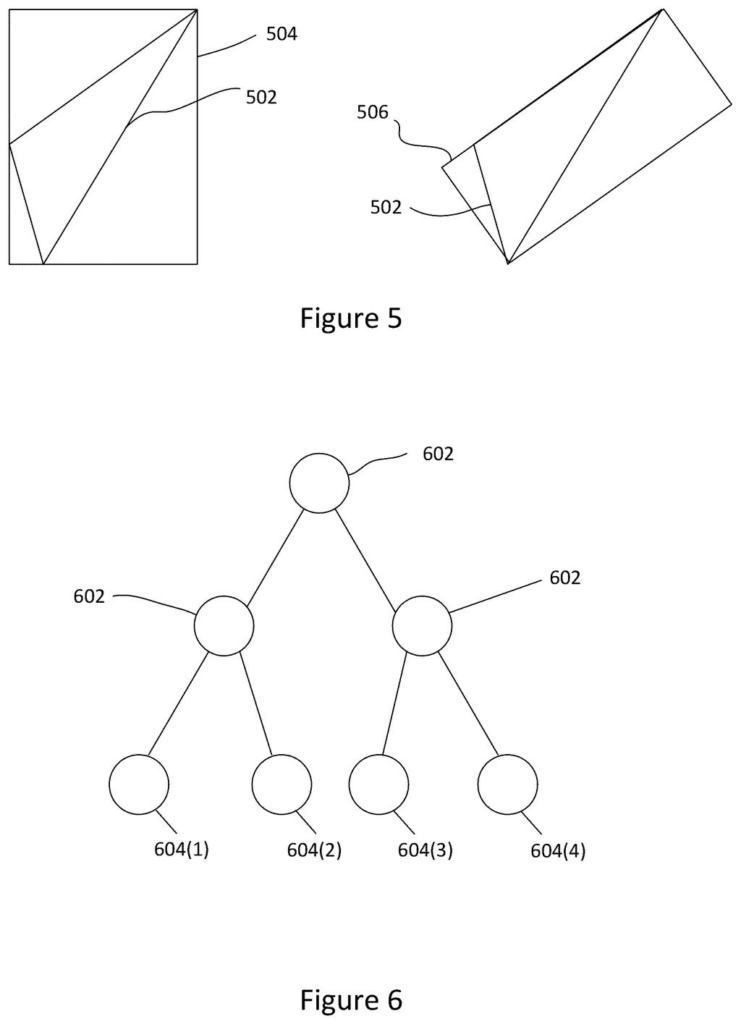
AMD's patent describes a smarter wrapping method where each box can tilt to fit its object more tightly. The twist is how AMD figures out which way to tilt each box: instead of doing expensive math to find the perfect angle, the system just borrows the angle from one of the object's sub-parts and moves on. It's not perfect, but it's fast.
Rather than attempting to find the child with the “best” orientation, or finding an orientation that accounts for the orientation of each child, the BVH builder considers the orientation of only one child, which is computationally cheaper.
Translation: Instead of finding the ideal angle, the system simply copies one child to save processing time.
How the BVH builder picks an orientation in one step
Ray tracing works by sending virtual rays from a camera into a 3D scene and checking what they hit. To avoid checking every single triangle in every single object, renderers organize geometry into a tree-like structure called a bounding volume hierarchy (BVH). Each branch of the tree wraps a group of objects in a bounding box; if a ray misses the outer box, the whole branch is skipped.
Standard boxes are axis-aligned, meaning their edges run perfectly horizontal and vertical regardless of what's inside them. An angled object ends up inside a box that's much bigger than the object itself, which causes false positive hits (the ray hits the box but then misses the actual geometry inside, wasting time). Oriented bounding boxes (OBBs) solve this by rotating the box to better hug the object's actual shape, dramatically reducing those wasted checks.
The catch is that choosing the right rotation for each box in the hierarchy is normally expensive. You'd have to evaluate every child node's geometry and find an angle that best represents all of them together. AMD's patent skips that entirely:
- The builder looks at a node's children.
- It picks just one child and copies that child's orientation up to the parent node.
- No averaging, no comparison, no optimization pass across multiple children.
This is a deliberate trade-off. The resulting orientation isn't mathematically optimal, but it's good enough to cut false positives compared to axis-aligned boxes, and it costs far less compute time to generate.
What this means for GPU ray tracing performance
False positive hits in a BVH are a hidden tax every ray-traced frame pays. A ray that checks a box, passes the box test, then misses the actual geometry inside has burned GPU cycles for nothing, and modern scenes contain millions of such checks per frame. Tighter boxes mean fewer wasted checks, which translates directly to faster frame rates or better image quality at the same speed.
The engineering challenge has always been that making those boxes tighter costs time up front, when the BVH is being built. AMD's approach bets that a fast, approximate orientation is better than a slow, perfect one. For GPU vendors competing on real-time ray tracing performance, any reduction in BVH build time that doesn't hurt render quality is worth filing on. Whether this ends up in a driver update or a future RDNA architecture is unclear, but the pattern in AMD's graphics-architecture filings points toward making ray tracing cheaper at every layer of the pipeline.
That makes this AMD's 11th filing we've tracked in our GPU rendering race watchlist since June, following earlier applications like one on task scheduling and one on power safety buffers.
False positives in ray tracing are a hidden tax on every frame a GPU renders. When the system incorrectly decides a ray might hit an object and wastes time checking, that error compounds across millions of rays per second eroding the visual quality and speed that modern games promise.
The approach here matches the scale of the problem well. AMD sidesteps an expensive calculation by simply borrowing a child box's orientation for the parent, trading theoretical perfection for real-world speed. That tradeoff is exactly right when the alternative is slowing down every frame to compute a cleaner answer.
Accumulated across driver updates and hardware generations, small wins like this are what separate smooth gameplay from stuttering. Users never see the math, but they feel the result.
There are more where this came from
We read every patent application Big Tech publishes and send you the ones worth knowing. Plain English, free, every week.
The drawings
7 drawing sheets from US 2026/0278913 A1 · click any drawing to enlarge


Want this weekly breakdown for a company we don't cover? Patentlyze Pro →
Be the first to weigh in