
AMD Patents a Way to Stop Fast Graphics Tasks From Waiting on Slow Ones
When a GPU renders realistic lighting, some scene-building jobs finish fast and some take forever. AMD has patented a system that stops the quick jobs from being stuck waiting at the same checkpoint as the slow ones.
How AMD's ray tracing fix cuts idle time in games
Every time a game draws a ray-traced scene, your graphics card has to build a kind of invisible 3D map of all the objects in view. This map lets the card figure out where light rays hit, bounce, or pass through. Building those maps takes work, and the time each one takes can vary a lot depending on how complex the object is.
The problem is that GPUs typically batch these jobs together and then make every job wait at a checkpoint before moving on. If one map takes ten times longer to build than another, everything else still has to wait at that shared checkpoint. AMD's patent describes a fix: sort the jobs by how long they are estimated to take, group similar-length jobs together, and only make jobs within the same group wait on each other.
The result is that fast jobs can clear their checkpoint and keep going without sitting idle while the slow jobs catch up. Less waiting means the GPU is doing useful work more of the time, which could translate to smoother, faster rendering in games that use ray tracing.
Due to the barriers, slower BVH builds can cause delays in BVH builds that would otherwise complete more quickly.
Translation: Slow tasks hold up fast ones because everything has to wait at checkpoints.
How the driver sorts and bins BVH build jobs
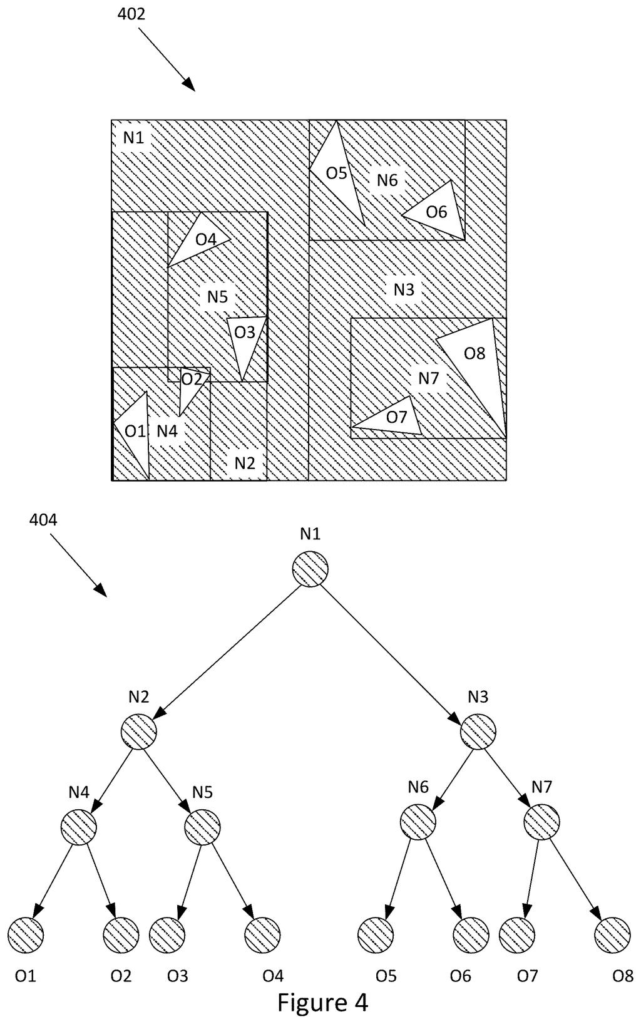
Ray tracing relies on a data structure called a bounding volume hierarchy (BVH), essentially a nested set of boxes that wraps every object in a scene. Before the GPU can trace a single ray, it has to build this structure. In complex scenes, the GPU builds many BVHs in parallel.
The conventional approach batches all those build operations together and separates phases of work with synchronization barriers (mandatory pause points where every thread must finish its current step before any thread can start the next one). Because BVH build times vary widely depending on geometry complexity, a single slow build holds up every other build waiting at the barrier.
AMD's patent describes a driver-level sorting step: before any work is queued, build requests are sorted into bins based on a criterion that predicts how long each one will take. The claim is intentionally broad here, covering any sorting criterion that acts as a proxy for execution time, so it could be mesh triangle count, object size, or something else entirely.
- Each bin gets its own work queue with its own barriers.
- Barriers only block jobs within the same bin.
- Fast-bin jobs complete and move on independently of slow-bin jobs.
The net effect is that synchronization overhead scales with estimated job similarity rather than with the slowest job in the whole batch.
What this means for ray tracing performance on AMD GPUs
Ray tracing is one of the most demanding things a modern GPU does, and stutters during scene transitions or complex lighting changes are a known pain point. A fix that reduces how long fast jobs sit idle at barriers could make a real difference in frame pacing, the consistency of how quickly frames arrive, which many players notice as smoothness more than they notice raw frame rate.
AMD keeps filing around GPU scheduling and workload efficiency, and this patent fits that pattern. The mechanism lives in the driver, which means it could theoretically be deployed as a software update rather than requiring new hardware. Whether AMD ships something like this in a driver release is a separate question from what the patent covers, but the approach is practical enough to be plausible.
This is the tenth AMD filing we've tracked since June in our GPU rendering race watchlist, following work like a chip power safety buffer and blocking video on weak displays.
The core claim here covers any software that sorts graphics-rendering jobs into groups based on any sorting criterion, assigns work and synchronization checkpoints per group, and sends those groups to a processor for execution. The claim does not specify what the sorting criterion must be, how many groups are required, or what chip runs the jobs. That is a wide net.
In practice, that breadth means the patent, if granted, could block a broad range of scheduling approaches that group parallel rendering tasks before setting synchronization points, as long as the grouping step happens in driver software and feeds into a queue-based execution model. Any system fitting that general shape would need to design around it or license it.
The fix described lives entirely in software, which matters for consumers: AMD could ship the benefit through a driver update to cards already in people's hands, with no new hardware required.
There are more where this came from
We read every patent application Big Tech publishes and send you the ones worth knowing. Plain English, free, every week.
The drawings
8 drawing sheets from US 2026/0278927 A1 · click any drawing to enlarge


Want this weekly breakdown for a company we don't cover? Patentlyze Pro →
Be the first to weigh in