
Apple Patents a Context-Aware AR Filter That Manages Notification Overload
Imagine your AR glasses deciding, on their own, that you're in the middle of a sprint interval — and silencing every floating notification until you cool down. That's the core idea in this Apple patent.
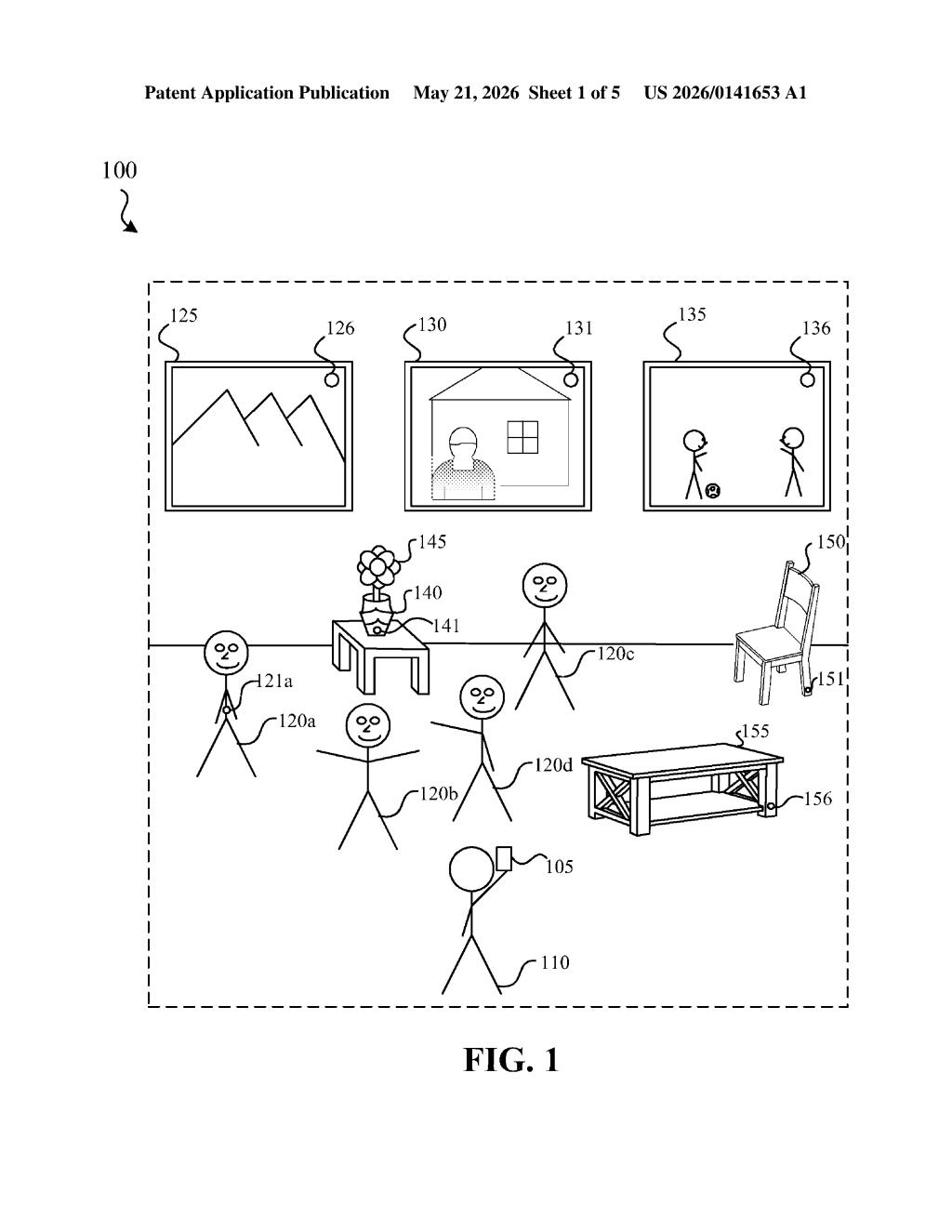
What Apple's environment-aware AR filtering actually does
Picture wearing AR glasses while you're rushing through an airport. Normally, apps might flood your view with news alerts, calendar reminders, and messages — but none of that is useful right now. Apple's patent describes a system that reads your physical environment using sensors, figures out what's going on around you, and automatically adjusts how many augmented-reality overlays you see and how much detail they contain.
The system doesn't just look at your surroundings. It can also factor in your mood, your calendar, how fast you're moving, and even how you've reacted to similar notifications in the past. If you've been dismissing workout alerts, it learns that. You can also manually turn a dial to signal your current level of interest.
The result is a layered "augmentation level" — think of it like a volume knob for your AR world. Quiet mode when you're focused, full detail when you're relaxed and browsing. It's essentially Focus Mode for spatial computing.
How Apple's system reads context to set augmentation levels
The patent describes a pipeline that moves from raw sensor data to a curated 3D view. Here's how the pieces fit together:
- Sensor data ingestion: The device pulls in data about the physical environment — likely camera, lidar, accelerometer, and GPS inputs — to understand where you are and what's happening around you.
- Context determination: The system classifies that sensor data into a context (e.g., "user is exercising," "user is in a meeting," "user is commuting at speed"). This is the core inference step.
- Augmentation level assignment: Based on context, the system picks an augmentation level — a structured setting that controls three distinct dimensions: how many AR overlays appear, how much content each overlay contains, and visual display characteristics like size or opacity.
- Filtering and presentation: Augmentations are filtered against that level, and the surviving ones are composited into a 3D view layered over the real world.
Beyond environment context, the patent explicitly covers user attributes as filtering inputs — calendar schedule, mood, movement speed — and prior behavior, meaning the system can learn from how you've responded to past notifications. A manual override (described as turning a dial) lets you directly signal your current interest level, giving users an escape hatch from pure automation.
What this means for AR wearables and Vision Pro focus modes
For anyone who's ever had a phone light up during a tense moment, the appeal of a system that reads the room is obvious. In an AR context, the stakes are higher — floating overlays can genuinely obstruct your view of the physical world. A framework that dynamically adjusts notification density based on what you're actually doing could be essential infrastructure for making AR glasses livable day-to-day.
This patent also points to a maturing Apple strategy around contextual computing — the idea that devices should adapt to you rather than demand your attention. If Apple's Vision Pro or a future lightweight successor ships with this kind of environment-aware filtering, it would directly address one of the sharpest criticisms of AR: that it's too distracting to wear in real life.
This is a genuinely useful idea, and it's the kind of unglamorous UX infrastructure that determines whether AR headsets actually get worn. The multi-factor approach — environment, user attributes, behavior history, manual override — suggests Apple is thinking seriously about the full surface area of distraction, not just building a simple Do Not Disturb toggle. Worth tracking as spatial computing hardware matures.
There are more where this came from
We read every patent application Big Tech publishes and send you the ones worth knowing. Plain English, free, every week.
Want this weekly breakdown for a company we don't cover? Patentlyze Pro →