
Apple Patent Shows Two Wireless Radios Working Together to Detect Nearby Objects
What if your iPhone could detect that someone is standing near it, not using a camera or a dedicated sensor, but by bouncing its own Wi-Fi or cellular signal off them? That is essentially what this Apple patent describes.
How Apple's dual-radio object sensing actually works
Imagine holding your phone up and having it sense that your hand is close, or that someone just walked into the room, without any camera turning on. Apple's new filing describes a way to do exactly that using the wireless radios already built into a device.
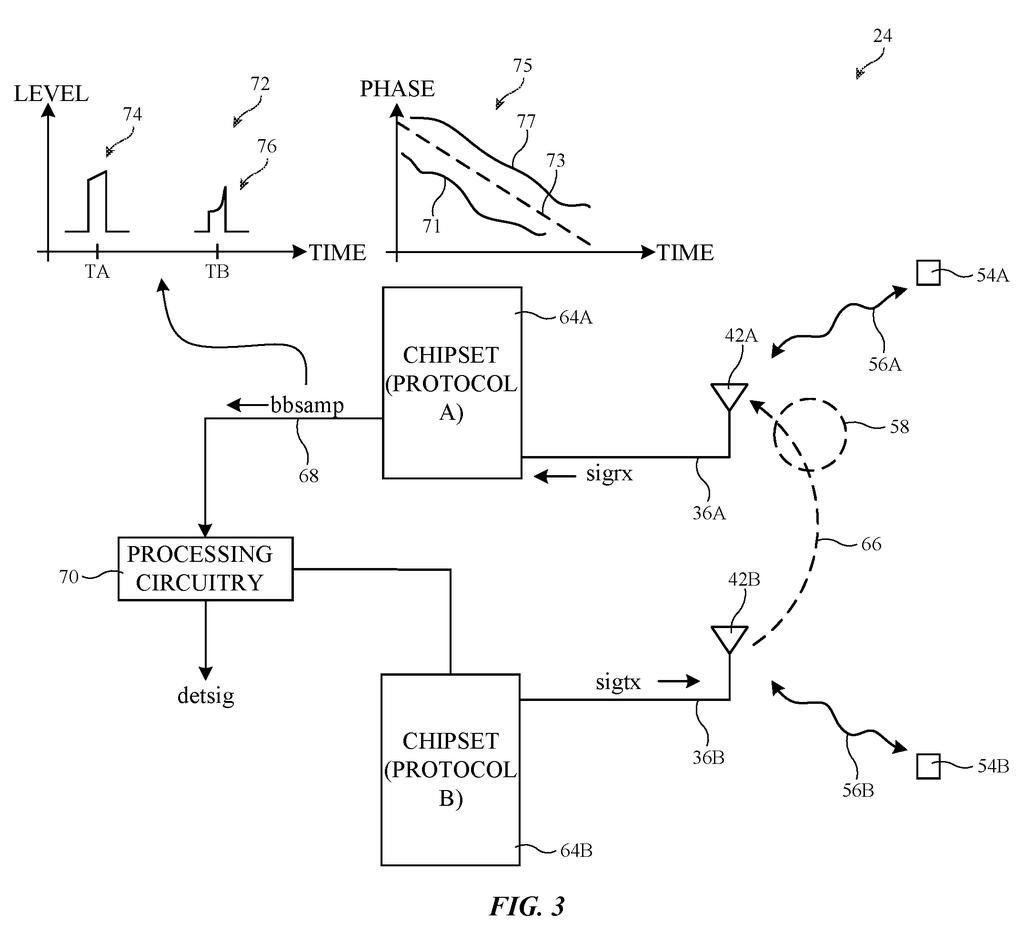
The trick is having one radio chip send out a signal, while a different radio chip listens for the echo of that signal bouncing back off nearby objects. Because the two chips use different wireless technologies (think Wi-Fi and 5G, for example), this is called "cross-protocol" detection. The device can then figure out whether something is nearby based on how that signal changes when it hits an object.
This is important because it means no extra sensing hardware is needed. The radios are already there. Apple just wants to teach them to work together in a new way.
… a transmitter communicatively coupled to the first antenna, wherein the transmitter implements a first radio access technology (RAT) and is configured to transmit a radio-frequency signal using the first RAT and the first antenna …
Translation: One radio sends out a wireless signal using its own specific technology.
How the two chipsets split transmit and receive duties
The patent describes a device, likely a phone or wearable, that contains two separate wireless chipsets, each built for a different radio standard (called a Radio Access Technology, or RAT). One chipset transmits a signal using its own protocol. The other chipset listens on a different frequency band using its own protocol.
The receiving chipset captures the incoming signal and converts it into baseband samples (a raw numerical representation of the radio wave). The onboard processor then applies part of the transmitting chipset's protocol math to those samples. This translation step produces what the patent calls channel impulse response samples, essentially a picture of how the radio signal was distorted by objects in its path.
From that distortion picture, the device can infer whether an external object (a hand, a person, a wall) is nearby. Key components in the system include:
- A dedicated transmitter and first antenna (using one wireless standard)
- A dedicated receiver and second antenna (using a different wireless standard)
- Processing circuitry that cross-applies protocol math to reconcile the two signals
The result is passive object sensing built on hardware that was already going to be in the device for normal wireless communication.
The second chipset may generate baseband samples based on the received radio-frequency signal using the second protocol. Processing circuitry may modify the baseband samples to obtain radio-frequency channel impulse response samples …
Translation: The receiving chip processes the signal data to map out the surrounding physical environment.
What this means for iPhones and future Apple devices
For everyday users, this technology could mean your device gets better at knowing when you are holding it, when it is resting on a surface, or when a hand is approaching the screen. That kind of awareness is already used to adjust display brightness, mute calls, and reduce radio emissions near your body. A more accurate, always-on sensing layer could make all of those behaviors more reliable without adding a new sensor.
For Apple's product lineup, this is particularly interesting in the context of devices where adding dedicated sensors is costly or space-constrained, like AirPods, Apple Watch, or a thin future iPhone. Reusing existing wireless hardware for sensing is a smart way to add capability without adding bulk.
This is a genuinely interesting engineering idea. Using two already-present radios in a coordinated way to get object detection for free, without a dedicated proximity sensor, is the kind of elegant hardware efficiency Apple tends to pursue before anyone else. Whether it ships as a product feature or improves existing proximity sensing in iOS is the open question, but this is not a patent to ignore.
There are more where this came from
We read every patent application Big Tech publishes and send you the ones worth knowing. Plain English, free, every week.
The drawings
5 drawing sheets from US 2026/0230351 A1 · click any drawing to enlarge


Want this weekly breakdown for a company we don't cover? Patentlyze Pro →
Be the first to weigh in