
Apple Patents a System for Splitting Web Pages Into Step-by-Step Panels
Scrolling through a long webpage has always meant one endless column of text. Apple's new patent describes a way to break that content into separate, sequential panels you step through one at a time.
How Apple wants to rethink reading long web pages
Long web pages today are essentially one tall stack of content. You scroll down, lose your place, and have no clear sense of how much is left or where one section ends and another begins.
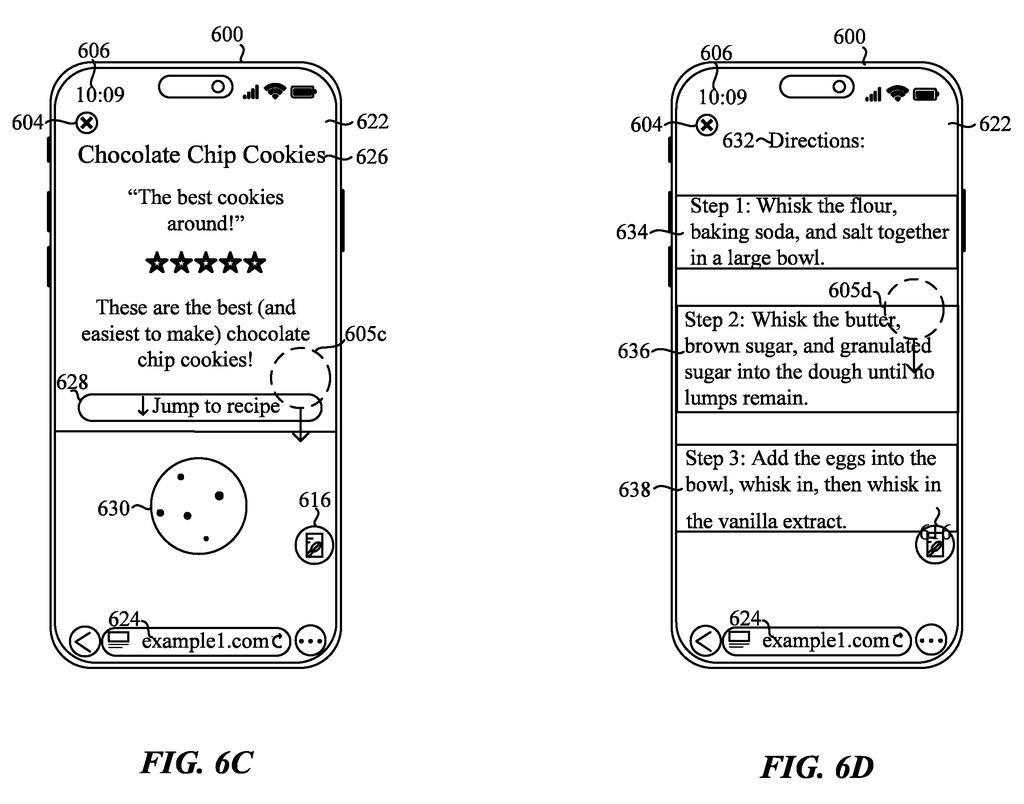
Apple's patent describes a system that takes a single page of web content and lets you navigate through it in distinct chunks. You see a first section, tap a control button, and the display shifts to show only the next section. Then you tap again to move to the one after that. Each step is its own clean view, not just an anchor-jump within the same scrolling page.
The idea is that the controls themselves change depending on which section you're reading, so the interface guides you through the content rather than just pointing you at a long scroll. Think of it like moving through slides rather than unrolling a scroll.
… displaying, via the one or more display generation components, a second user interface different from the first user interface that: includes the first set of content; does not include the second set of content; and includes a third user-interface element; …
Translation: The system transitions to a new view showing only the first part of the content with a new control.
How the three-panel navigation sequence actually works
The patent describes a method that works across three distinct user interface states, each tied to a portion of content on a page.
- First view: A page element contains two separate sets of content simultaneously, alongside a separate control element. The user sees the whole starting state.
- Second view: When the user triggers that control element (taps a button, for example), the display transitions to a new interface showing only the first set of content, plus a new navigation control. The second set is hidden.
- Third view: Triggering the new control swaps the display again, now showing only the second set of content and hiding the first. This third view is distinct from both earlier states.
The key detail is that each transition produces a genuinely different user interface, not a scroll position change within the same view. The controls are different at each step, meaning the system is actively orchestrating what you see and how you move forward.
The patent title references web-based content specifically, suggesting this is aimed at how a browser (like Safari) could present webpage sections rather than one continuous scroll.
The present disclosure generally relates to altering display of content. Some techniques are for serially displaying portions of content in accordance with some embodiments.
Translation: Apple's invention describes methods for breaking up and showing web page information one step at a time.
What this means for Safari and web browsing on Apple devices
For everyday users, this could make reading content-heavy pages on a small screen far less disorienting. Right now, a long article or product page in a mobile browser is just one tall column where you can easily lose context or accidentally scroll past the part that matters. A step-by-step panel system would give that content a clearer beginning, middle, and end.
The patent sits at the intersection of browser design and reading experience, an area where Apple has long made opinionated choices in Safari. The specifics here suggest Apple is exploring how to make web pages feel more like structured documents rather than infinite feeds, a direction worth watching alongside the latest Big Tech patents in browser interfaces and content display.
The reader-facing payoff here is modest but real: anyone who has lost their place in a long mobile article or bounced off a wall-of-text product page would feel the difference immediately. Apple is essentially proposing to give web content the pacing of a slideshow without asking publishers to rebuild their pages. Whether it ever ships in Safari in any recognizable form is an open question, but the problem it addresses is one that every mobile web user has bumped into daily for years.
There are more where this came from
We read every patent application Big Tech publishes and send you the ones worth knowing. Plain English, free, every week.
The drawings
24 drawing sheets from US 2026/0244461 A1 · click any drawing to enlarge


Want this weekly breakdown for a company we don't cover? Patentlyze Pro →