
Apple Files Patent for a Door Lock That Checks Which Way You Walk Up
Apple has a patent application for a door lock that unlocks itself as you walk up, but only if you come from the right direction. Walk past the door from inside your house, and it stays shut.
What Apple's approach-angle door lock actually does
Every time you walk up to your front door with your hands full of groceries, you'd probably love it to just unlock itself. Some wireless locks can already do that, but the closer you let them listen for your phone, the more likely they are to open when you didn't mean it, like when you walk past the door inside your own home.
Apple's filing tackles that by making the lock care about which way you are coming from. You mark the directions that count, usually the outside of the house, and the lock only opens for your phone or watch when you approach along one of those paths. Come at it from the hallway, and nothing happens.
The lock can also look at how fast and how steadily you walk. A slow, wandering stroll doesn't count as an attempt to get in.
… unlocking the lock device only when an authorized device is approaching along one or more predetermined unlock approach angles, and refraining from unlocking the lock device when an authorized device is approaching the lock device along other approach angles.
Translation: The door opens only if you approach from the correct direction and stays locked otherwise.
How the lock reads angle, speed and steadiness
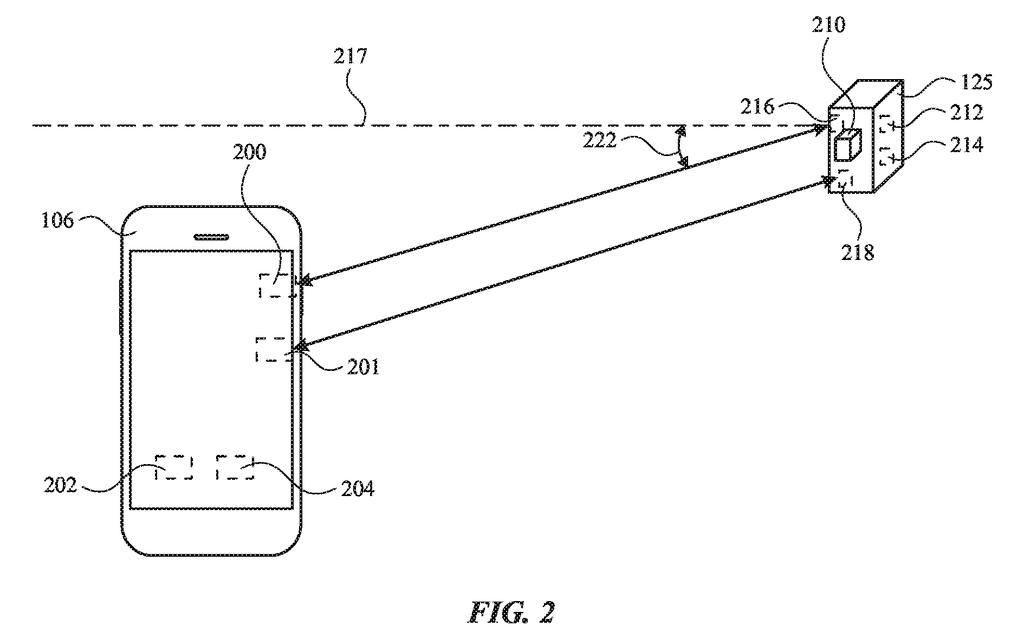
The core idea is that a lock device works out the approach angle of a portable device (such as a phone or smart watch) that carries a wireless electronic key. If that angle matches one of the angles you set ahead of time, the lock opens. If it doesn't, the lock stays locked, even though the key is valid.
To measure the angle, the filing describes ultra-wideband (UWB) radio, a short-range signal good at measuring position. The lock has several antennas spaced apart, and by comparing small timing differences in the signal reaching each one, it can work out the direction your phone is coming from. The filing says other methods, such as Bluetooth, lidar or cameras, could do the job too.
The filing also describes extra checks:
- Speed: a slow drift toward the door, below walking pace, doesn't unlock it.
- Consistency: lots of stops, starts or turns suggest wandering, so the lock stays shut. One example allows less than a one mile per hour speed change and less than five degrees of angle change over two seconds.
- Camera confirmation: a camera can look for your hand reaching for the handle before the lock opens.
A second claim covers the setup screen on your phone. You can pick an entryway layout, such as a wide wall, a narrow hallway or an L-shaped corner, and each comes with a matching set of allowed angles. Very close to the lock, the usual tap-to-unlock still works from any angle.
Why walk-up unlocking needs this kind of guardrail
The practical payoff is a lock that you don't have to think about. Hands-free unlocking is convenient, but if it opens when you walk past the door inside your house, or when someone is knocking and you're just peeking out the window, it becomes a problem. Angle checks aim to fix that without making you tap your phone to the door again.
The filing says it could apply well beyond front doors: car doors, windows, cabinets, lockers and safes. If a version of this ever ships in a smart lock or a car key feature, you would likely see it as a simple setup screen asking what your entryway looks like. As with any patent application, there's no guarantee it becomes a product.
Apple's third patent in our sensor coverage since July follows one about telling smudges from nearby objects and one about pairing devices by light flashes.
The trade here is clear: the lock gets pickier, and being pickier means it will sometimes be wrong. A lock that insists on a steady walk at the right angle at the right speed will occasionally refuse someone who really is heading in, such as a person who stops to answer a text halfway up the path.
That cost looks acceptable. A door that stays shut a moment too long is an annoyance, since the old tap still works up close. A door that pops open when it shouldn't is a safety problem, so leaning toward caution is the right call for a lock.
The rule set also adds things for you to configure and for the lock to get wrong, including angles, speeds and a camera check. If setup is as simple as picking a picture of your doorway, it could be a sensible fix. If it turns into a tangle of sliders, people will skip it.
Get our take in your Top Stories
Liked this breakdown? Add Patentlyze as a preferred source on Google, and our plain-English take shows up more often in your Top Stories the next time Apple patent news breaks.
There are more where this came from
We read every patent application Big Tech publishes and send you the ones worth knowing. Plain English, free, every week.
The drawings
9 drawing sheets from US 2026/0351061 A1 · click any drawing to enlarge


Show the other 1 sheets

Want this weekly breakdown for a company we don't cover? Patentlyze Pro →
Be the first to weigh in