
A New Apple Patent Gives Folding Screens a Frame That Bends With Them
Folding screens get most of the attention, but the thin border around them has to bend too. Apple's patent describes a frame made of hard plastic, metal corners and a stretchy rubber-like material that handles the fold.
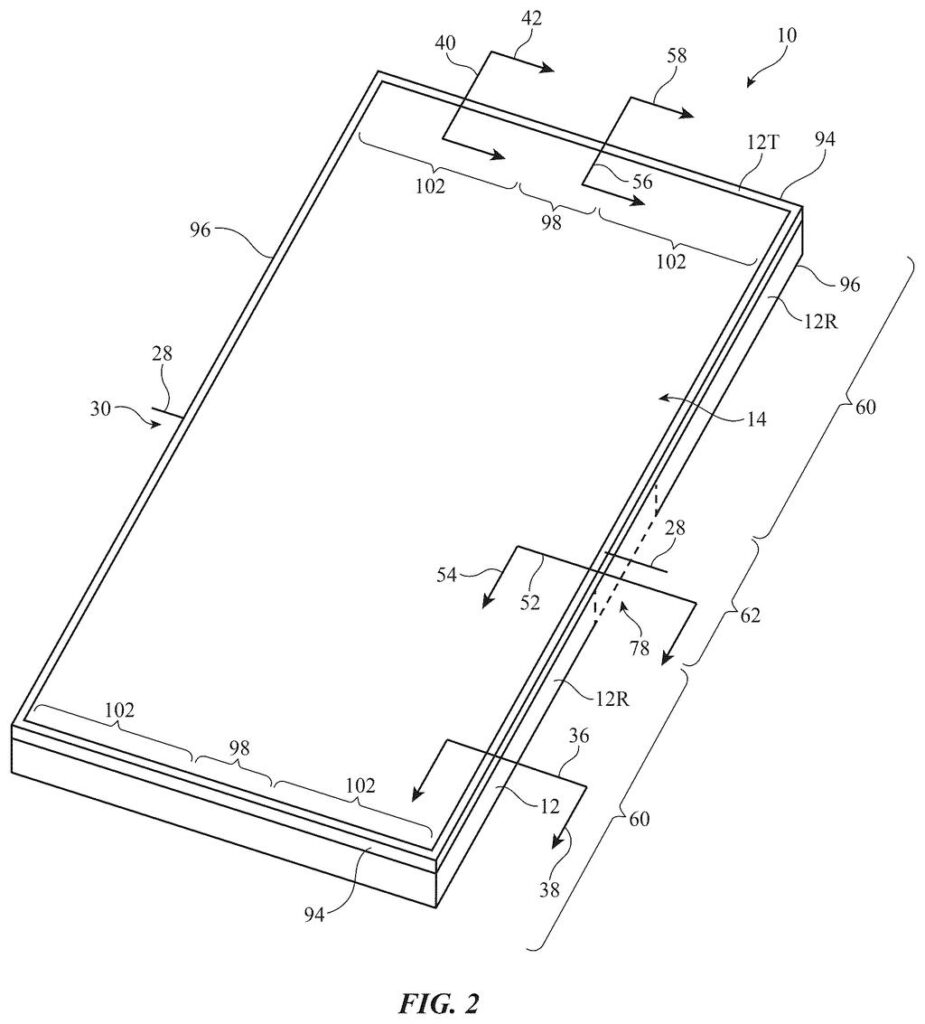
What Apple's foldable screen frame actually does
A folding phone sits open on a desk, and its screen is held in place by a thin frame around the edge. Every time someone closes it, that frame has to bend with the glass, and a stiff frame would crack, pop loose or fight the fold.
Apple's patent describes a display trim built from different materials in different places. Near the four corners, where nothing bends, it uses hard plastic over metal supports. Across the fold line, it switches to a soft, stretchy polymer that flexes along with the screen.
The stretchy sections also help during assembly. The frame can briefly widen so the screen drops in, then snap back to its original size and hold the edges of the glass in place. For you, that means a folding device that is built to survive thousands of opens and closes.
… a first polymer overmolded onto the first and second metal support structures; and a second polymer that spans the gap between the first and second metal support structures, wherein the second polymer has a lower modulus of elasticity than the first polymer.
Translation: The frame uses a stiff plastic for structure and a softer, stretchable plastic right over the folding crease.
How metal corners and stretchy joints share the work
The first claim covers a device with a flexible display that folds along a bend axis (the line the screen creases along). Around the display sits a trim made of two metal support structures separated by a gap right over that fold line. A hard polymer is molded over the metal, and a second, softer polymer bridges the gap.
The key spec is that the bridging polymer has a lower modulus of elasticity (a measure of stiffness) than the hard one. In the description, the hard material is something like polycarbonate and the soft one is silicone. The filing also describes four L-shaped metal pieces, one per corner of the display, with the soft polymer spanning gaps on all four sides.
Other claimed details:
- A lip on the hard plastic hooks over the top of the screen, with an air gap so the display can slide slightly as the device folds.
- The metal pieces can slide against the rear housing wall instead of being fixed to it.
- A foam or adhesive layer cushions the screen edge against the metal shelf.
A second approach skips the premade frame. The screen goes into a mold and a liquid adhesive (a two-part polyurethane or a light-cured acrylic) is injected around the edge of the cover glass, including across the fold. The filing says it is cured with infrared light, keeping heat below 65 degrees Celsius to protect the display.
The elastomeric polymer may span across each of the gaps and may allow the display trim to laterally expand during display assembly operations and to bend during folding.
Translation: The stretchy material lets the border stretch while the phone is being put together and bend when it folds.
Why a bendable border matters for a folding iPhone
If you have ever worried about a folding phone, the edges are a big part of it. That is where dust, bumps and stress collect, and where a rigid frame would fight the screen every time you open the device. A trim that stretches where it needs to and stays hard where it doesn't could mean fewer cracked borders and a cleaner look.
The filing mentions phones and tablets as the example and doesn't name a product. It does describe a roller hinge and a screen that folds flat against itself, which fits the broader idea of a compact folding device. Whether that becomes something you can buy is not something this document says.
This is the tenth Apple filing we've tracked on our foldable iPhone watch since May, following the self-flattening hinge and the ceramic screen layer.
A folding phone's frame is one of those details you never think about until something goes wrong: a corner that starts to lift, a border that looks slightly warped after a year of daily opening and closing. Apple's solution is to build give directly into the border material, so the edge can flex with the fold instead of resisting it.
That same flexibility does something useful before the phone ever reaches you. The frame can expand slightly during assembly, which means the screen gets seated gently rather than forced into place. Fewer screens damaged before shipping is a small thing with real consequences.
The payoff is boring in the best way. Open and close your phone every day for two years and the edges still look tight, still look new. No one will list this in a commercial, but it is the gap between a device that ages well and one that starts looking worn before you are ready to replace it.
Get our take in your Top Stories
Liked this breakdown? Add Patentlyze as a preferred source on Google, and our plain-English take shows up more often in your Top Stories the next time Apple patent news breaks.
There are more where this came from
We read every patent application Big Tech publishes and send you the ones worth knowing. Plain English, free, every week.
The drawings
9 drawing sheets from US 2026/0339398 A1 · click any drawing to enlarge


Show the other 1 sheets

Want this weekly breakdown for a company we don't cover? Patentlyze Pro →
Be the first to weigh in