
Apple Files Patent to Give Earbuds Separate Spots for Charging and Talking to the Case
Your earbud case has to deliver power and pass messages in one very small space. Apple's filing puts those two jobs at opposite ends of the earbud's stem.
What Apple's two-coil earbud case actually does
Right now, many wireless charging setups squeeze their messages into the same magnetic link that carries the power. Earbuds and a case can talk by slightly varying the charging signal, but that limits how much they can say. Historically, the other route has been a radio link, which means one more part to build in.
Apple's filing proposes a third option: give the earbud and the case a second, dedicated pair of small magnetic coils just for talking. The trick is where they go. The charging coil sits at the tip of each earbud's stem, and the messaging coil sits higher up the stem, so the two stay apart.
Keeping them apart stops the strong charging field from drowning out the data signal. Apple also describes optional copper shields between the coils and special magnetic cores to sharpen the isolation. Once you drop an earbud in, both pairs line up at once.
… wherein the first wireless communications coil is separated from the power transmitting coil along a longitudinal axis corresponding to a stem portion of the wireless earphone to be received in the wireless earphone charging case …
Translation: The charging case uses separate spots for powering the earbuds and talking to them along the earbud stem.
How Apple keeps charging and data coils apart
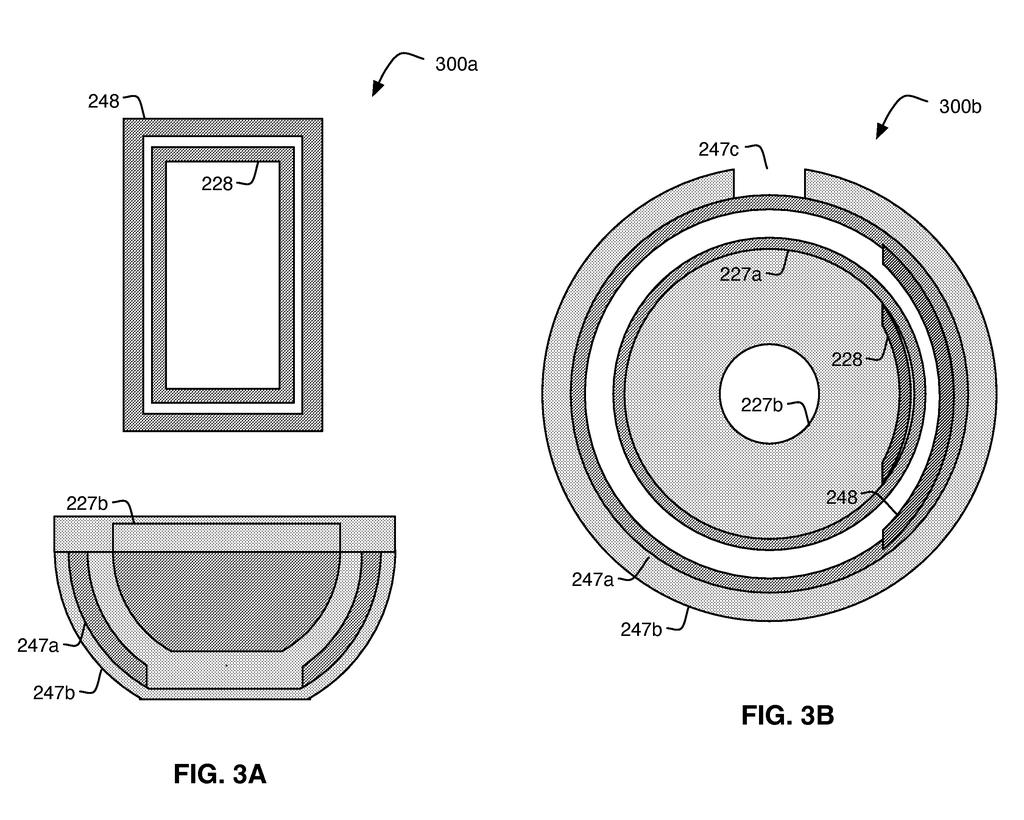
The filing covers a system made of a charging case and a wireless earphone with a stem, plus the earphone on its own. Each side has two separate magnetic coils (loops of wire that pass energy or signals through magnetic fields). One pair moves power from the case to the earbud. The other pair carries messages between them.
The key claim is placement. The case's power coil sits where the tip of the stem rests, and the communications coil is spaced away from it along the stem's length. The earbud mirrors that layout, so both pairs line up when you seat it. The charging coil is shaped like a bowl, with the earbud's rounded tip sitting inside.
The filing also describes optional extras:
- Shield: a copper barrier between the power coil and the communications coil for extra isolation.
- Coil height and spacing: a shorter coil or a wider gap to tune how well the two stay separate.
- Ferrite cores: a magnetic ceramic placed behind or around the communications winding to shape its signal.
- Alignment features: shapes in the case that position the earbuds so the coils meet.
The description says magnetic communication can offer more bandwidth than the older method of varying the power signal. This filing is a continuation of an application first filed in 2022.
Why separate coils matter for your earbuds
If you wear stem-style wireless earbuds, the case already handles charging and keeps in touch with the buds. A dedicated path for those messages could make the exchange more dependable, and it leaves room to pass more information than a power-based link handles comfortably. The filing lists no specific features, so any new capability is a guess.
For Apple, the value is fitting more into a very small space. Earbud stems are tight, and the claims spell out exact coil placement, with the charging coil at the tip and the data coil higher up. Shields, coil heights and ferrite cores give engineers ways to tune the isolation as the design shrinks or changes.
That makes this Apple's 25th filing we've tracked in battery and power since May, a topic that already spans a charger that detects stray metal and location-aware power use.
If this ever reaches a product, you would probably never notice it. Nobody buys earbuds for the coil layout, and the filing names no new feature you could point to. What you might notice is an earbud and case that talk to each other reliably every time you snap the buds in.
Charging puts a strong magnetic field right next to a data signal, and the patent's answer is distance plus optional copper shielding. It is a sensible fix for interference you would only ever see when something misbehaves.
Verdict: routine plumbing with a clear purpose, and the best outcome is that you never think about it.
Get our take in your Top Stories
Liked this breakdown? Add Patentlyze as a preferred source on Google, and our plain-English take shows up more often in your Top Stories the next time Apple patent news breaks.
There are more where this came from
We read every patent application Big Tech publishes and send you the ones worth knowing. Plain English, free, every week.
The drawings
6 drawing sheets from US 2026/0342133 A1 · click any drawing to enlarge


Want this weekly breakdown for a company we don't cover? Patentlyze Pro →
Be the first to weigh in