
Apple Files Patent for Photos That Remember How Bright the Room Really Was
A photo of a dim kitchen and a photo of a sunny beach often end up looking about equally bright on your screen. Apple's patent application tries to bring that difference back by saving the real light level inside the file.
What Apple's brightness-tagged photos actually do
You're flipping through photos on a big TV. A shot of a dim kitchen glows almost as brightly as one from a sunny beach, and the kitchen walls look like they're lit from the inside.
The cause is simple. A photo file mostly records how bright each dot is compared with the other dots in the same picture, so the real brightness of the scene gets lost along the way. Your screen then has to guess, and it often guesses wrong.
Apple's filing has the camera write down how bright the scene actually was, using a standard light measurement called lux, and tuck that note into the photo or video file. Later, the screen reads the note and adjusts, so the kitchen looks dimmer and the beach looks brighter, closer to how each one felt when you took it.
a camera system that captures image data of a local environment and a measurement of brightness of the local environment at a time of capture, and a processor that generates an image file having pixels representing the image data at the time of capture …
Translation: The camera records both what the scene looks like and how bright the room was when the photo was taken.
How Apple's adjustment curve dims the indoor shot
The patent has two halves. On the capture side, the camera measures the brightness of the scene and the phone saves it as metadata (extra information stored alongside the pixels) in the image or video file. The filing describes two versions: a scene lux value for the average brightness, and a clipping point lux value for the brightest part. Lux is the standard unit for light levels.
On the display side, software first studies the picture's pixel statistics, such as a histogram (a tally of how many pixels are dark or light), the average, and the maximum. It combines those with the saved lux value to build an adjustment function, a curve that says how bright each pixel should be shown. The claims also cover spline curves (smooth, flexible curves) and tailoring the result to the display's own limits.
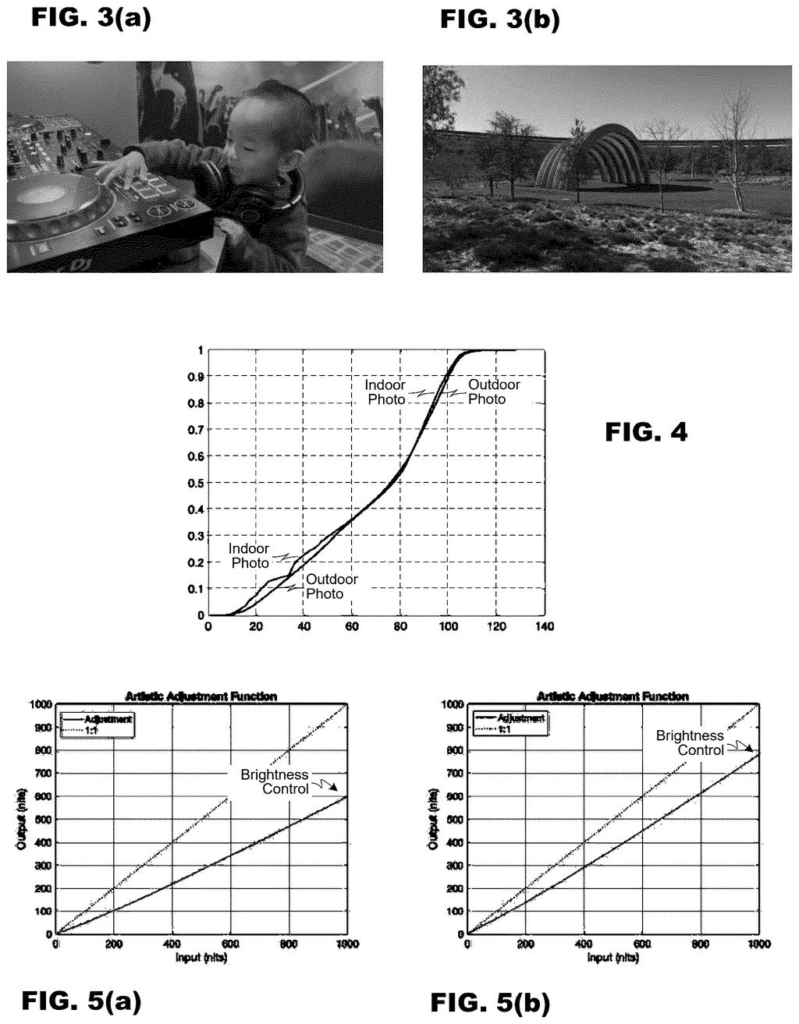
The description gives two examples on a screen that peaks at 1000 nits (a nit is a unit of screen brightness):
- An indoor shot at 400 lux has its top brightness held to about 600 nits.
- An outdoor shot at 56,000 lux is shown with a top brightness of about 800 nits.
The filing also covers picture-in-picture, where each image gets its own curve scaled by its brightness. A second approach converts pixels back into a model of real-world light before grading (the stylistic tuning step).
… an image processing system that alter the image's/video's pixel data according to the measured scene brightness at the time of rendering.
Translation: The system adjusts the image display based on how bright the original environment was.
Why your vacation photos could look more true
If this reached a product, you would notice it when photos and videos from different places show up side by side on one screen. A candlelit dinner would stay moody, and a bright day outside would stay bright, even on a display that can get very bright. It could also stop dim indoor walls from looking like they glow behind your subject, a problem the filing names directly.
A company that builds both the camera and the screen, as Apple does, is well placed to write a note at capture and read it at playback. The examiner's first review rejected the claims as filed, which is routine at this stage and usually leads to amendments. Nothing in the filing says a product is on the way.
Apple's 636th filing in our Apple coverage since May follows applications like the warped-hands camera fix and floating torso-anchored controls.
The benefit is easy to picture: your photos would look the way the moment felt. Right now a cozy living room and a bright beach can come out nearly equal on a big screen, and you only notice something is off when the walls seem to glow.
You would see this most when you browse mixed albums or videos on a bright TV or a recent iPhone-class screen, since that is where the display has room to overdo it. If it works, the effect is subtle and nobody thinks about it. The failure it prevents is the over-lit, flat look of indoor shots.
The claims are broad about storing a brightness reading and using it on playback, so the payoff depends on how well the adjustment curves are tuned. It is a small, useful fix for something most people already feel but cannot name.
Get our take in your Top Stories
Liked this breakdown? Add Patentlyze as a preferred source on Google, and our plain-English take shows up more often in your Top Stories the next time Apple patent news breaks.
There are more where this came from
We read every patent application Big Tech publishes and send you the ones worth knowing. Plain English, free, every week.
The drawings
4 drawing sheets from US 2026/0350750 A1 · click any drawing to enlarge


Want this weekly breakdown for a company we don't cover? Patentlyze Pro →
Be the first to weigh in