
Nvidia Files Patent to Let Robots Change Plans the Moment Something Moves
A robot that notices you moved its block and changes plans on the spot: that is the idea in this Nvidia filing. Instead of marching through a fixed script, the robot rechecks the world over and over and picks its next move fresh.
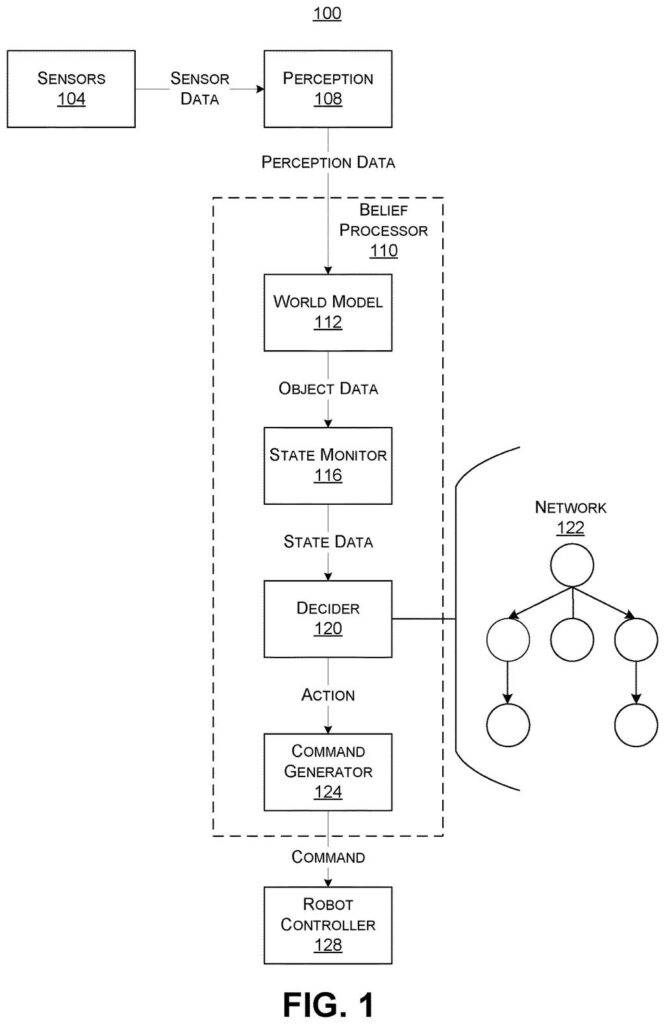
What Nvidia's robot decision checklist does
Every time a typical factory robot finishes one step of a job, it simply moves on to the next, even if the scene changed in the meantime. Say a person knocks a block out of its gripper. A script-following robot may carry on as if nothing happened.
Nvidia's filing describes a way around that. The robot keeps a running list of simple facts about its surroundings: is the drawer closed, is the gripper holding a block, how are the blocks stacked? Many times a second, it runs those facts through a branching checklist of yes/no questions, and the answer at the end is its next move.
Because the checklist starts over from the top every cycle, a dropped block just sends the robot back to picking it up. No panic mode or special exception code needed.
… determine at least one action for a robot by traversing, from a root node and based at least on the at least one state, a path through a predefined network of nodes, the path including at least one fixed successive node corresponding to a predefined action or condition …
Translation: The system figures out what a robot should do next by walking down a map of preset choices based on the surroundings.
How the robot picks its next move each cycle
The filing describes a decider network: a branching set of decision points (called nodes) that a robot's processor walks through to choose its next action. Each cycle, the system first updates a world model (the robot's internal map of objects and where they are) using camera or sensor data. Small state monitors then boil that map down to simple facts, such as 'the door is open' or 'the ball is within reach.'
The walk starts at a single root node. Each node holds a 'decide' function (basically an if/then check) that looks at those facts and picks the next node. The path ends at a leaf node, which selects an actual command. The network is an acyclic graph, meaning connections only run one way, so a path can never loop back on itself.
Nodes can also have enter and exit steps. The system remembers the path it took last cycle. If a check now gives a different answer, it runs exit steps to drop the old branch, then enters the new one.
In one example, the whole thing runs at 60 cycles per second. A separate command layer turns the chosen command, such as 'move toward the ball,' into signals for the robot's motors. The filing says the same setup can drive robotic arms, vehicle controllers, collaborative robots, or simulated agents.
… change decisions and/or paths of decision execution responsive to dynamic changes in logical states …
Translation: Robots can instantly shift their plans when something around them changes.
Why this matters for robots near people
Many industrial robots today follow a script, which is one reason they often work behind fences or barriers away from people. The filing says tools like state machines and behavior trees (older ways of sequencing robot actions) struggle with events outside their plan, or grow very complicated trying to cover every case. A network that rechecks the world each cycle is meant to let a robot react instead of carrying on blindly.
For you, the practical payoff would show up as robots that can share space with people and cope with surprises. The filing also describes letting users set up the network through a user interface, so the decision logic looks like something an engineer can edit and inspect, rather than a sealed black box. It also covers simulated robots, which gives developers a way to test behavior before anything touches real hardware.
That makes this Nvidia's 37th filing we've tracked since May in our robot grasping and movement watchlist, which already includes one on maps that self-update and one on vision that redraws objects.
Claim 1 is wide. It asks for a processor that reads a world model, pulls out a state tied to task progress and some trait of an object, walks from a root node through a preset network of nodes, and controls a robot with the result. It names no particular robot, no cycle rate, and no number of nodes. Claim 19 swaps 'robot' for 'autonomous machine,' which stretches it further.
The parts that make it feel like a specific invention sit in the dependent claims. Rechecking the state every cycle is claim 10. The one-way graph with a root and leaf nodes is claim 2. Exiting an old branch when the path changes is claim 9. If the office granted only the language of claim 1, it would reach a lot of robot software that picks actions by walking a branching set of checks.
Branching decision logic has been around in software for a long time, so the open question is how much of claim 1 survives once it is compared with older robot control methods. The wording that carries the weight is the tie to task progress and the fixed successive node. Those are the phrases to watch as this application moves along.
Get our take in your Top Stories
Liked this breakdown? Add Patentlyze as a preferred source on Google, and our plain-English take shows up more often in your Top Stories the next time Nvidia patent news breaks.
There are more where this came from
We read every patent application Big Tech publishes and send you the ones worth knowing. Plain English, free, every week.
The drawings
6 drawing sheets from US 2026/0339297 A1 · click any drawing to enlarge


Want this weekly breakdown for a company we don't cover? Patentlyze Pro →
Be the first to weigh in