
Apple
Apple · AI / ML · Filed Apr 17, 2026 · USPTO published Aug 27, 2026 · Aug 27 release
New Apple Patent Teaches Room Sensors to Detect Real Occupants
Apple is patenting a presence-detection system that uses one sensor to spot people and a second sensor to verify those detections are real, then feeds that confirmed data back to make the first sensor more accurate over time. It's a self-improving feedback loop baked into a device sitting in your room.
- Publication number
- US 2026/0251790 A1(US20260251790A1)
- Applicant
- Apple Inc.
- Filed · Published
- Apr 17, 2026 · Aug 27, 2026
- Inventors
- Barak Baum, Yoav Feinmesser, Naftali Sommer
- Status when we published
- Waiting for an examiner
- Document
- 20 claims
- US classification
- 356/4.01
- Parent application
- Continuation of 18/140,517 (filed Apr 27, 2023)(18140517)
How Apple's radar-plus-camera presence system works
Today's smart home devices that try to sense whether a room is occupied often get it wrong, either missing someone sitting still in a corner or triggering when there's no one there at all. Apple wants to fix that with a system that doesn't just detect presence but teaches itself to get better at it.
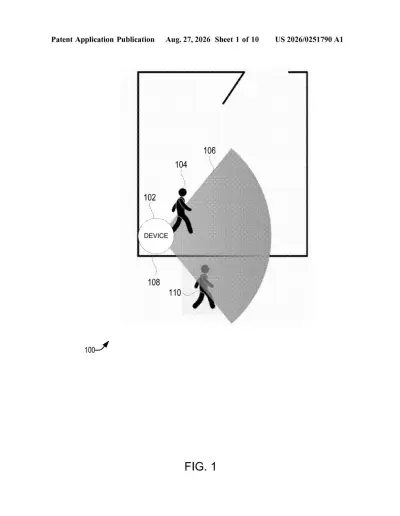
Here's how it works in plain terms: a device in your room sends out a wireless signal (think radar, but short-range and low-power). When that signal bounces back, the device looks at the pattern to figure out if someone is in the room. To make sure it isn't just guessing, a second sensor, like a camera, double-checks the answer. When both sensors agree someone is there, the device saves that snapshot as a confirmed example and uses it to train an AI model.
Over time, the AI builds up a library of real, room-specific examples. Instead of relying on a one-size-fits-all algorithm, it learns what your room's signals actually look like when you're in it.
transmitting an electromagnetic wireless signal by an electromagnetic transceiver of a first sensor of the electronic device; receiving, by the electromagnetic transceiver, an electromagnetic return signal from the electromagnetic wireless signal; and detecting, using a machine learning model, a target in the room based on the electromagnetic return signal …
Translation: The device sends out wireless signals, catches the bounce back, and uses AI to spot someone in the space.
How the two-sensor training loop builds the AI model
The patent describes a two-phase system running on a single electronic device placed inside a room.
Phase one: data collection. The device's first sensor (an electromagnetic transceiver, essentially a short-range radar chip) continuously broadcasts a wireless signal and listens for what bounces back. If the return signal looks like it might indicate a person, the device flags that as a "potential target." A second sensor, which the patent describes separately from the radar, then independently checks whether a person is actually present. When the second sensor confirms the hit, the device saves the radar return signal as a training signature (a captured snapshot of what the radar saw at that moment).
Phase two: model training. After collecting a set of these confirmed signatures, the device uses them to train a machine learning model (an AI algorithm that learns patterns from examples rather than following hand-written rules). From that point on, the radar alone, without the help of the second sensor, can run the trained model to decide in real time whether someone is in the room.
The practical upside is that the model is trained on data from that specific room, with its particular shape, furniture, and materials, rather than on generic datasets gathered elsewhere. That room-specific tuning is the core engineering idea the patent is protecting.
Responsive to determining the potential target is in the room, the technique may include saving a training signature of the electromagnetic return signal for training a machine learning model.
Translation: When a person is confirmed to be present, the system saves that specific radar pattern to train its AI.
What this means for smart home and HomeKit sensing
Presence detection sounds simple until you actually need it to work reliably. Smart thermostats that waste energy because they think an occupied room is empty, TVs that turn off mid-show, security systems that miss a person sitting: these are real, everyday failure modes that stem from sensors that weren't trained on the actual environment they're deployed in. A self-calibrating system that builds its accuracy from real in-room data, rather than a factory-preset model, addresses that gap directly.
For Apple, this fits into a broader push around home sensing technology, including features tied to HomePod, Apple TV, and any future home hub hardware. A radar sensor that learns your specific living room is a meaningfully different product than one that ships with a fixed algorithm. Coverage of this and related filings appears regularly across Big Tech patent news as home-sensing becomes one of the more competitive areas in consumer electronics.
That makes this the second AI vision filing from Apple we've tracked since July, following one on Siri address detection.
Source: US 2026/0251790 A1 at the USPTO (PDF). Full patent text and figures are in the official publication.
Get our take in your Top Stories
Liked this breakdown? Add Patentlyze as a preferred source on Google, and our plain-English take shows up more often in your Top Stories the next time Apple patent news breaks.
Add Patentlyze on Google
One click.
There are more where this came from
We read the new patents from Big Tech, carmakers and more and send you the ones worth knowing. Plain English, free, every week.
The drawings · 10 sheets
10 drawing sheets from US 2026/0251790 A1 · click any drawing to enlarge


Show the other 2 sheets


More from Apple
All 748 Apple patents →
More in AI vision
All 352 AI vision patents →
Google
Google Patent: Robots Obeying Open-Ended Object Commands Without Hardcoded Vocabulary Lists
IBM
IBM Patents Software That Reads Crowd Movement to Stop Arena Dangers Early
Google
Google Patent Teaches AI to Recognize Objects in Images Without Human Labels
Microsoft