
Apple Patent Reveals a Secret-Listening Chip That Wakes Phones Without Draining Battery
Apple has filed a patent for a chip that keeps one ear open for a secret wireless password even when your phone's main processor is completely off. If the right signal shows up, the device wakes up on its own.
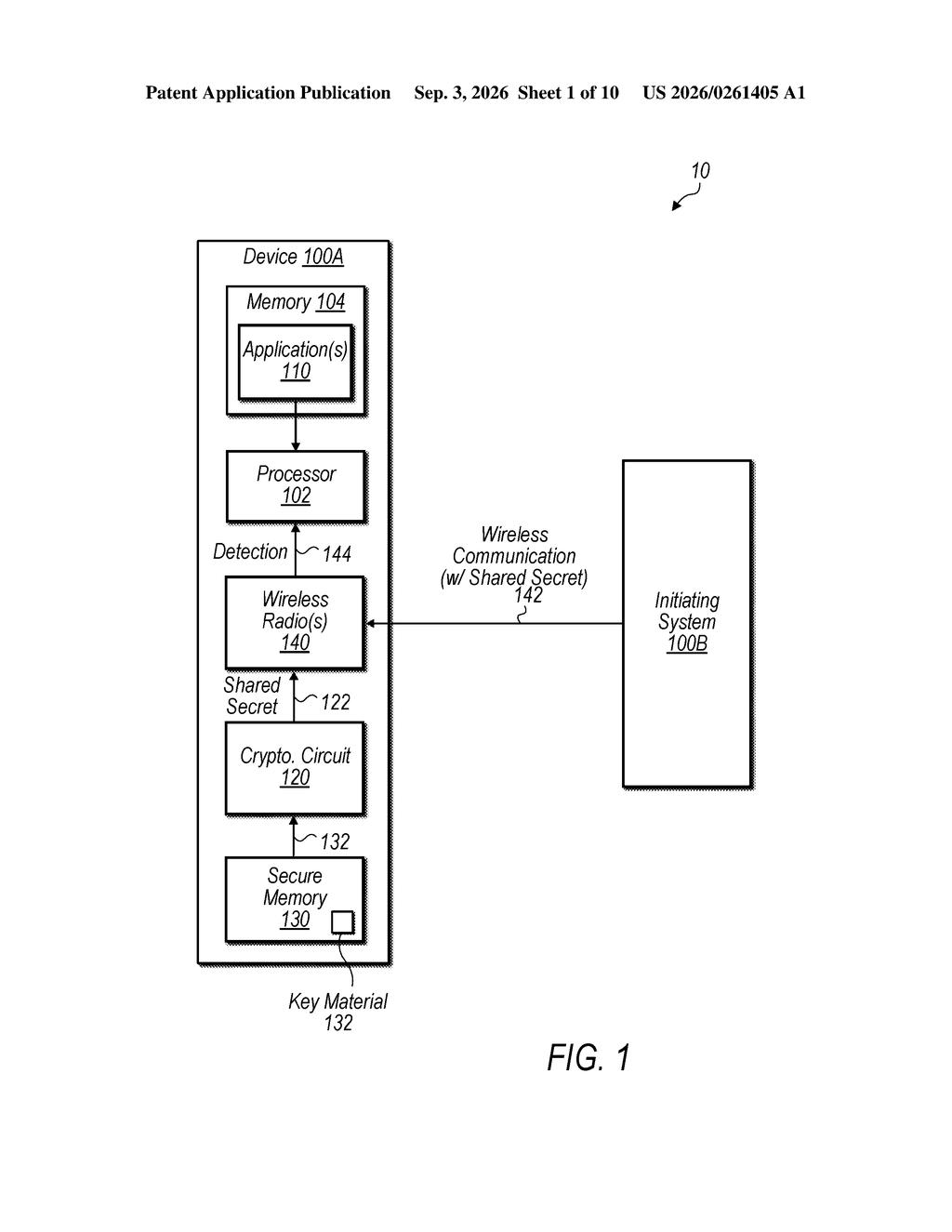
What Apple's sleeping-phone secret signal actually does
Every time your phone sits dark in your pocket, its main chip is essentially asleep to save battery. But Apple's patent describes a small, separate chip that stays awake listening for a specific wireless signal. That signal is protected by a secret code baked into hardware your phone's main processor can't even see.
When the right wireless message arrives carrying that secret code, the listening chip recognizes it and tells the main processor to wake up. Think of it like a bouncer who checks a password before letting anyone inside, except the bouncer never sleeps and the password is stored in a vault only the bouncer can open.
The practical upside is that your device could respond to authorized wireless commands without leaving its main chip running all day, which drains your battery. The secret is protected in dedicated hardware, so software running on your phone can't easily steal it.
… a cryptographic circuit coupled to a secure memory inaccessible to the processor, wherein the cryptographic circuit is configured to: derive a shared secret using key material maintained in the secure memory …
Translation: A locked down hardware security chip generates secret keys that the main processor cannot access.
How the cryptographic circuit guards the shared secret
The patent describes a cryptographic circuit (a specialized chip built purely for security math) that is paired with a secure memory module. Critically, that memory is physically inaccessible to the device's main processor, meaning even compromised software running on the phone cannot read the stored keys.
The cryptographic circuit uses the protected key material (the raw cryptographic ingredients) to derive a shared secret. A shared secret is a value that two parties, say your phone and an authorized server, calculated independently using matched private keys, so they both know it without ever transmitting it directly.
A wireless radio circuit then runs continuously in a low-power mode, scanning incoming wireless messages for one that contains that shared secret. The main processor stays in a reduced power state (asleep) the entire time. Only when the radio circuit detects a matching message does it trigger the processor to wake.
The claimed design separates responsibilities cleanly:
- The cryptographic circuit handles key derivation and secret matching
- The radio circuit handles the always-on listening
- The processor only activates after authentication succeeds
This layered approach means neither the radio nor the processor alone holds enough information to be exploited.
… the wireless radio circuit listens for the wireless communication while the processor is in a reduced power state and, in response to detecting the shared secret in the wireless communication, causes the processor to exit the reduced power state …
Translation: The wireless receiver watches for a specific code while the main processor sleeps to save battery.
What this means for always-on device control
For everyday users, this kind of design could mean a device that responds to authorized remote commands (think waking a laptop before you reach your desk, or activating a locked device for a specific service) without burning battery on a fully awake chip. The security piece matters as much as the power piece: because the keys live in hardware the operating system cannot touch, a malware infection on the device still can't fake or intercept the wake signal.
Apple's run of secure-enclave and hardware-key filings fits a broader pattern of separating sensitive operations from the general-purpose processor. For consumers, that separation is what makes features like Face ID feel trustworthy rather than just clever.
Apple's tenth filing we've tracked since July in our on-device AI privacy watchlist follows earlier applications on object tracking by sound and motion and real-time facial learning.
The patent describes a chip that handles secret handshakes in hardware, completely separate from the main processor, so a device can recognize a trusted wireless signal while the rest of the system stays asleep. That separation is the whole point, and it requires the feature to be physically baked into the chip at manufacturing time.
That makes this a long road to a product. A software update cannot add a new isolated chip and a sealed memory compartment after the fact, so the earliest any device could ship this would be whenever the next silicon design cycle completes, which typically runs two to four years from concept to consumer hands.
The document names no product and announces nothing, so reading it as a coming feature would be a stretch. What it does signal is that Apple is staking out the architectural rules early, before the hardware exists to carry them out.
Get our take in your Top Stories
Liked this breakdown? Add Patentlyze as a preferred source on Google, and our plain-English take shows up more often in your Top Stories the next time Apple patent news breaks.
There are more where this came from
We read every patent application Big Tech publishes and send you the ones worth knowing. Plain English, free, every week.
The drawings
10 drawing sheets from US 2026/0261405 A1 · click any drawing to enlarge


Show the other 2 sheets


Want this weekly breakdown for a company we don't cover? Patentlyze Pro →
Be the first to weigh in