
Apple Files Patent for Wireless Charging That Spots Stray Coins and Keys
Your wireless charger has to tell the difference between your phone's own metal and a coin that slipped underneath. This Apple patent says it can do that with some careful subtraction.
What Apple's charger does about stray coins
Every time you set your phone on a wireless charger, the charger has to answer a small question: is all this power going into the phone, or is some of it heating up a coin or a key that slid underneath? It checks by comparing the power it sent with the power the phone says it received. Any gap is "lost" power.
The trouble is that some loss is normal. Your phone's metal frame, magnets and internal parts soak up a little energy, which engineers call friendly metal. Apple's patent describes the phone sending the charger a short list of numbers that describe how much its own metal usually absorbs. The charger subtracts that expected amount from the gap. If a big chunk is still missing, something foreign is probably sitting between the two devices.
A better estimate of the normal loss means fewer false alarms, like charging that slows or stops for no reason, and fewer missed coins.
monitors one or more observable parameters associated with the wireless power transfer to estimate friendly metal losses associated with wireless power transfer to the other wireless power transfer device based on parameters associated with the other wireless power transfer device …
Translation: The system tracks power levels to calculate energy lost inside authorized devices like a phone.
How the charger subtracts your phone's own losses
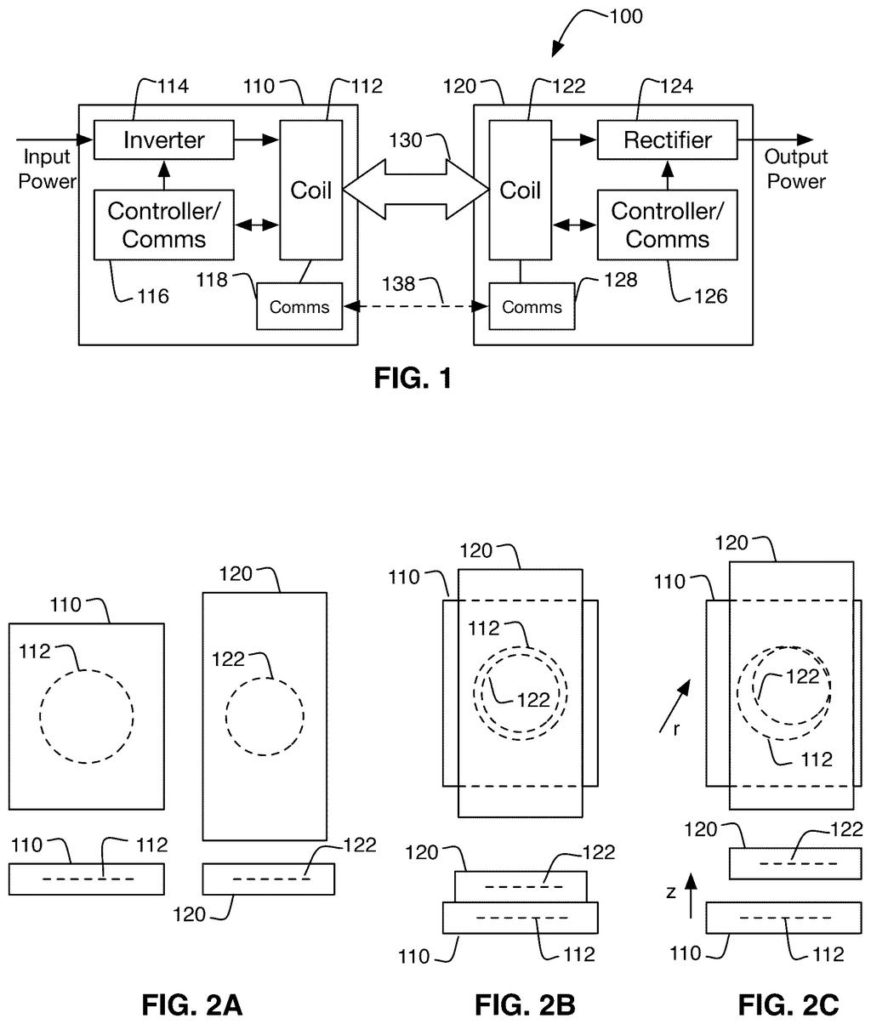
The filing covers a wireless charging setup built from a coil, an inverter (the part that turns incoming power into the alternating current the coil needs) and a controller that watches the electrical readings. The controller estimates how much power the other device's metal parts should absorb, then adjusts the inverter based on that estimate.
The estimate comes from a simple formula. Expected loss depends on the square of the current in the charging coil, plus the inverter's input voltage, each scaled by coefficients (fixed numbers) that describe the device being charged. The phone sends those numbers to the charger. The patent says this could happen over the charging coils themselves or over a separate link such as Bluetooth or Wi-Fi.
The filing also describes a second refinement:
- The phone can supply two sets of numbers, one for a loose coil fit (a thick case, a sloppy placement) and one for a tight fit.
- The charger switches between them based on a measured coupling factor, a score of how well the two coils line up.
Once the expected loss is subtracted from the measured loss, anything left over above a threshold counts as a foreign object. The charger can then cut power, limit it, or alert you. Either the charger or the phone can run the check.
… detect a presence of a foreign object that is not the counterpart device and control the power converter responsive to detection of a foreign object. The controller and communication circuitry can perform foreign object detection based on power accounting that includes estimating friendly metal losses …
Translation: It spots stray items like coins on the mat by factoring in the energy normally absorbed by your gadget.
Why fewer false alarms matter at 20 watts
Wireless charging only works well if it is cautious about stray metal and also not jumpy about it. The patent says a loss estimate that is too low can trigger needless slowdowns, interrupted charging and spurious on-screen messages. An estimate that is too high can let a coin heat up. Getting the math closer to reality means you see fewer unexplained pauses.
The filing also points out that the problem grows as charging power rises from around 5 watts to 20 watts or more, where even a small hidden loss matters. The description mentions that the exchange of numbers could follow an industry standard such as Qi, so a charger and a phone from different makers could still share them. That makes this a piece of plumbing for future, faster wireless charging.
Apple's 55th filing in our cell phone coverage since May follows camera holes that sense touch and scratch-resistant curved glass among the patents we've tracked.
Claim 2 is wider than the headline idea suggests. It covers a coil, an inverter and a controller that estimates the friendly metal losses of the other device from numbers describing that device, covering both current and voltage, and then controls the inverter based on the result. The claim itself does not mention finding a foreign object at all.
If granted, that breadth would reach any charger that estimates its partner's built-in losses from current and voltage numbers and acts on the answer. The tighter limits sit in the later claims: the exact formula and the two coupling settings.
The idea is a modest refinement of a chore every wireless charger already does. Its payoff will show up as fewer pointless slowdowns, and a charger that stops crying wolf is one you stop noticing.
Get our take in your Top Stories
Liked this breakdown? Add Patentlyze as a preferred source on Google, and our plain-English take shows up more often in your Top Stories the next time Apple patent news breaks.
There are more where this came from
We read every patent application Big Tech publishes and send you the ones worth knowing. Plain English, free, every week.
The drawings
3 drawing sheets from US 2026/0361139 A1 · click any drawing to enlarge


Want this weekly breakdown for a company we don't cover? Patentlyze Pro →
Be the first to weigh in