
Samsung Files Patent to Keep a Crooked Phone Charging on a Wireless Pad
A phone sitting slightly off-center on a wireless pad can get stuck in a loop of failed fast-charging attempts while still looking like it's charging. Samsung's patent application breaks the loop by dropping to slow charging.
What Samsung's slow-charge fallback actually does
Ever put your phone on a wireless charger, seen the charging icon, and still woken up to a nearly dead battery? One way that can happen: your phone and the pad try to set up fast charging, but the two coils sit slightly out of line. The connection drops, they start over, fail again, and repeat. Meanwhile it can look like charging is underway.
Samsung's patent application describes a simple fix. The phone remembers that its fast-charging setup was underway, so if the connection dies partway through, the next attempt goes straight to the slower, simpler mode instead. That slower mode delivers 5 watts or less, against up to 15 watts for fast charging, but it actually keeps the battery filling.
When charging ends, because you lift the phone or the battery is full, the phone resets itself after about a second. Your next charge starts with a fresh try at fast mode.
… initiates wireless charging when the configuration operations of the first charging mode fails, performs configuration operations of a second charging mode for receiving second power lower than the first power from the power supply device based on a signal from the processor, and operates in the second charging mode for receiving the second power.
Translation: The system switches to a weaker power setting when the primary high-speed charging setup does not work.
How the phone remembers its failed fast-charge try
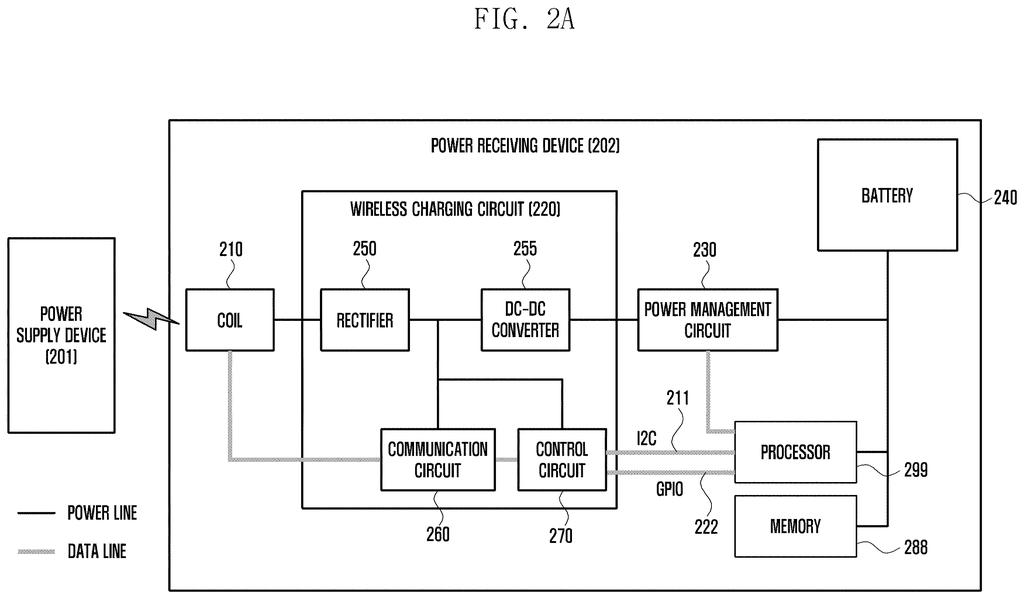
The phone has a coil that catches power from the pad, a charging circuit that converts it into the direct current a battery needs (called rectifying), and a processor. The processor tells the circuit which mode to use through one control pin (a GPIO pin, a general-purpose connection) set to a high or low voltage.
High means fast mode, which the Qi wireless charging standard calls the extended power profile (up to 15 watts). Low means slow mode, the baseline profile (5 watts or less). The pin starts high. Fast-mode setup has three steps:
- Configuration: agree on the power level.
- Negotiation: agree on a maximum, after checking how well the coils line up.
- Calibration: measure power loss, which helps spot stray metal.
The moment setup begins, the processor flips the pin low. If setup finishes, it flips back to high and fast charging starts. If the connection drops mid-setup, the pin is still low when the pad wakes the phone again, so slow-mode setup runs instead. About a second after charging ends, the pin returns to high.
The filing also describes switching to slow mode after the voltage dips twice, and logging setup progress in memory.
Why a crooked phone on a pad still gets charged
Wireless pads live on nightstands, desks, and car mounts, where phones get nudged out of place. A fallback that favors slow charging over no charging means the battery fills even when the placement is imperfect, and you do not have to check the screen to be sure. Fast charging still gets the first attempt every time.
The filing works within the existing Qi standard instead of inventing a new one. It relies on a signal from the processor and some logic in the charging chip, so it reads as a tweak to phone chip logic and software. It is a patent application, and nothing in it says when, or whether, it ships in a product.
Samsung's 290th filing in our cell phone patent coverage since May follows a wireless charger alignment alert and a triple-fold rubber edge guard in the applications we've tracked.
Most people never think about how a phone starts charging on a pad, and this patent keeps it that way. The benefit you would notice comes the morning after: a phone that charged overnight instead of one stuck in a loop of connecting and dropping.
The price is speed. Fast mode can deliver up to 15 watts and the fallback delivers 5 or less, so a crooked phone charges at roughly a third of top speed. For an overnight charge that trade is easy to accept, since a slow full battery beats a fast empty one.
The fix lives in how the phone and charger handshake, which makes it routine engineering with no new gadget to buy. It earns its keep on the bad days, when your phone sits slightly off-center on a pad, and those are the days you most want charging to work.
Get our take in your Top Stories
Liked this breakdown? Add Patentlyze as a preferred source on Google, and our plain-English take shows up more often in your Top Stories the next time Samsung patent news breaks.
There are more where this came from
We read every patent application Big Tech publishes and send you the ones worth knowing. Plain English, free, every week.
The drawings
12 drawing sheets from US 2026/0352028 A1 · click any drawing to enlarge


Show the other 4 sheets


Want this weekly breakdown for a company we don't cover? Patentlyze Pro →
Be the first to weigh in