Get the newsletter
Archer · Flight & Space · Filed Jul 22, 2026 · USPTO published Nov 19, 2026 · This week's release

Archer Files Patent for a Cockpit Display That Counts Down to Battery and Engine Limits

A new Archer patent application would give electric aircraft pilots a countdown clock for overheating engines and draining batteries. In the filing's examples, the clock reads 243 seconds at takeoff power and 27 seconds at emergency power.
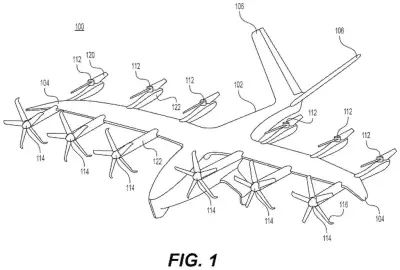
An electric air taxi that balances power across multiple engines and onboard batteries to fly safely if a power pack fails. Drawing from patent filing US 2026/0365316 A1.
An electric air taxi that balances power across multiple engines and onboard batteries to fly safely if a power pack fails.All 29 drawings ↓
Publication number
US 2026/0365316 A1(US20260365316A1)
Applicant
Archer Aviation Inc.
Filed · Published
Jul 22, 2026 · Nov 19, 2026
Inventors
Pedro Roberto Paterson CARLEIAL, Alan D. TEPE, Bharat TULSYAN, Geoffrey Christien BOWER, Nathan Thomas DEPENBUSCH, Nansi XUE
Status when we published
Waiting for an examiner
Document
30 claims
US classification
701/3
Examiner
MANCHO, RONNIE M (Art Unit 3657)
Parent application
Continuation of 19/424,055 (filed Dec 17, 2025)(19424055)

What Archer's overheating countdown actually shows

Ever watched your phone drop from 20% to dead much faster than the number promised? A percentage tells you where you are, but it doesn't tell you how long you have. Pilots of electric aircraft face a similar puzzle, with engines that can overheat and battery packs that drain at different rates.

Archer's patent application describes a cockpit display that turns those readings into a countdown. The aircraft keeps track of how much energy is left in its battery packs and how close the engines or batteries are to their temperature limits. It then shows the pilot how near a reading is to its limit, tied to the time remaining.

In the filing's examples, a gauge at takeoff power might show 243 seconds left, and one at emergency power just 27 seconds. Seconds are easier to act on than a raw temperature.

From the filing · CLAIM 1
… determining, using the at least one hardware processor, a time remaining based on at least one of the monitored available energy or a temperature limit, wherein the temperature limit is associated with at least one of the battery packs or an electric engine of the aircraft; …

Translation: The system calculates how much time is left before hitting battery and temperature limits.

How Archer turns engine heat into seconds left

The claims cover a pilot display. The system monitors the available energy in the aircraft's battery packs and works out a time remaining, based on that energy or on a temperature limit for a battery pack or an electric engine. It then displays how close an aircraft reading, such as engine torque (the twisting force the motor produces), is to its limit, tied to that time.

The description explains how engine time is figured. An engine time estimator (software that reads the engine's temperature sensors) checks parts like the stator winding, oil, rotor magnet and control board. Each part heats at its own speed and has its own limit, so the estimator converts everything into one yardstick, time, and reports the part with the least time left.

The example gauge includes:

  • A torque arc showing available torque and an indicator for torque in use
  • Markers for the continuous, takeoff and emergency limits
  • A boost bar showing time left at maximum torque

Continuous means unlimited time, takeoff means under 300 seconds, and emergency means under 30 seconds. The filing also describes an energy function that shifts power away from weaker battery packs so they run down together. In one failure example, range reaches about 11/12 of the trip instead of about three quarters.

From the filing · THE ABSTRACT
… engine information includes at least one time-based metric for temperature associated with the at least one EPU, generates control commands based on the received engine information, and controls effectors according to the generated control commands to meet the desired commands of the aircraft.

Translation: It tracks motor heat limits over time to automatically manage the aircraft controls.

Why a countdown helps pilots of electric aircraft

For a pilot, the practical gain is a clearer answer to how long can I keep doing this? A temperature number alone forces a guess about how fast it is climbing. A countdown tied to the part closest to its limit lets a pilot decide when to ease off, before the aircraft has to cut power on its own.

The filing describes a tilt-rotor aircraft built for frequent short flights carrying four to six passengers, with twelve electric engines and six battery packs in the main example. With that many parts to watch, one simple readout matters more. You would likely never see this gauge as a passenger, but you would feel what it prevents: a surprise power reduction or a battery pack running dry early.

Source: US 2026/0365316 A1 at the USPTO (PDF). Full patent text and figures are in the official publication.

Get our take in your Top Stories

Liked this breakdown? Add Patentlyze as a preferred source on Google, and our plain-English take shows up more often in your Top Stories the next time Archer patent news breaks.

There are more where this came from

We read the new patents from Big Tech, carmakers and more and send you the ones worth knowing. Plain English, free, every week.

The drawings · 29 sheets

29 drawing sheets from US 2026/0365316 A1 · click any drawing to enlarge

The electric aircraft tilted forward into cruise flight, drawing sheet 1 from US 2026/0365316 A1
Sheet 1 The electric aircraft tilted forward into cruise flight
Front propellers rotated upward for vertical takeoff and hovering, drawing sheet 2 from US 2026/0365316 A1
Sheet 2 Front propellers rotated upward for vertical takeoff and hovering
Top view showing six front and six rear propellers, drawing sheet 3 from US 2026/0365316 A1
Sheet 3 Top view showing six front and six rear propellers
Alternating propeller spin directions to balance flight forces, drawing sheet 4 from US 2026/0365316 A1
Sheet 4 Alternating propeller spin directions to balance flight forces
Six battery packs wired to twelve electric propulsion motors, drawing sheet 5 from US 2026/0365316 A1
Sheet 5 Six battery packs wired to twelve electric propulsion motors
Electric motor and propeller connections to power and flight controls, drawing sheet 6 from US 2026/0365316 A1
Sheet 6 Electric motor and propeller connections to power and flight controls
Movable wing flaps and tail surfaces that steer the craft, drawing sheet 7 from US 2026/0365316 A1
Sheet 7 Movable wing flaps and tail surfaces that steer the craft
Control wiring linking pilot inputs to motors and steering surfaces, drawing sheet 8 from US 2026/0365316 A1
Sheet 8 Control wiring linking pilot inputs to motors and steering surfaces
Show the other 21 sheets
Alternative wing and propeller layouts for the air taxi, drawing sheet 9 from US 2026/0365316 A1
Sheet 9 Alternative wing and propeller layouts for the air taxi
How pilot inputs become commands for the motors, drawing sheet 10 from US 2026/0365316 A1
Sheet 10 How pilot inputs become commands for the motors
Adjusting motor output to balance battery drain, drawing sheet 11 from US 2026/0365316 A1
Sheet 11 Adjusting motor output to balance battery drain
Steps for tailoring motor thrust to available battery power, drawing sheet 12 from US 2026/0365316 A1
Sheet 12 Steps for tailoring motor thrust to available battery power
An unadjusted battery failure draining one power line early, drawing sheet 13 from US 2026/0365316 A1
Sheet 13 An unadjusted battery failure draining one power line early
Rebalancing power draw across lines after a battery fails, drawing sheet 14 from US 2026/0365316 A1
Sheet 14 Rebalancing power draw across lines after a battery fails
Excess starting power wasted without active battery rebalancing, drawing sheet 15 from US 2026/0365316 A1
Sheet 15 Excess starting power wasted without active battery rebalancing
Rebalancing allows a safe landing with minimal reserve power, drawing sheet 16 from US 2026/0365316 A1
Sheet 16 Rebalancing allows a safe landing with minimal reserve power
Engines draw power evenly when all batteries are full, drawing sheet 17 from US 2026/0365316 A1
Sheet 17 Engines draw power evenly when all batteries are full
Cutting power to select engines after one battery pack fails, drawing sheet 18 from US 2026/0365316 A1
Sheet 18 Cutting power to select engines after one battery pack fails
Rerouting power to nearby engines when one engine shuts down, drawing sheet 19 from US 2026/0365316 A1
Sheet 19 Rerouting power to nearby engines when one engine shuts down
Holding steady commands when an electrical line fails, drawing sheet 20 from US 2026/0365316 A1
Sheet 20 Holding steady commands when an electrical line fails
Throttling back two engines to spare a weakened battery, drawing sheet 21 from US 2026/0365316 A1
Sheet 21 Throttling back two engines to spare a weakened battery
Tracking engine heat spikes across each phase of flight, drawing sheet 22 from US 2026/0365316 A1
Sheet 22 Tracking engine heat spikes across each phase of flight
Cockpit dials counting down seconds of safe boost remaining, drawing sheet 23 from US 2026/0365316 A1
Sheet 23 Cockpit dials counting down seconds of safe boost remaining
Safety cutoffs that reduce power before an engine overheats, drawing sheet 24 from US 2026/0365316 A1
Sheet 24 Safety cutoffs that reduce power before an engine overheats
Calculating safe motor torque to keep engines from overheating, drawing sheet 25 from US 2026/0365316 A1
Sheet 25 Calculating safe motor torque to keep engines from overheating
How flight computers balance motor power using engine readings, drawing sheet 26 from US 2026/0365316 A1
Sheet 26 How flight computers balance motor power using engine readings
Combining heat limits and battery reserves into new steering commands, drawing sheet 27 from US 2026/0365316 A1
Sheet 27 Combining heat limits and battery reserves into new steering commands
Motor temperatures and battery levels before adjustments kick in, drawing sheet 28 from US 2026/0365316 A1
Sheet 28 Motor temperatures and battery levels before adjustments kick in
Throttling a hot motor while drawing power from fuller batteries, drawing sheet 29 from US 2026/0365316 A1
Sheet 29 Throttling a hot motor while drawing power from fuller batteries
Patent filing page

More in Flight & Space

All 10 Flight & Space patents →
Reader comments

No comments yet

Start the discussion

Real name or a handle, either is fine. Comments are read by a person before they appear, so allow a little time. Keep it about the filing.