
Airbus
SpaceX · Flight & Space · Filed May 8, 2026 · USPTO published Nov 19, 2026 · This week's release
SpaceX Files Patent for Internet Dishes That Hop Satellites Before a Tree Blocks Them
Your satellite dish could pick a new satellite on its own, either after a connection goes bad or just before a tree gets in the way. SpaceX's patent application covers both moves.
- Publication number
- US 2026/0371196 A1(US20260371196A1)
- Applicant
- Space Exploration Technologies Corp.
- Filed · Published
- May 8, 2026 · Nov 19, 2026
- Inventors
- Andrew D. Bohn, Michael Nicolls, Yashodhan Dandekar
- Status when we published
- Waiting for an examiner
- Document
- 26 claims
- US classification
- 370/331
- Parent application
- Continuation of 18/392,815 (filed Dec 21, 2023)(18392815)
What SpaceX's self-switching satellite dish does
A satellite dish on a roof follows one satellite across the sky. Halfway through, the satellite slides behind a tree, and your video call freezes. This SpaceX patent application is about making that freeze much shorter, or skipping it entirely.
The satellites in this system circle low and fast, so each one is overhead for only a short time. Your dish gets a schedule minutes ahead that names at least two satellites it can use at any moment, each linked to a different ground station. If the connection gets shaky, the dish switches to the backup on its own, without waiting for orders from a control center.
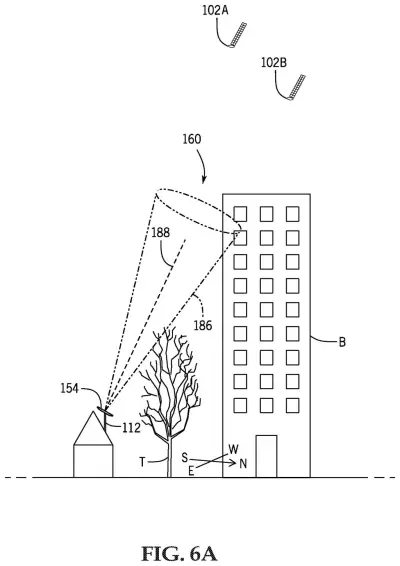
The dish can also keep a map of the trees and buildings blocking its view. If it can tell a satellite is about to slip behind one, it moves over before the signal drops.
… detecting a deviation from a communication quality threshold on a communication path between the phased array antenna and the ground network PoP; and during the first time slot and in response to detecting the deviation, commanding the phased array antenna to transmit a second one or more data requests to another of the candidate satellites …
Translation: Spotting a sudden drop in signal and instantly switching to a different satellite to keep the internet connection steady.
How the dish spots trouble and picks a backup
The filing covers three related ideas, all running inside the user terminal (the dish plus its built-in computer). The network divides time into short slots, 10 to 20 seconds each, with 15 seconds given as an example. Roughly five to ten minutes ahead, the dish receives topology schedule data (a plan listing which satellites it may use). Each slot lists at least two candidates, and each is tied to a different gateway (a ground station that connects to the internet), so the two routes share no satellite or gateway.
In the reactive</em version, the dish sends its requests through one satellite and watches for the link getting worse. It can do that several ways:
- Pinging its home point-of-presence (the entry point to the wider internet) and checking for slow replies
- Counting data chunks it failed to decode, for example 25 percent over 200 milliseconds
- Counting data that arrives out of order
- Counting lost packets
Pinging ten times a second would burden the network as users multiply, so the filing treats a slow ping, about once a second, as a backstop. The filing says switching within about 500 milliseconds, ideally 300, gives a smooth experience. If the backup satellite never grants permission to send, the dish jumps to a third.
In the proactive version, the dish compares each satellite's flight path to a stored obstruction map and switches at the moment one would be blocked. The network may briefly send duplicate packets down both routes so nothing is missed during the handoff.
… determine during the first time slot, based on information in a memory of the user terminal and a path of the first satellite, that a reduced communication capacity with the first satellite is imminent, and, in response to the determining, command the phased array antenna to switch to communicate with a second of the candidate satellites …
Translation: Predicting ahead of time that a satellite's path will be blocked and jumping to a new one before the signal drops.
Why a dish that decides alone matters for you
If you use satellite internet, freezes usually come from something small: a branch, a crowded satellite, a problem at a ground station. This patent application aims to let your dish react in well under a second, and the filing says that speed is the target for a smooth experience. Because the dish makes the call itself, nothing has to travel to a central control center and back first.
The filing says the dish could sit on a house, a business, a car, a boat, or an airplane, and it names online multiplayer gaming as a use that suffers most from delays. The network is built so the backup route shares no satellite or ground station with the main one, which means the dish does not need to know what went wrong. It only needs to know that something did.
Source: US 2026/0371196 A1 at the USPTO (PDF). Full patent text and figures are in the official publication.
Get our take in your Top Stories
Liked this breakdown? Add Patentlyze as a preferred source on Google, and our plain-English take shows up more often in your Top Stories the next time SpaceX patent news breaks.
Add Patentlyze on Google
One click.
There are more where this came from
We read the new patents from Big Tech, carmakers and more and send you the ones worth knowing. Plain English, free, every week.
The drawings · 12 sheets
12 drawing sheets from US 2026/0371196 A1 · click any drawing to enlarge


Show the other 4 sheets


No comments yet