
Airbus
Airbus · Flight & Space · Filed May 15, 2026 · USPTO published Nov 19, 2026 · This week's release
Airbus Patents a Timetable That Tells Each Plane Where to Taxi and When
Airlines already reserve airport gates months ahead. Airbus now describes reserving the taxiways too, giving every plane its own stretch of pavement at an exact time.
- Publication number
- US 2026/0369172 A1(US20260369172A1)
- Applicant
- Airbus Operations SAS
- Filed · Published
- May 15, 2026 · Nov 19, 2026
- Inventors
- Benjamin THUBERT
- Status when we published
- Waiting for an examiner
- Document
- 10 claims
- US classification
- 701/120
What Airbus's taxiway time-slot plan actually does
A passenger jet sits on a taxiway with its engines running, waiting for a controller in the tower to say it can move forward. Today that clearance comes one step at a time, and every pause burns fuel. If you've ever sat on the tarmac after landing, you know the feeling.
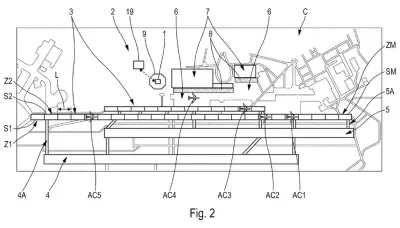
Airbus has filed a patent application for a different approach. Instead of deciding as it goes, a computer builds a schedule in advance. The taxiways are chopped into short sections, and each plane gets a list of sections along with exact times for when it can be in each one. No two planes are ever booked into the same section at the same time.
As planes roll, the system tracks them and sends each one a go-ahead for the next section, but only if that section is clear. If a plane drifts off plan, or something blocks a taxiway, the schedule gets rebuilt on the fly.
… a planning step, performed by a computer, to generate from the input data a schedule that deterministically assigns a route for each of the one or more aircraft, the route of each aircraft defining a succession of predetermined transit zones on taxiways at the airport from an initial position of said aircraft to a final position of said aircraft …
Translation: A computer builds a schedule mapping out exact paths and stopping zones for every plane.
How the system hands out one zone at a time
The filing describes four steps that run nonstop and automatically. The system first collects data: airport maps, gate reservations that airlines book months ahead, aircraft type and size, weather forecasts and incident alerts. A computer then builds a schedule that is deterministic, meaning each section of taxiway is reserved for exactly one plane in a specific time window, rather than being a probability or a best guess.
The taxiways are divided into sections described as 70 to 90 meters long, with 80 meters preferred, about the length of the biggest planes at the airport. One variation leaves an empty section between two planes in a line as a safety buffer.
A traffic management device then does the following:
- Tracks the current position of each taxiing plane.
- Issues a go-ahead for the next section only if it is free, meaning no plane is in it and no incident is affecting it.
- Sends that go-ahead to the aircraft.
- Flags any plane that wanders from its assigned section, so the computer can rebuild the schedule.
The preferred version uses artificial intelligence (software trained on examples of events and the schedule changes that followed) to rewrite the plan. Routes are chosen to cut taxi time, distance or fuel. Ground vehicles such as fuel trucks and baggage carts can be scheduled the same way.
The steps are carried out continuously and automatically, which allows an economic gain, in particular by reducing the fuel consumption of the aircraft.
Translation: Running the system constantly saves money by cutting down on burned airplane fuel.
What this could mean for airport fuel bills
If this idea were put into practice, the change you'd notice most is less sitting still on the ground. The filing says cutting the wait for permission to move saves fuel, which lowers airline costs, and lets an airport handle more flights. It also points to safety: every plane would have a defined spot at all times, and the system would refuse to send traffic toward a blocked area.
It's a patent application, and nothing in it says any airport is using the system. Today, the filing explains, the tower clears planes step by step. This would swap that for a plan made ahead and updated continuously. Whether airports, airlines and pilots would accept software handing out taxi clearances is a question the filing doesn't address.
Source: US 2026/0369172 A1 at the USPTO (PDF). Full patent text and figures are in the official publication.
Get our take in your Top Stories
Liked this breakdown? Add Patentlyze as a preferred source on Google, and our plain-English take shows up more often in your Top Stories the next time Airbus patent news breaks.
Add Patentlyze on Google
One click.
There are more where this came from
We read the new patents from Big Tech, carmakers and more and send you the ones worth knowing. Plain English, free, every week.
The drawings · 3 sheets
3 drawing sheets from US 2026/0369172 A1 · click any drawing to enlarge


More from Airbus
All 5 Airbus patents →
More in Flight & Space
All 10 Flight & Space patents →
SpaceX
SpaceX Files Patent for Internet Dishes That Hop Satellites Before a Tree Blocks Them
Boeing
Boeing Files Patent for a Fold-Down Cabin Shelf That Also Parks the Trash Cart
Boeing
Boeing Patents a Silicone Seal to Keep Bathroom Water Out of Airplane Floors
Boeing
No comments yet