
IBM Patents a Two-Step Error-Correction Method for Quantum Computers
Quantum computers make mistakes constantly — and fixing those mistakes fast enough is one of the biggest unsolved problems in the field. IBM's new patent describes a structured way to catch and correct those errors before they snowball.
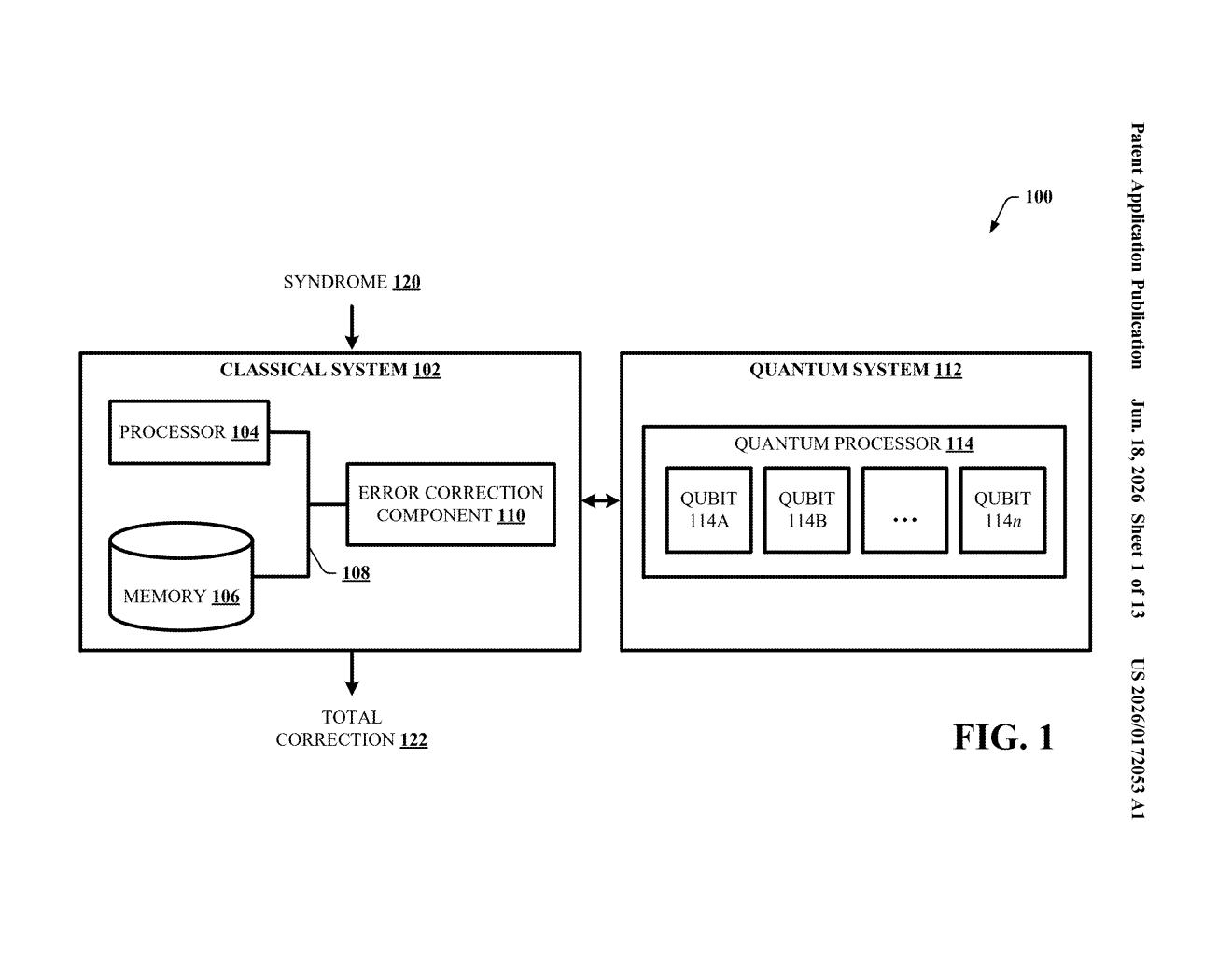
What IBM's quantum error decoder actually does
Imagine you're trying to have a conversation in a very noisy room. Every few seconds, random words get garbled, and you have to figure out what was actually said before you can respond. That's roughly what a quantum computer deals with every time it tries to run a calculation — its basic units of information, called qubits, are extremely fragile and constantly pick up errors from their environment.
To keep those errors from ruining a computation, engineers wrap qubits in layers of error-correction code. But decoding those errors — figuring out what went wrong and where — has to happen quickly, or the computer falls further behind. IBM's patent describes a decoder that attacks this in two stages: first, it groups related errors together by spotting patterns called "defects," and then it fixes each group locally rather than trying to solve the whole mess at once.
Think of it like a spell-checker that first circles suspicious words, then fixes each one in context, rather than trying to rewrite the whole page in one pass. IBM's approach is designed specifically for a type of error-correction scheme called quantum low-density parity check (qLDPC) codes, which many researchers consider a leading candidate for practical quantum computing.
How the matching-and-local-correction loop runs
The patent describes a software system — a decoder — that processes error information coming off a quantum processor running qLDPC code.
qLDPC codes (quantum low-density parity check codes) are a family of error-correcting schemes that can protect more qubits using fewer physical overhead qubits than older approaches like surface codes. The tradeoff is that decoding them is algorithmically harder. IBM's decoder tackles this with two main steps:
- Defect matching on symmetries: The decoder looks at "syndromes" — the readout signals that reveal where errors have occurred — and identifies "defects" (anomalies in the pattern). It then uses the geometric symmetries of the code to group defects into local defect networks, small clusters of related errors. The key property exploited here is that any single qubit error always creates an even number of defects, which makes the pairing mathematically tractable — similar to how a matching algorithm pairs up socks in a laundry pile.
- Local correction: Once defect networks are identified, the decoder corrects each one independently rather than solving one giant global optimization problem. This divide-and-conquer approach is faster and scales better.
The result is a decoder that can handle the complexity of qLDPC codes without requiring the kind of computational power that would slow down a real quantum system.
What this means for building reliable quantum hardware
Error correction is the bottleneck standing between today's noisy quantum hardware and the large-scale, fault-tolerant quantum computers that would actually be useful for drug discovery, cryptography, or materials science. A decoder that is both accurate and fast is not a nice-to-have — it's a prerequisite for the whole enterprise.
qLDPC codes have generated a lot of excitement in the research community because they promise to dramatically reduce the number of physical qubits needed to encode one reliable logical qubit. If IBM's decoding approach holds up at scale, it could bring that theoretical advantage into practice. This is foundational infrastructure work — not a consumer product, but the kind of patent that matters if IBM's quantum roadmap is going to move past demonstrations and into real computation.
This is deep infrastructure — the kind of patent that will never make a product announcement but could quietly determine whether qLDPC codes become the dominant error-correction architecture of the next decade. IBM has been one of the most active filers in quantum error correction, and this one fits a clear strategic pattern: reduce overhead, speed up decoding, make fault-tolerant quantum computing economically viable. It's worth paying attention to even if it won't ship as a feature any time soon.
There are more where this came from
We read every patent application Big Tech publishes and send you the ones worth knowing. Plain English, free, every week.
Want this weekly breakdown for a company we don't cover? Patentlyze Pro →