
Nvidia
Nvidia · AI / ML · Filed Nov 15, 2024 · USPTO published May 21, 2026 · May 21 release
Nvidia Patents a Neural Network That Designs Data Center Cooling Systems
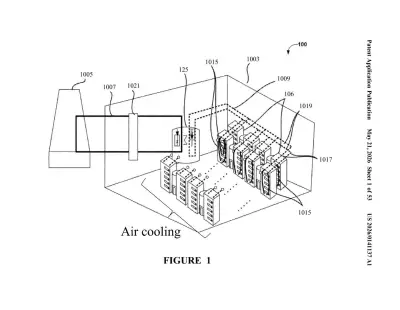
Nvidia is patenting a system where you describe what you need in a data center — in plain text — and a neural network spits out a full cooling system design. Think of it as a ChatGPT moment for data center architecture.
- Publication number
- US 2026/0141137 A1(US20260141137A1)
- Applicant
- NVIDIA Corporation
- Filed · Published
- Nov 15, 2024 · May 21, 2026
- Inventors
- Ali Heydari, Reza Yousofvand, Sushrut Kumar, Mehdi Heydari, Kourosh Nemati, Bahareh Eslami, Mohammad Tradat
- Status when we published
- Waiting for an examiner
- Document
- 20 claims
- US classification
- 703/4
What Nvidia's AI-generated data center designs actually do
Imagine you're an engineer who needs to cool a massive server room. Normally, you'd spend weeks working with specialists, running simulations, and iterating on floor plans. Nvidia's patent describes a way to shortcut that: you type in a description of your data center's characteristics, and an AI generates design options for you.
The system takes your plain-text input — things like server density, room dimensions, or heat load requirements — and produces output tokens representing one or more complete data center designs. It's the same token-generation mechanic you'd recognize from large language models like GPT, but pointed at a very specific engineering problem.
In short, Nvidia wants to let AI handle the first (and often most tedious) pass at cooling system design, so human engineers can focus on refining and validating rather than starting from scratch every time.
How the neural network turns text prompts into cooling layouts
At its core, this patent describes a processor with neural network circuits that takes natural-language descriptions of a data center and generates structured design outputs — what the patent calls "output tokens representing one or more data center designs."
The token-generation framing is significant. It means Nvidia is applying a generative AI architecture (similar to transformer-based language models) to a domain-specific engineering task. Rather than training a model to answer general questions, the model here is specialized for translating data center characteristics — think thermal requirements, rack configurations, airflow constraints — into actionable design blueprints.
Key aspects of the claimed system include:
- One or more neural networks operating on a dedicated processor
- Input: natural-language text describing data center characteristics
- Output: tokens encoding one or more cooling system design proposals
- Support for generating multiple design variants from a single prompt
The patent is broad at the claim level — it doesn't lock down a specific model architecture — but the framing strongly suggests a large language model or sequence-to-sequence model (a type of neural network that maps one ordered sequence, like a text prompt, to another, like a design specification). The practical implication is a system that can rapidly prototype data center layouts without manual CAD work.
What this means for AI-driven infrastructure planning
Data centers are Nvidia's most important customer segment right now. As AI compute demand explodes, designing and deploying data centers fast has become a genuine bottleneck — and cooling is one of the hardest parts to get right. A tool that auto-generates cooling layouts from text descriptions could meaningfully compress the design cycle for hyperscalers and colocation providers who are Nvidia's core GPU customers.
For Nvidia specifically, this also hints at a broader ambition: not just selling GPUs into data centers, but offering AI-assisted tools that help customers build those data centers. That's a services and software layer on top of hardware — a strategic expansion that would deepen Nvidia's lock-in with enterprise and cloud customers.
Source: US 2026/0141137 A1 at the USPTO (PDF). Full patent text and figures are in the official publication.
Get our take in your Top Stories
Liked this breakdown? Add Patentlyze as a preferred source on Google, and our plain-English take shows up more often in your Top Stories the next time Nvidia patent news breaks.
Add Patentlyze on Google
One click.
There are more where this came from
We read the new patents from Big Tech, carmakers and more and send you the ones worth knowing. Plain English, free, every week.
More from Nvidia
All 665 Nvidia patents →
More in AI / ML
All 2,745 AI / ML patents →
Samsung
Samsung's New Patent Finds Products That Match Where Every Detail Actually Sits
Qualcomm
Qualcomm Patents a Way to Split AI Video Analysis Between Two Devices
Microsoft
Microsoft Files Patent for Search Toggling Between AI Chat and Web Results
Microsoft