
Sony's New Patent Pairs Two Cameras to Track Fast-Moving Objects Without the Usual Delay
Most cameras have to choose between image detail and speed. Sony's new patent describes a tracking system that uses both at once, pairing a slower, richer image stream with a faster, lightweight one to keep a moving object in its sights without the usual delay.
What Sony's two-speed tracking system actually does
Imagine trying to follow a tennis ball with your eyes while also reading the score on the scoreboard. Your brain switches between quick glances at the ball and slower, focused looks at the sign. Sony's patent works the same way.
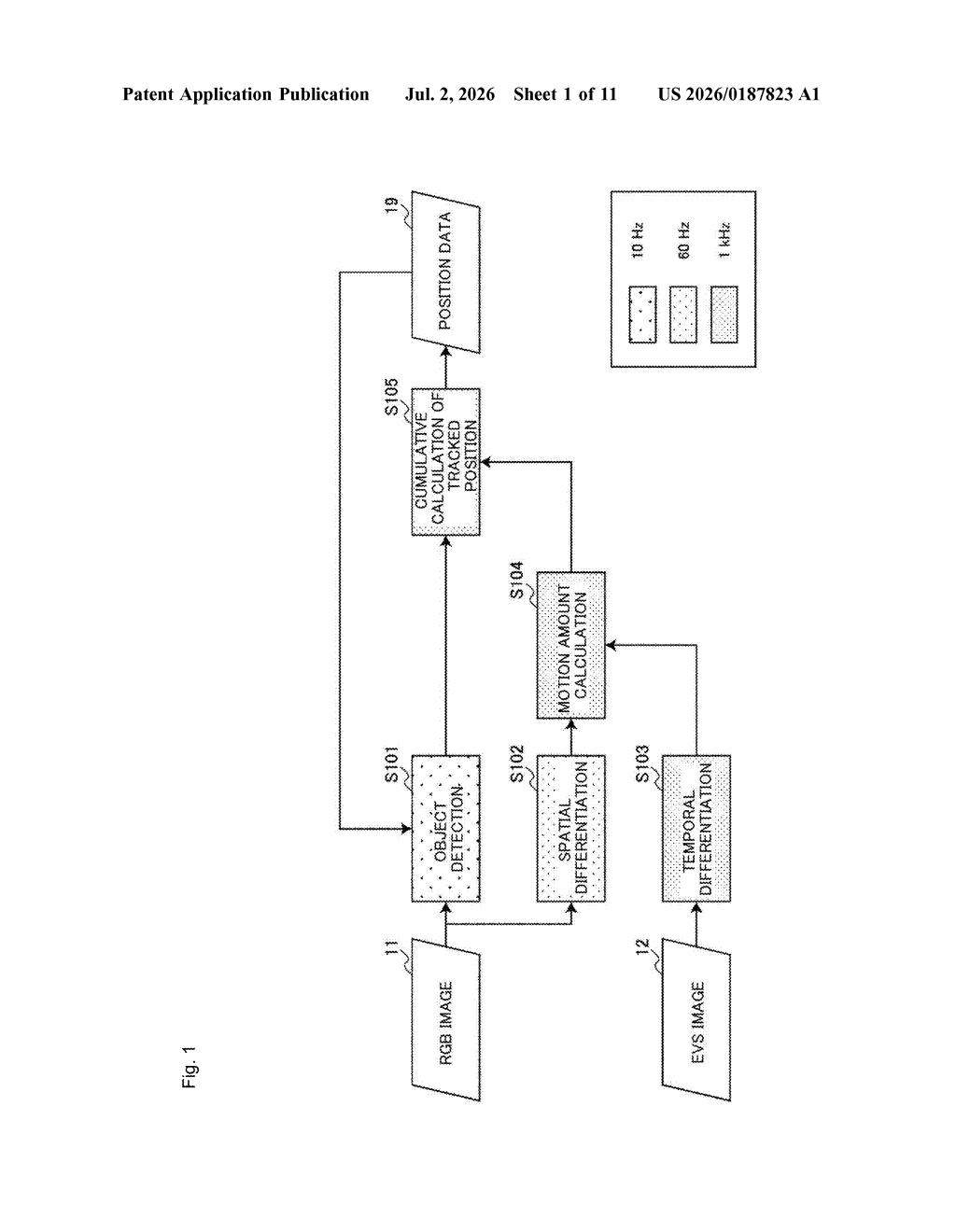
The system uses two image streams captured one after another. The first, slower stream is used to identify whatever object you want to track, like a person's face or a moving car. The second stream runs at a much higher frame rate, meaning it captures many more pictures per second, and those rapid-fire frames are used to calculate exactly how fast and in which direction the object is moving.
By splitting the job this way, the camera doesn't have to process every single high-speed frame from scratch. It uses the slow, detailed image to find the target once, then uses the fast frames just to follow the motion. The result is tracking that's both quick and accurate, without needing a more powerful processor.
How Sony blends slow and fast frames to follow a target
The patent describes an information processing device with a dedicated tracking unit that handles two separate image streams simultaneously.
- First image (low frame rate): A standard or slower video feed used purely for object detection. The system analyzes this image to identify and locate the target object, which is the computationally expensive step.
- Second image (high frame rate): A faster-updating feed captured after the first. The system does not re-run full object detection on this stream. Instead, it calculates a spatial gradient (the difference in pixel brightness across the image at one moment) from the first image and a temporal gradient (the difference in pixel brightness across time, frame to frame) from the second image.
- Optical flow estimation: Combining those two gradients is a classic computer-vision technique called optical flow, which estimates how much and in which direction each part of the scene is moving. The system uses this to update where the tracked object is without re-detecting it from zero.
The core insight is that detection is slow and expensive, while motion estimation is fast and cheap. By doing detection only on the slow stream and motion estimation on the fast stream, Sony's design keeps tracking responsive even on hardware with limited processing power.
What this means for cameras, drones, and AR tracking
Low-latency object tracking is one of the harder problems in computer vision, and it shows up everywhere: sports cameras that lock onto a player, drones that follow a subject, augmented reality headsets that need to pin virtual objects to real ones, and security systems that follow moving targets. Today's systems often have to pick between accuracy (re-detecting the object often) and speed (tracking at a high frame rate). This patent's two-stream approach is designed to avoid that tradeoff.
For Sony specifically, the applications span its camera and imaging business, its PlayStation platform (which uses camera-based tracking for controllers and VR), and its professional broadcast equipment. If this technique can be packed into a sensor or image-processing chip, it could make real-time subject tracking noticeably more responsive in Sony's consumer cameras without requiring a bigger battery or a faster chip.
This is a solid, well-focused engineering patent rather than a flashy concept. Optical flow estimation is a proven technique, but the specific architecture of running detection and motion estimation on separate frame-rate streams is a practical optimization worth attention. Sony's camera and sensor business gives it a clear path to actually shipping something like this.
Get our take in your Top Stories
Liked this breakdown? Add Patentlyze as a preferred source on Google, and our plain-English take shows up more often in your Top Stories the next time Sony patent news breaks.
There are more where this came from
We read every patent application Big Tech publishes and send you the ones worth knowing. Plain English, free, every week.
Want this weekly breakdown for a company we don't cover? Patentlyze Pro →