
Samsung Patents an Image Sensor That Splits Charge Storage Across Two Regions
Samsung is rethinking how image sensors store the electrical charge that light creates, filing a patent for a design that uses two separate storage regions and a dedicated switching transistor between them. The twist is that the two ends of that transistor are deliberately different sizes.
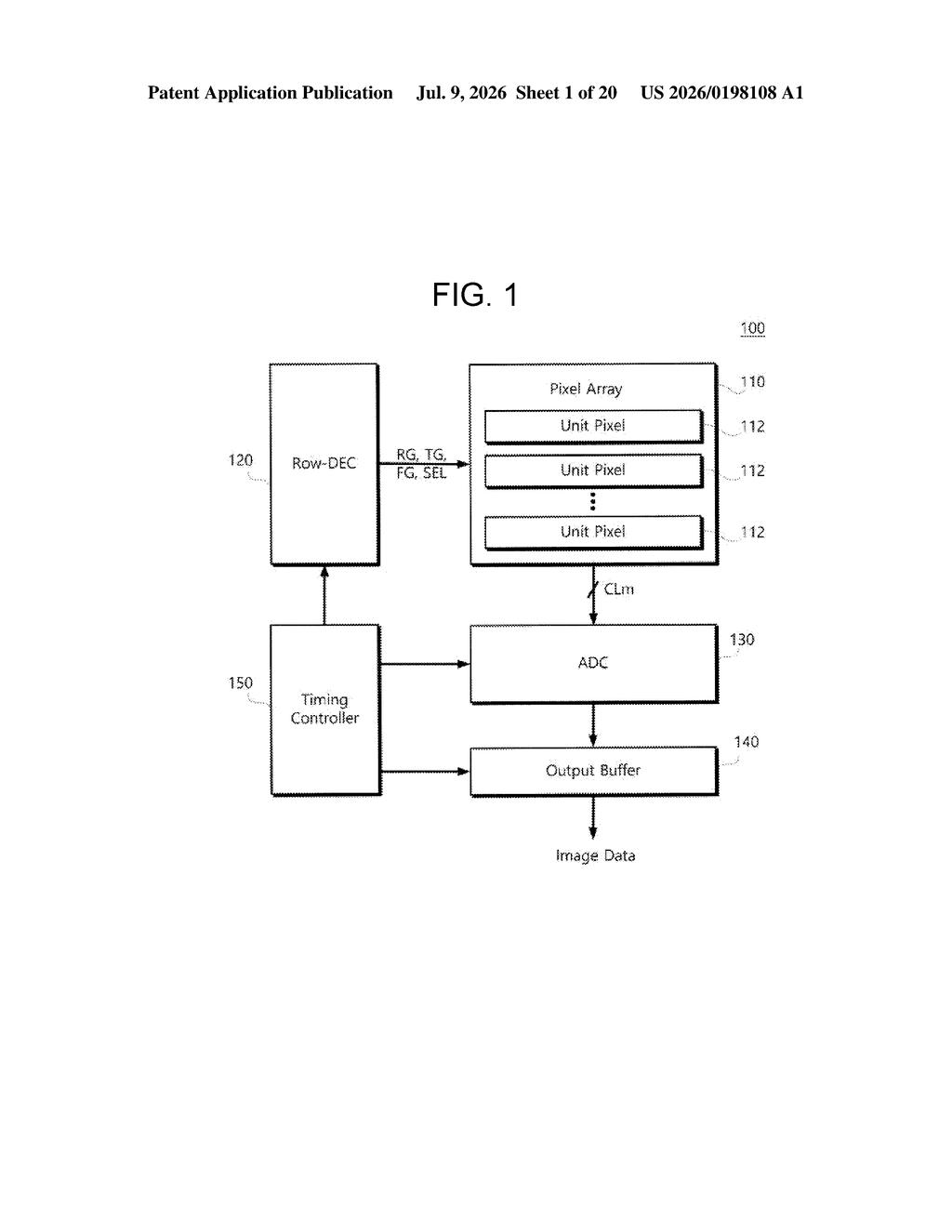
What Samsung's two-region image sensor actually does
When your phone's camera captures a photo, light hits a tiny detector called a photodiode, which converts photons into an electrical charge. That charge then gets shuffled into a storage area before the sensor reads it out. The bigger and more flexible that storage area is, the better the sensor can handle tricky lighting conditions like bright skies and dark shadows at the same time.
Samsung's patent describes a sensor with two separate storage areas connected by a small switching transistor. The first area collects charge directly from the photodiode. The second area sits further away and feeds into the transistor that actually drives the readout circuit. A control signal can open or close the connection between them, giving the sensor flexibility over how much charge capacity it uses at any given moment.
The key detail is that the transistor bridging these two regions has a smaller contact area on the first-region side and a larger contact area on the second-region side. That asymmetry is intentional, and it affects how efficiently charge moves and how much electrical noise creeps into the final image.
How the floating diffusion transistor routes stored charge
The patent describes a pixel architecture built around two floating diffusion regions (the temporary charge-holding nodes inside an image sensor pixel) separated by a transistor the inventors call a floating diffusion region transistor.
- First floating diffusion (FD1): directly receives charge transferred from the photodiode via a standard transfer transistor. A boosting capacitor is also attached here to increase charge-handling capacity.
- Second floating diffusion (FD2): sits apart from FD1 and connects to the gate of the drive transistor, which is the component that converts stored charge into a readable voltage signal.
- FD transistor: bridges FD1 and FD2, opening or closing on command via a floating control signal.
The critical structural claim is that the source region of the FD transistor (the side touching FD1) has a smaller planar footprint than the drain region (the side touching FD2). In plain terms, the transistor is physically lopsided. This asymmetry is a deliberate engineering choice: it affects the transistor's threshold voltage and leakage behavior, which in turn influences read noise, a key measure of how faithfully a sensor captures dim light.
What this means for low-light and high-dynamic-range cameras
Modern smartphone cameras already push image sensor design close to its physical limits, so improvements tend to come from clever architectural choices rather than raw size increases. A dual-storage design like this lets a sensor operate in a low-capacity, low-noise mode for dim scenes and switch to a higher-capacity mode for bright scenes, all within the same pixel. That kind of dynamic range flexibility is exactly what makes night mode and HDR photography work better.
For you as a camera user, the practical payoff would be photos that hold more detail in both the brightest and darkest parts of a frame simultaneously. Samsung makes image sensors not just for its own Galaxy phones but for a wide range of manufacturers, so a new pixel architecture from the company has the potential to show up in many devices.
This is a fairly deep-in-the-weeds semiconductor architecture patent, and its real significance depends on whether the asymmetric transistor geometry delivers measurable noise improvements in production. Samsung's sensor division is one of the most aggressive in the industry, and dual-FD pixel designs are a known direction for next-generation sensors, so this is a real research thread, not a defensive placeholder.
Get our take in your Top Stories
Liked this breakdown? Add Patentlyze as a preferred source on Google, and our plain-English take shows up more often in your Top Stories the next time Samsung patent news breaks.
There are more where this came from
We read every patent application Big Tech publishes and send you the ones worth knowing. Plain English, free, every week.
Want this weekly breakdown for a company we don't cover? Patentlyze Pro →